What you need to know about reach and ROI
Advertisers are expected to create strategies nimble enough to keep up with the times, reach audiences that are progressively more insular and niche, navigate a cookieless world, and, ultimately, figure out what ROI everything’s driving.
There are tools, like ROI measurement, that help you realize impact. But what if you could get an earlier indicator of success, too?
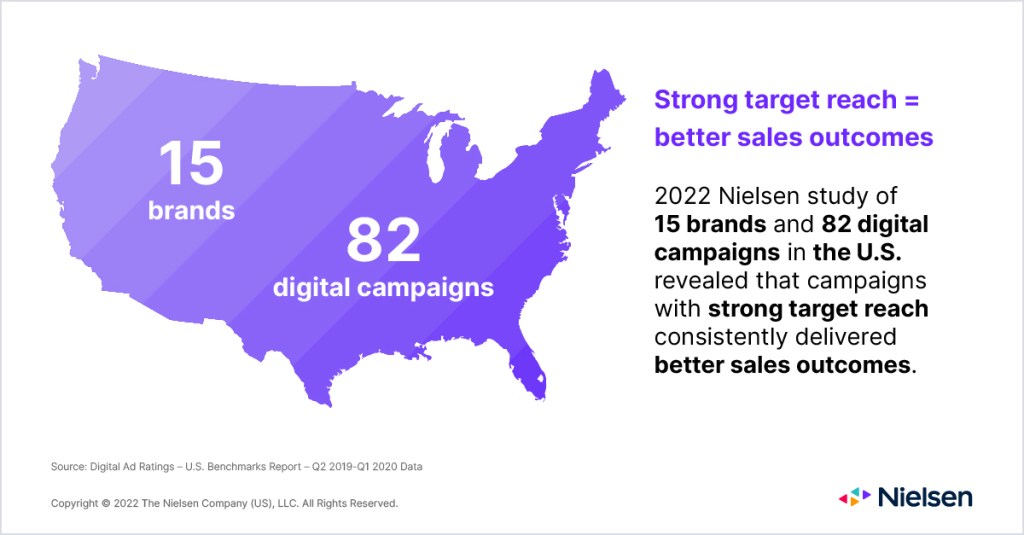
Unique reach is the unsung ROI hero, letting you effectively identify brand-new potential customers quickly. In fact, a 2022 Nielsen study of 15 brands and 82 digital campaigns in the U.S. revealed that there is a very strong relationship between target reach and campaign ROI.
We break down answers to common questions advertisers have about capturing online behavior and how to use metrics to grow sales and justify media buys.
1. How can I prove my media spend’s ROI?
Keep it simple. Especially when you’re talking to non-marketing folks, you need to explain how complicated metrics and micro-targeting contribute to larger company goals.
What’s your company’s primary goal? We’ll take a wild guess: increase revenue. However, unless consumers are finding you on their own and throwing money your way, you’ve got to develop a pipeline to convert them from passive audience to active buyer—that means reach.
If your marketing isn’t reaching fresh eyeballs, you’re repeating the same message to the same people. For this reason, unique reach is a powerful proxy for new customer acquisition, which is at the top of any successful business pipeline.
Unique reach lets you:
- Select the right media partner
- Establish audience guarantees
- Quickly and continuously optimize ad placements
Combined, these allow you to communicate with new customers and grow your brand efficiently—and what’s the end result of that process? Positive ROI.
At the very least, you need to track everywhere you’re spending. With the labyrinth of premium publishers to walled gardens, that means using analytics, like Nielsen’s Digital Ad Ratings (DAR), that can follow nearly 90% of your total digital spend and 100% of your television spend.
Just because you know your money is well spent doesn’t mean that’s an easy story to tell succinctly, especially to the many stakeholders at your company. Being able to see in nearly real-time what’s working—and what isn’t—across platforms, publishers and devices is a story that anyone in your company can easily digest.
2. How do I know I’m reaching the right audience?
Nearly everyone is diversifying their digital footprint across computers, smartphones, tablets and connected TV (CTV). Advertisers need deduplicated impression data through direct publisher integrations in order to target current audiences—and new ones, too.
Cookies, mobile advertising IDs (MAIDs) and other digital identifiers that the advertising industry has relied on for years are on their way out. In their absence, modern digital strategies should prioritize first-party data and additional premium data assets, which can be authenticated or unauthenticated.
- For authenticated digital traffic: Triangulate hashed email addresses, Unified ID 2.0 and verified self-reported demographic labels.
- For anonymous traffic: You need a machine learning model that can ingest multiple metrics—like time, browser, content, device and platform information—to build a profile of your audience. Better yet: calibrate that data against a representative, people-based panel that can confirm the accuracy of your algorithm.
Even the most basic internet users aren’t just browsing one site. They’re ricocheting across the internet, from premium publishers to walled gardens to the open web, making it easy to count the same person multiple times. That means you need to deduplicate your metrics, ideally using a tool like Nielsen’s DAR, which runs on Nielsen’s Identity System and contains 2 billion deduplicated identifiers.
Having first-party, panel-approved, deduplicated data is a major accomplishment, but what good is it if every channel has its own unique and siloed data? To understand how your content’s performing across the entire media landscape, you need metrics that are analogous and interoperable.
3. How much of my media spend is wasted?
As media consumption becomes more tangled, the risk of wasting your media spend continues to rise. Reach is an early indicator of sales. So if you don’t get that right, you risk losing out on potential revenue.
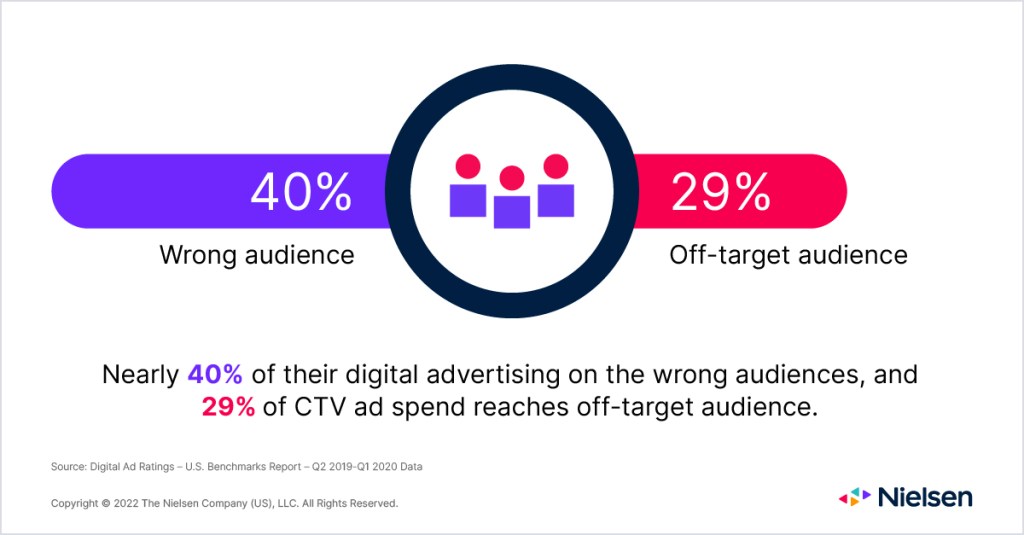
The bad news: The internet is an ant colony with billions of passageways, making it difficult to use data to engage audiences in the right place and the right time. In fact, brands waste nearly 40% of their digital advertising on the wrong audiences, and 29% of CTV ad spend reaches off-target audiences.
The good news: When used correctly, all of this data can be translated into a coherent, audience-first strategy. The key is balance.
Casting a wide net with a mass buy ensures you’ll capture an unwanted audience, whereas targeted advertising means you might miss out on potential fans. How do you strike the perfect blend?
You need to rethink the bedrocks of digital analytics: reach and frequency.
Just because ads are going to the target demographic doesn’t necessarily mean they are building reach. The same is true if ads keep going to people who have already seen them.
You need a holistic evaluation of your reach and frequency. That means two things:
- An on-target percentage that tracks the impressions that reach your target audience.
- Reach and frequency metrics that evaluate how well these on-target impressions are converted into reach.
The math is simple. Higher reach + better frequency management = higher returns on ad spend.
4. How should I improve my campaign on the fly?
Using in-flight metrics and owning your data are the best ways to spot and capitalize on advertising opportunities.
Data is the lifeblood of modern advertising, so controlling yours is one of the best ways to maintain a ready stance for constant improvement. Twenty-one of the top 25 global advertisers based on ad spend agree and choose to own their data, allowing them to see across campaigns and identify opportunities as only they can—by acting in nearly real-time.
Trends and tastes evolve so quickly today that you need immediate learnings. That means a single tool that analyzes reach, frequency and gross rating points across platforms and delivers data daily, regardless of the size of the campaign, the platform or the device.
And when your content spans multiple platforms, you need to know who saw an ad on their phone, who saw it on their laptop and who saw it both places—allowing for strategic duplication and incremental reach.
With these insights, you can more accurately determine if your advertising is meeting the mark. If not, you have the tools to make in-flight adjustments or to optimize for the next wave.
5. Why should I trust DAR’s accuracy?
If you’ve made it this far, you know that DAR scratches nearly every audience measurement itch. The only big question left: Why should you trust it?
DAR relies on cutting-edge technology and the industry’s best representative truth panel. That human-machine combo provides data that are far more accurate than just big data sets, phone surveys or metrics automatically collected from digital devices.
DAR isn’t just precise. It’s dynamic enough to help you navigate the constantly-shifting world of content, platforms and consumer preferences. DAR lets you understand if you’re reaching your target audience, calibrate your strategy on the fly, and justify every move to the person pulling the budget strings.
The Takeaway: Everything you need to know, at a glance
1. Unique reach + better frequency management = less wasted ad dollars.
2. Advertisers need deduplicated audience measurement to verify if ads are reaching the right audiences once personal identifiers go away.
3. Using in-flight metrics and owning your data are the best ways to spot and capitalize on ad ROI opportunities.
4. Advertisers need to track their entire ad spend with comparable metrics across platforms to get the full performance picture.
5. DAR relies on cutting-edge technology and unbiased representative truth panels to provide solutions for all the above.