Music has long been a cultural connector for Latinx* consumers across all ages. This proclivity for music, combined with a preference for everything digital, has made music an important online activity—both personal and social—for Latinx consumers.
Whether through streaming songs, watching videos or following a favorite artist on social media, digital media provide a seamless avenue for Latinx to embrace their deep attachment to their roots, as well as share their culture widely. It’s no accident that the past year has been a monumental one for Latinx music, with a record 19 predominantly Spanish songs hitting the Billboard Hot 100 charts, including “Despacito” by Luis Fonsi, “I Like It” by Cardi B and “Mi Gente” by J Balvin and Willy William.
A deeper dive into how Latinx consume music reveals just how ingrained this art form is in Hispanics’ daily lives. In fact, Latinx consumers spend 32 hours a week listening to music, outpacing non-Hispanic Whites and the total U.S. population. Radio—both online and terrestrial—remains a key source of music for Latinx, who consume far more radio than the total U.S. population But while traditional radio consumption is steady, streaming audio consumption is really taking off.
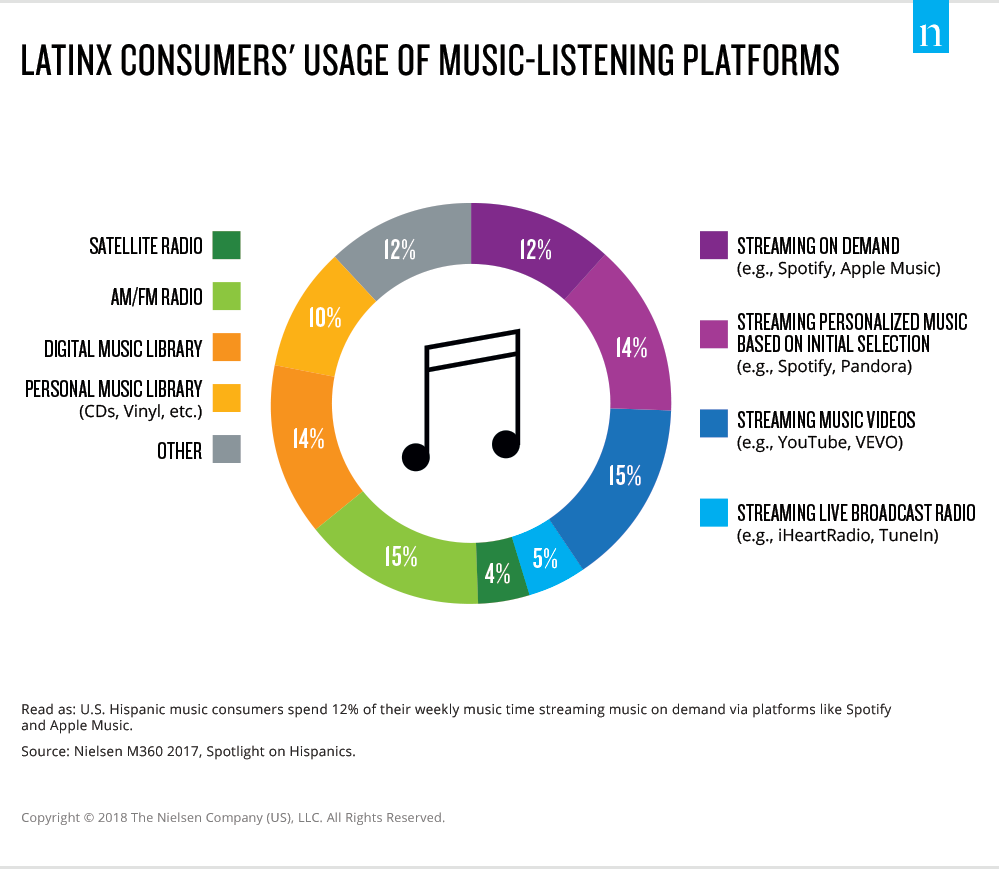
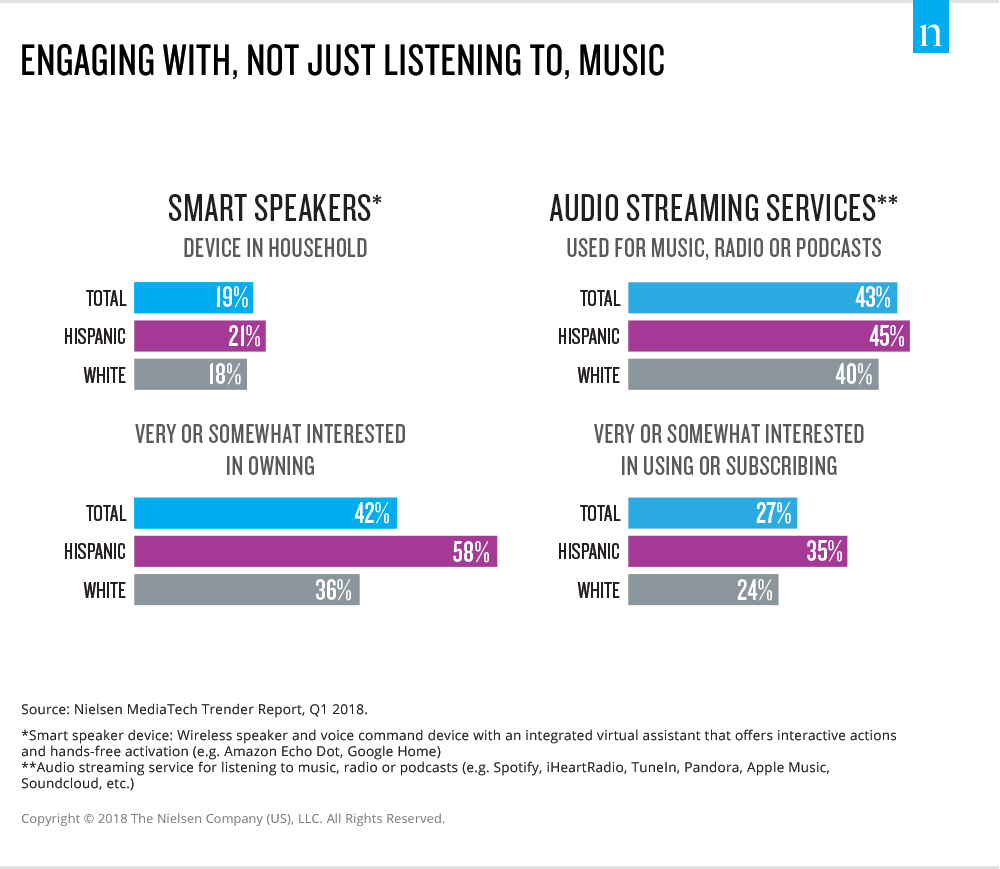
Streaming has become the most popular source of Hispanics’ music listening, accounting for almost half of listening time. Moreover, 45% of Hispanics subscribe to a streaming service for music, radio and podcasts, more than non-Hispanic Whites, who clock in at 40%. And there’s plenty of room for streaming subscription growth, as more than a third of Hispanics say they’re interested in signing up for a subscription service in coming months.
With such an ear for music, it’s no surprise that Latinx consumers have proven quick to adopt new technology to listen to it. More than one in five Latinx households owns a smart speaker, which is higher than the total population. These devices represent another strong opportunity for growth, as 58% of Latinx consumers say they want to acquire some type of smart speaker in the future, 16 percentage points higher than the total population.
Consider also that the average Hispanic consumer over the age of 13 uses four devices to listen to music, radio and podcasts each week. This shows a comfort and ease with using technological devices that will inevitably spill over to new platforms as they’re developed in the future. Thanks to their passion for music and inherent social gregariousness, Latinx consumers have become leaders in digital-early adoption, incorporating online fluidly into their lives.
Moreover, it’s important to note that music is far more than a listening experience for Latinx consumers. In fact 70% of Hispanics say they follow performers on social media sites, well above non-Hispanic Whites. Of Latinx consumers who use YouTube, 88% go to the site to view music videos, while one in four share music video links with family and friends. For Hispanics, music represents an immersive, 360-degree engagement that forms a cultural touchstone in their social circles.
This strong support for music and musicians, plus the overall popularity of streaming, has boosted Latinx artists as never before. 2017’s phenomenal success of “Despacito” by Luis Fonsi and Daddy Yankee, and its remix featuring Justin Bieber, underscores this trend. The song was the year’s biggest in terms of sales and on-demand streaming. “Mi Gente,” by J. Balvin and Willy Williams with a Beyonce remix collaboration, was another smash hit, selling 1.8 million copies via on-demand streaming and song sales. With the increased ability to reach universal audiences on digital access-for-all platforms, Latinx performers have now entered the mainstream consciousness.
For marketers and advertisers, music is clearly one of the most authentic and relevant paths to connect to Latinx consumers who, by the way, view brands that sponsor concerts and tours more favorably than others. Marketers should tune into music when designing strategies to develop meaningful relationships with Latinx consumers or risk losing the beat that drives this digitally savvy demographic.
For additional insights, download Nielsen’s Descubrimento Digital: The Online Lives of Latinx Consumers.
*Nielsen uses the term Latinx to connote unspecified gender. The decision is a nod toward greater inclusion of women, LGBT+ and non-binary Hispanics and the growing popularity of the term in social media and academic writing.