Last year, U.S. consumers bought 226 million children’s print books, with moms leading the charge to the register. According to Nielsen BookScan, the 2014 sales represent a 13% increase from 2013. And despite growing e-commerce options, consumers purchased half of the year’s books at physical stores. Over one-third of purchasers bought multiple books a month, and new research shows that very few actually planned their purchases. What does that mean? Kids’ books seem to fall squarely into the impulse purchase category.
According to Nielsen’s Spring/Summer 2015 Children’s Deep Dive survey, 38% of parents identify themselves as frequent purchasers of kids’ books, defined as one or two book purchases per month, with another 25% purchasing every other month. Only 3% of respondents said that they never buy on impulse– in other words, looking at all the books that they buy for their child, hardly any would say they never buy a book on impulse. More than half (53%) of the parents surveyed estimated that half of their book purchases were impulse buys, and another 26% said most of their book purchases are impulse buys.
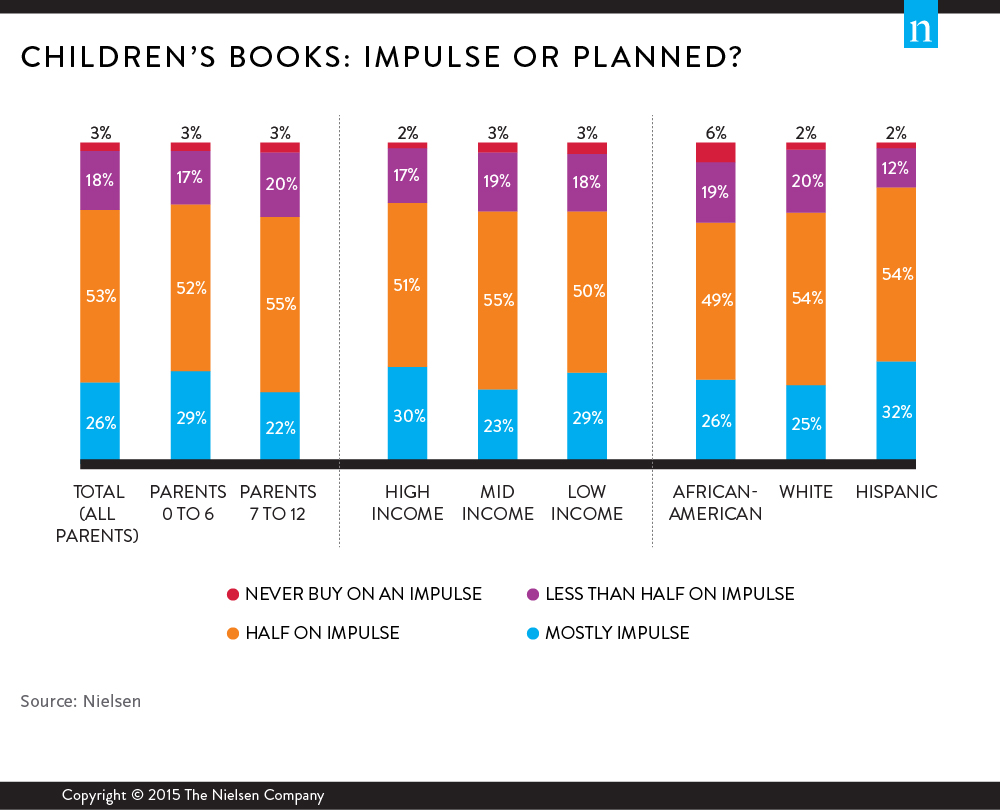
Hispanic consumers (acculturated, English-speaking), who are more likely than the general population as a whole to purchase kids’ books, are also more likely to be frequent purchasers of books for their kids. Forty-seven percent of acculturated Hispanic respondents reported buying books for their kids one-two times per month, and 15% say they buy a kids’ book as often as once a week, compared with 10% for the general population. However, they too are also more likely to buy on impulse: 32%, versus 26% among the general population.
Similarly, more than 60% of the parents surveyed don’t do any research into kids’ books before making a purchase, though 29% did report doing online research before buying. So what drives the most purchases? In most cases, parents make a purchase simply because their child asked for it. This was particularly true for parents of children aged 7-12. This group also cited word-of-mouth reviews from families and friends as an important factor. For parents of children under the age of 7, pricing, illustrations and packaging play an important role in purchasing decisions.
What does this mean for publishers? New strategies for merchandising books in both in-store and online environment, direct engagement with the decision makers and multi-cultural marketing all need to be evaluated with both the reader and purchaser in mind.
Nielsen’s Children’s Book Summit on Sept. 16 will dive into these areas while focusing on who the customers are, what they love and how to engage with them.