Overindulgence doesn’t have to be a bad thing. And when it comes to television content, heavy viewers represent a weighty opportunity for marketers and brands. In fact, a recent study conducted by Nielsen notes that programmers can leverage heavy TV viewers to reduce risk, drive programming and increase advertising efficiency.
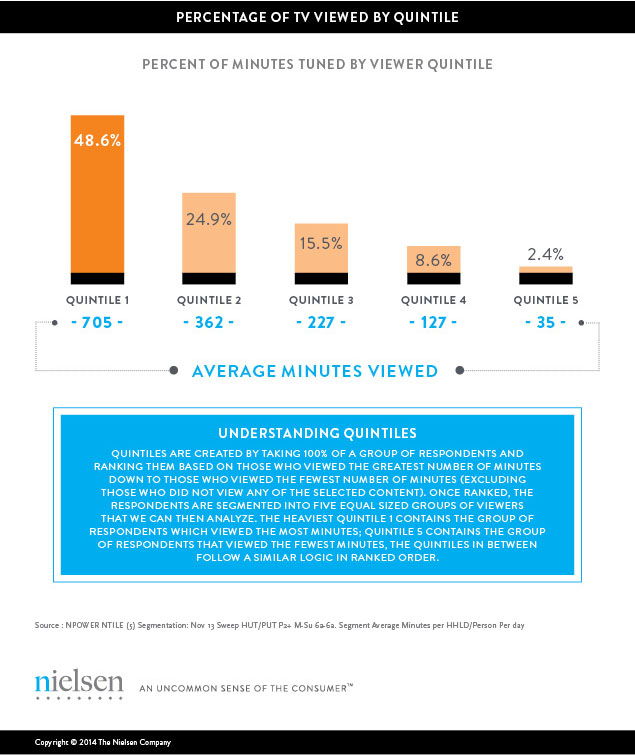
How much of an opportunity? According to a recent quintile study breaking users into five different groups, nearly 50 percent of all TV viewing comes from the heaviest 20 percent of TV viewers.
According to the study, heavy TV viewers in the U.S. spend an average of 705 minutes a day in front of the tube—that’s almost 12 hours! And the amount of time they watch continues to rise. Since 2009, heavy viewers have increased their TV viewing by 8 percent—that’s almost a one-hour increase in daily viewing. When looking at different race/ethnicities, the study found that African-American are 75 percent more-likely to be heavy television viewers, tuning in for an average of 917 minutes per day.
Not only are heavy TV viewers consuming a lot of content, they’re also active consumers, especially when it comes to their automotive, apparel, electronics and dining purchases. For example, heavy TV viewers are 16 percent more likely to buy a domestic car and 17 percent more likely to have purchased new clothing in the past 12 months. Compared to groups that watch less TV, heavy viewers rule the top spot in 10 out of 17 purchasing categories.
Heavy TV viewers aren’t just contributing to retail sales, they’re also influencing advertisers.
Consider that an advertiser has 705 minutes per day to reach a heavy viewer. Although that’s plenty of time to place an ad, they also have to think about competition. Those viewers will likely be exposed to many other advertisements, all vying for a place in that viewer’s mind. So in order to stay at the forefront, advertisers need to find unique ways to feed those hungry eyes.