With the media still a-buzz about U2’s sudden release of “Songs of Innocence” in conjunction with the announcement of Apple’s iPhone 6 and iPhone 6+, it seems as though the “surprise album” is becoming a growing industry trend.
In July 2013, Jay Z announced the imminent release of his newest album via a Samsung commercial that ran during an NBA Finals game. Beyoncé followed her husband’s example when she released a self-titled surprise album to iTunes at the end of the year. Other artists, such as David Bowie, Wolfmother, Radiohead and most recently Thom Yorke, have also surprised fans with unannounced albums in recent years.
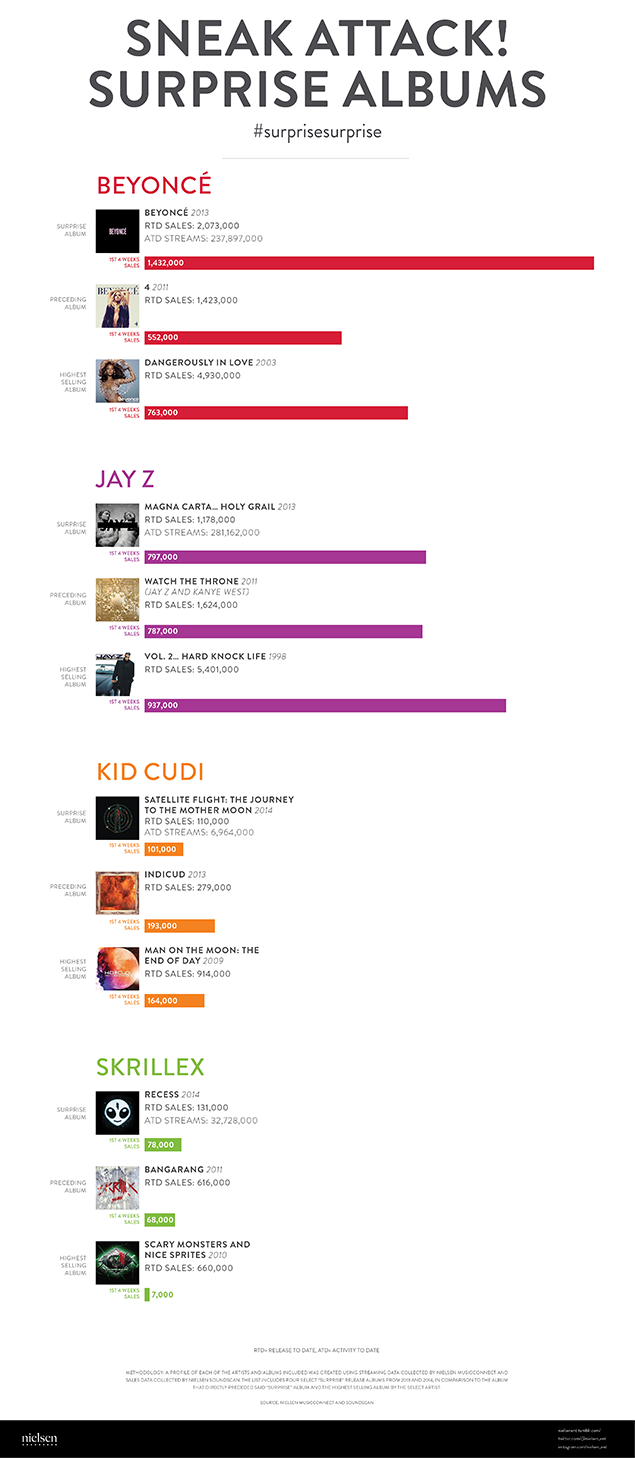
Despite varied methods of release (e.g., Jay Z collaborated with Samsung while Skrillex released his album though his free Alien Ride phone app), one thing is constant: consumers’ reactions to unanticipated new music are unpredictable. “Beyoncé” outsold its predecessor, “4,” in just four weeks, but not every artist has Queen Bey’s fan base.
So how successful is a surprise release’s limited marketing efforts over a traditional album release? Does the publicity around a surprise launch—sometimes through a single retailer—outweigh weeks of advance publicity for a widely distributed traditional release? Does a surprise album become less surprising when everyone is doing it?
It’s still the early days for Thom Yorke’s and U2’s respective releases, but we compared Beyoncé’s album to three other “surprise” albums from well-known artists that followed (as well as the Jay Z album that preceded) to see how they measured up. While other promotional factors may be at play, and other metrics can define success (ticket sales, social media, etc.), we wanted to compare the initial four weeks of sales of a surprise album to each artist’s previous album. We also compared both to the top-selling album and streams to date as an overall measure of each artist’s success.