Entre muitas coisas, a chegada da Copa do Mundo deste ano validou a imensa atração dos esportes ao vivo na TV tradicional. Embora o apelo dos esportes ao vivo seja amplamente conhecido, a audiência deste ano nos EUA ilustra que o fascínio é forte o suficiente para levar muitos americanos a deixar suas vidas de lado para assistir à ação.
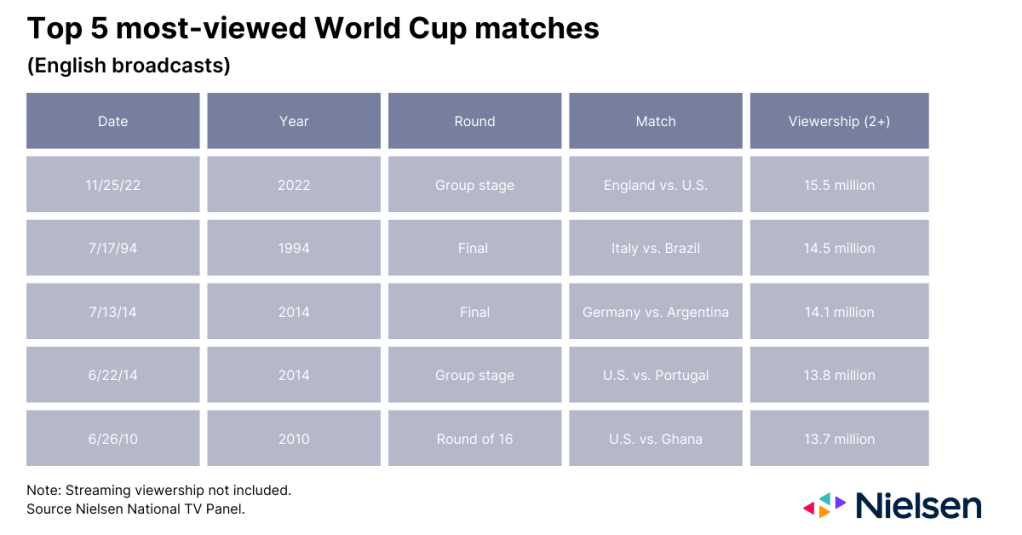
Em comparação com a maioria dos esportes ao vivo nos EUA, que são transmitidos fora dos horários tradicionais de trabalho e escola, a maioria dos jogos da Copa do Mundo foi realizada em horários em que muitos americanos estariam indispostos. Não obstante esse fato, os jogos da Copa do Mundo deste ano, especialmente os que envolveram a equipe dos EUA, atraíram grandes audiências de TV nos EUA. Na verdade, três dos jogos em que a equipe dos EUA competiu este ano estão entre os 10 jogos da Copa do Mundo transmitidos em inglês mais assistidos nos EUA desde 1994. E o jogo deste ano entre EUA e Inglaterra teve uma audiência de quase 15,5 milhões de espectadores na transmissão em inglês - a maior audiência nos EUA de qualquer jogo da Copa do Mundo masculina até hoje.
For context, consider the viewership associated with new fall TV programming—the primary driver of the annual advertising upfronts. This year, the four primary English broadcast networks1 attracted an average of 3.9 million viewers for primetime programming airing in the first month of the new fall TV season2. The audience grows to 5.5 million when we factor in time-shifted viewing over one week, but the aggregate viewership still pales in comparison to that of the World Cup matches featuring the U.S. Those four matches engaged an average of 12.2 million viewers across English telecasts.
The viewership of this year’s tournament is perhaps more notable when Insights de fãs da Nielsen indicates that just 28% of U.S. respondents are interested in soccer. Overall, Americans remain most interested in the NFL, the Olympics, the NBA and MLB.
The appeal and interest in this year’s tournament has also withstood some intense competition. From an audience perspective, fall is when linear TV programming gets a boost, and this year was no exception, as sports viewing increased 222% in September as the new American football season kicked off. In October, sports viewing volume increased another 19%, just ahead of the start of the year’s World Cup, which is typically held in the summer.
By the time the tournament started, the matches that were broadcast on traditional cable began challenging other sports events for slots in Nielsen’s weekly top 10 listings. And over Thanksgiving weekend, possibly the biggest sports viewing period of the fall, survey respondents claimed the World Cup was their third choice for sports viewing, coming in behind NFL and college football. Yet perhaps more noteworthy is that the two matches listed in the top 10 cable listing for the week of Nov. 21-27, 2022, didn’t feature the U.S. men’s team:
- 4,1 milhões de pessoas assistiram ao jogo entre Argentina e México
- 3,6 milhões de pessoas assistiram ao jogo entre Espanha e Alemanha
Given the 90-minute matches, tuning in—especially midday—is a commitment. Most Americans acknowledge the need to balance their interest in the games with other aspects of their daily lives. While the majority of fans are keeping track of the action by watching highlights on TV, many are following on social media and hearing from others via word of mouth, including texting. And with 47% texting and 43%3 scrolling on social media, big moments in individual matches have attracted audiences who might not have already been tuned in.
Take the Group State match between Brazil and Serbia for example. Nielsen Gracenote had given Serbia a 32% chance of advancing, possibly limiting audience engagement for the Thanksgiving Day matchup with tournament-favorite Brazil. But when Brazil’s Richarlison de Andrade, known mononymously as Richarlison, made a dynamic scissor kick goal just before the 73-minute mark, viewership jumped 7% during the five minutes following the goal.
Dado o grande apelo dos esportes ao vivo, as ativações de patrocínio continuam sendo uma forma importante de as marcas se envolverem com fãs novos e existentes. E, embora o sucesso a longo prazo dependa de preencher a lacuna entre conscientização e conversão, as ativações de patrocínio no setor esportivo aumentaram sua capacidade de converter fãs.
For example, our 2022 annual sports report noted that during the pandemic, when we controlled for the impact of changing levels of brand awareness and sponsorship maturity, levels of purchase intent among exposed fans were higher than levels of brand familiarity. In addition, a recent Nielsen analysis of 100 sponsorships between 2020 and 2021 in seven markets across 20 industries found that the sponsorships drove an average 10% lift in purchase intent among the exposed fanbase.
Durante a Copa do Mundo deste ano, quase dois terços das pessoas que assistiram ou pretendiam assistir aos jogos da Copa do Mundo ao vivo em nossa Pesquisa de Hábitos de Visualização da Copa do Mundo disseram que se lembraram dos anúncios que viram durante os jogos a que assistiram. E, não surpreendentemente, as marcas de alimentos, lanches e bebidas alcoólicas foram as que mais se beneficiaram, obtendo a melhor lembrança entre o público.
The World Cup, like the Olympics, presents a unique opportunity for brands and agencies to attract audiences who might not otherwise be inspired to watch. With an average 4.7 million4 people watching the 2022 men’s World Cup live on cable and broadcast—higher than the average primetime programming we saw this year—advertisers would be wise to consider global tentpole sporting events in their marketing mix.
Do ponto de vista do futebol, elas não terão que esperar muito para marcar um gol de ouro, pois a Copa do Mundo Feminina da FIFA 2023 está chegando. A oportunidade fala por si só; a final de 2015 entre os EUA e o Japão foi a partida da Copa do Mundo (masculina e feminina) mais assistida de todos os tempos.
Notas
- ABC, CBS, NBC, FOX
- 20 de setembro a 17 de outubro de 2022
- Pesquisa de hábitos de visualização da Copa do Mundo da Nielsen, 27 de novembro a 1º de dezembro de 2022
- Painel Nacional de TV da Nielsen