Tegoroczne Mistrzostwa Świata w piłce nożnej potwierdziły między innymi ogromną atrakcyjność sportu na żywo w tradycyjnej telewizji. Podczas gdy atrakcyjność sportu na żywo jest powszechnie znana, tegoroczna oglądalność w USA pokazuje, że urok jest wystarczająco silny, aby zachęcić wielu Amerykanów do wstrzymania życia, aby obejrzeć akcję.
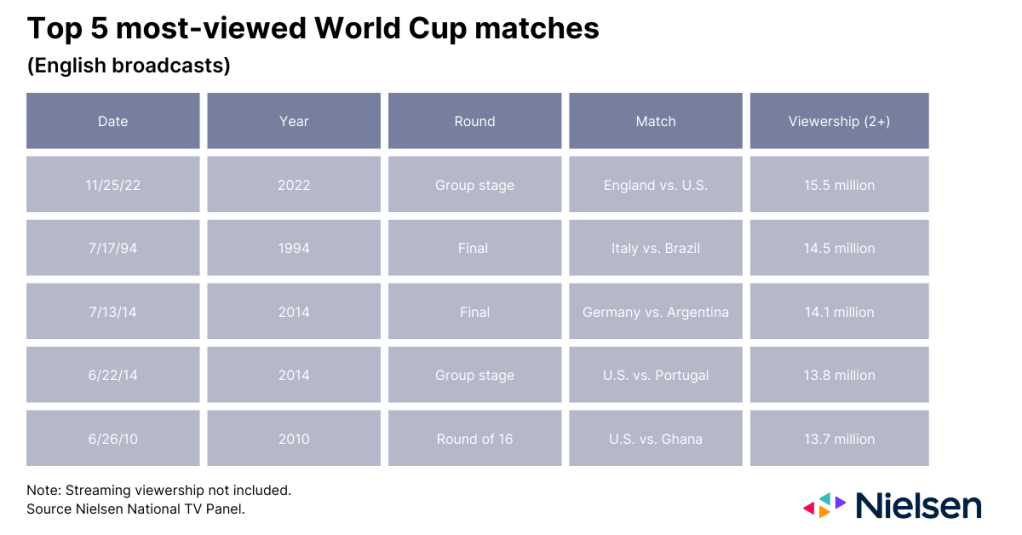
W porównaniu z większością transmisji sportowych na żywo w Stanach Zjednoczonych, które odbywają się poza tradycyjnymi godzinami pracy i szkoły, większość meczów Mistrzostw Świata odbywała się w czasie, gdy wielu Amerykanów byłoby niedysponowanych. Niezależnie od tego faktu, tegoroczne mecze mistrzostw świata, zwłaszcza te z udziałem drużyny USA, przyciągnęły ogromną widownię telewizyjną w Stanach Zjednoczonych. W rzeczywistości trzy z meczów, w których drużyna USA rywalizowała w tym roku, znajdują się w pierwszej dziesiątce najchętniej oglądanych angielskich meczów mistrzostw świata w USA, począwszy od 1994 roku. Tegoroczny mecz USA-Anglia zgromadził przed telewizorami prawie 15,5 miliona widzów - to najwyższa oglądalność w USA spośród wszystkich dotychczasowych meczów Mistrzostw Świata w piłce nożnej mężczyzn.
For context, consider the viewership associated with new fall TV programming—the primary driver of the annual advertising upfronts. This year, the four primary English broadcast networks1 attracted an average of 3.9 million viewers for primetime programming airing in the first month of the new fall TV season2. The audience grows to 5.5 million when we factor in time-shifted viewing over one week, but the aggregate viewership still pales in comparison to that of the World Cup matches featuring the U.S. Those four matches engaged an average of 12.2 million viewers across English telecasts.
The viewership of this year’s tournament is perhaps more notable when Nielsen Fan Insights indicates that just 28% of U.S. respondents are interested in soccer. Overall, Americans remain most interested in the NFL, the Olympics, the NBA and MLB.
The appeal and interest in this year’s tournament has also withstood some intense competition. From an audience perspective, fall is when linear TV programming gets a boost, and this year was no exception, as sports viewing increased 222% in September as the new American football season kicked off. In October, sports viewing volume increased another 19%, just ahead of the start of the year’s World Cup, which is typically held in the summer.
By the time the tournament started, the matches that were broadcast on traditional cable began challenging other sports events for slots in Nielsen’s weekly top 10 listings. And over Thanksgiving weekend, possibly the biggest sports viewing period of the fall, survey respondents claimed the World Cup was their third choice for sports viewing, coming in behind NFL and college football. Yet perhaps more noteworthy is that the two matches listed in the top 10 cable listing for the week of Nov. 21-27, 2022, didn’t feature the U.S. men’s team:
- 4,1 miliona widzów oglądało mecz Argentyna-Meksyk
- 3,6 miliona widzów oglądało mecz Hiszpania-Niemcy
Given the 90-minute matches, tuning in—especially midday—is a commitment. Most Americans acknowledge the need to balance their interest in the games with other aspects of their daily lives. While the majority of fans are keeping track of the action by watching highlights on TV, many are following on social media and hearing from others via word of mouth, including texting. And with 47% texting and 43%3 scrolling on social media, big moments in individual matches have attracted audiences who might not have already been tuned in.
Take the Group State match between Brazil and Serbia for example. Nielsen Gracenote had given Serbia a 32% chance of advancing, possibly limiting audience engagement for the Thanksgiving Day matchup with tournament-favorite Brazil. But when Brazil’s Richarlison de Andrade, known mononymously as Richarlison, made a dynamic scissor kick goal just before the 73-minute mark, viewership jumped 7% during the five minutes following the goal.
Biorąc pod uwagę szeroką atrakcyjność sportu na żywo, aktywacje sponsorskie pozostają kluczowym sposobem, w jaki marki mogą angażować nowych i obecnych fanów. I chociaż długoterminowy sukces będzie zależał od wypełnienia luki między świadomością a konwersją, aktywacje sponsorskie w branży sportowej wzrosły pod względem zdolności do konwersji fanów.
For example, our 2022 annual sports report noted that during the pandemic, when we controlled for the impact of changing levels of brand awareness and sponsorship maturity, levels of purchase intent among exposed fans were higher than levels of brand familiarity. In addition, a recent Nielsen analysis of 100 sponsorships between 2020 and 2021 in seven markets across 20 industries found that the sponsorships drove an average 10% lift in purchase intent among the exposed fanbase.
Podczas tegorocznych mistrzostw świata w piłce nożnej prawie dwie trzecie osób, które oglądały lub zamierzały oglądać na żywo mecze mistrzostw świata w piłce nożnej w naszym badaniu dotyczącym nawyków oglądania mistrzostw świata, stwierdziło, że przypomniało sobie reklamy, które widzieli podczas oglądanych meczów. Nic dziwnego, że najbardziej skorzystały na tym marki żywności, przekąsek i napojów alkoholowych, uzyskując najlepszą zapamiętywalność wśród widzów.
The World Cup, like the Olympics, presents a unique opportunity for brands and agencies to attract audiences who might not otherwise be inspired to watch. With an average 4.7 million4 people watching the 2022 men’s World Cup live on cable and broadcast—higher than the average primetime programming we saw this year—advertisers would be wise to consider global tentpole sporting events in their marketing mix.
Z perspektywy piłki nożnej, nie będą musiały długo czekać na zdobycie złotego gola, ponieważ Mistrzostwa Świata FIFA Kobiet 2023 są tuż za rogiem. Szansa mówi sama za siebie; finał 2015 roku pomiędzy USA i Japonią był najchętniej oglądanym meczem Mistrzostw Świata (mężczyzn i kobiet) wszechczasów.
Uwagi
- ABC, CBS, NBC, FOX
- 20 września - 17 października 2022 r.
- Nielsen World Cup Viewing Habits Survey, 27 listopada - 1 grudnia 2022 r.
- Krajowy panel telewizyjny Nielsen