Se non si racconta la propria storia, lo farà qualcun altro. Per le persone provenienti dal Medio Oriente/Nord Africa (MENA), questa è stata una sfida quando si è trattato delle storie che hanno visto nei media. I dati Nielsen mostrano che la presenza dei MENA sullo schermo è solo del 2,5% in 1.500 programmi televisivi trasmessi, via cavo e in streaming. Ma non sono solo i media a non rappresentare questo gruppo. Infatti, il censimento degli Stati Uniti classifica ancora le persone MENA come bianche, lasciando una popolazione che deve lottare più duramente per ottenere risorse perché è poco rappresentata e poco contata. Quindi, cosa può fare l'industria dei media per aumentare la rappresentazione dei MENA sullo schermo e raccontare storie più accurate sulle loro esperienze?
To explore some ideas and opportunities, we spoke with Dr. Evelyn Alsultany, Associate Professor, Department of American Studies and Ethnicity at University of Southern California, and educational consultant for the MENA Arts Advocacy Coalition (MAAC), an organization that advocates for greater visibility of Middle Eastern, North African, and South Asian talent in Hollywood.
"Abbiamo consumato così tante immagini e storie che stereotipano arabi, iraniani e musulmani, e naturalmente molti altri gruppi. Il danno non sta in una sola storia, ma piuttosto nella loro ripetizione e nella mancanza di diversità nelle immagini. Il risultato è che gli stereotipi arrivano a rappresentare un intero gruppo di persone, privandole della loro umanità".
Dr. Evelyn Alsultany
Q: From 2019-2021, Nielsen data shows that the genres where MENA talent is most often seen are biographies, action sports and dark comedies. From your research/experience, what stories about MENA culture are being told on screen? Are there stereotypes or accurate representation/depictions?
R: I film e gli spettacoli televisivi di Hollywood non sono "solo intrattenimento". Le immagini stereotipate e la loro ripetizione nel corso della storia influenzano il sostegno a politiche che danneggiano gli arabi e i musulmani. Hanno un impatto e conseguenze enormi. Nel 2017 il MAAC ha creato una maggiore consapevolezza sul MENA nell'industria dell'intrattenimento come nuova categoria di diversità, aiutando la comunità a ottenere un riconoscimento e consentendo ad aziende come Nielsen e altre di misurare correttamente l'aspetto della rappresentazione del MENA sullo schermo. Ma la situazione continua a non essere soddisfacente.
There have been some notable changes over the last two or three decades. After 9/11, there was an increase in “good” Arab and Muslim characters in TV shows like 24, Patria e Jack Ryan. However, these characters appeared as U.S. patriots who either worked for the FBI or CIA or who were willing to fight and die for the U.S. to prove their patriotism. It is an improvement over portrayals as terrorists but it is nonetheless a very limiting character that defines Arabs and Muslims as “good” or “bad” in relation to terrorism and in relation to a very narrow conception of patriotism.
D: Con l'aumento dei contenuti in streaming e delle piattaforme digitali, stiamo vedendo più cultura/persone MENA sullo schermo?
Siamo passati dai giorni in cui la maggior parte delle persone guardava la stessa serie di programmi sulla televisione di rete a un'ampia gamma di programmi offerti dai servizi di streaming. Abbiamo anche un maggiore accesso alle produzioni non statunitensi. C'è un grande potenziale nel diversificare le immagini che consumiamo del popolo MENA.
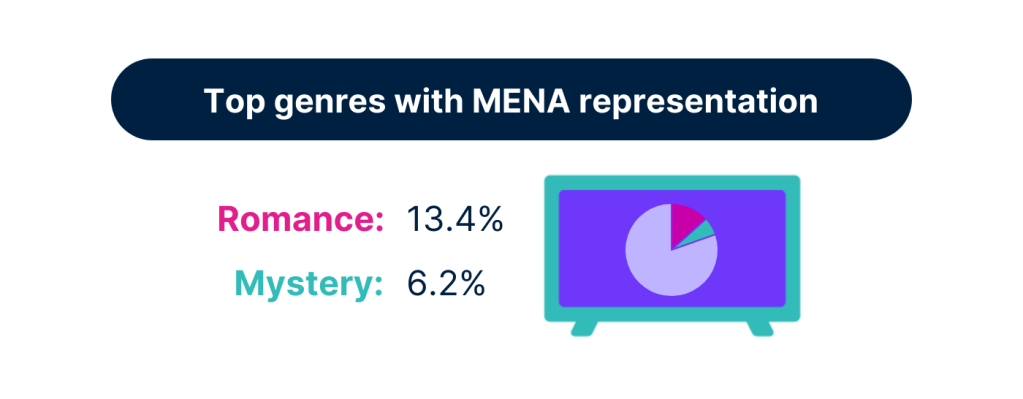
Historically,non-Arabs would play Arab roles and would use costumes and accents to convey Arabness. Anthony Quinn, who was Mexican, played Arab characters in several movies: The Road to Morocco, Lawrence of Arabia (1962), and Lion of the Desert (1981). As recently as 2014 and 2016, Gerard Butler was in Gods of Egypt, and both Christian Bale and Joel Edgerton in Exodus: Gods and Kings were all painted brown to play MENA Characters. Most of the roles left available for MENA actors over the last two decades have been stereotypical characters. Even when MENA talent is present, there is still a need to expand the stories that are told about them. Nielsen’s Gracenote Inclusion Analytics data shows that romance was the top genre where MENA talent appeared on screen in 2021—almost twice more than in mystery, which is the genre with the second highest MENA share of screen. And when we look at the programs under the romance genre, 40% is in Spanish-language novelas, which is limited to the Spanish audience.
Luckily, we have content creators like Ramy and Nasim Pedrad helping to change the landscape. But we need more streamers and networks to buy MENA content from MENA creators and put it on air. With TV more global than ever, there is a market for it. We’ve seen a concerted and notable effort in Hollywood to expand and improve representations especially in response to the Muslim Travel Ban proposed in 2015. As a result, we saw an increase in representations of Muslims outside of terrorism. It is quite refreshing. These include CBS’ FBI, Fox’s 9-1-1: Lonestar, the CW’s DC Legends of Tomorrow, Freeform’s The Bold Type, NBC’s Transplant, Hulu’s Ramy, Peacock’s We Are Lady Parts, and most recently Disney+ Moon Knight. These shows have been impacting the MENA audience in moving ways for their accurate and thoughtful representation.
D: Cos'altro si può fare per promuovere il cambiamento?
Gli approcci più efficaci saranno quelli che cercano di correggere una storia di rappresentazioni piuttosto che una crisi momentanea.
Dr. Evelyn Alsultany
Over the last five years, some wonderful resources have emerged to support Hollywood in diversifying representations. The MENA Arts Advocacy Coalition, MAAC, works to educate the industry at large on the underrepresentation of MENA in entertainment and has created a database of MENA and South Asian creatives to connect emerging and established talent from these regions to the industry. The WGA launched a Middle Eastern Writers Committee to create awareness for MENA Writers, and SAG-AFTRA recently created a National MENA Committee to advocate for performers.
But devising effective solutions requires developing a fuller understanding of the problem. The problem is not one movie or TV show, but how a history of stereotypical representations has constructed negative meanings about Arabs (and Muslims) that have real world consequences. The problem is that MENA performers have been portrayed as terrorists so many times that it has come to represent the entire community of 300 million people. Therefore, we need to encourage streamers and networks to invest in MENA talent and hire MENA writers.
Tendiamo a cercare di risolvere i problemi quando esplodono o quando c'è una crisi, come il bando dei musulmani. Ma l'approccio più efficace sarà quello che cerca di correggere una storia di rappresentazioni piuttosto che una crisi momentanea.