Se você não contar sua própria história, outra pessoa contará. Para as pessoas do Oriente Médio/Norte da África (MENA), isso tem sido de fato um desafio quando se trata das histórias que elas veem na mídia. Os dados da Nielsen mostram que a presença do MENA na tela é de apenas 2,5% em 1.500 programas de TV aberta, a cabo e de streaming. Mas não é apenas a mídia que sub-representa esse grupo. Na verdade, o Censo dos EUA ainda classifica as pessoas do grupo MENA como brancas, deixando uma população que precisa lutar mais por recursos porque está sub-representada e sub-contada. Então, o que o setor de mídia pode fazer para aumentar a representação do grupo MENA na tela e contar histórias mais precisas sobre suas experiências?
To explore some ideas and opportunities, we spoke with Dr. Evelyn Alsultany, Associate Professor, Department of American Studies and Ethnicity at University of Southern California, and educational consultant for the MENA Arts Advocacy Coalition (MAAC), an organization that advocates for greater visibility of Middle Eastern, North African, and South Asian talent in Hollywood.
"Consumimos muitas imagens e histórias que estereotipam árabes, iranianos e muçulmanos e, é claro, muitos outros grupos. O mal não está em uma única história, mas em sua repetição e na falta de diversidade de imagens. O resultado é que os estereótipos passam a representar um grupo inteiro de pessoas e lhes roubam a humanidade."
Dra. Evelyn Alsultany
Q: From 2019-2021, Nielsen data shows that the genres where MENA talent is most often seen are biographies, action sports and dark comedies. From your research/experience, what stories about MENA culture are being told on screen? Are there stereotypes or accurate representation/depictions?
R: Os filmes e programas de TV de Hollywood não são "apenas entretenimento". Imagens estereotipadas e sua repetição ao longo da história influenciam o apoio a políticas que prejudicam árabes e muçulmanos. Elas têm um impacto e consequências tremendos. A MAAC criou uma maior conscientização sobre o povo MENA no setor de entretenimento em 2017 como uma nova categoria de diversidade, ajudando a comunidade a ganhar reconhecimento e permitindo que empresas como a Nielsen e outras avaliem adequadamente como é a representação do povo MENA na tela. Mas isso ainda é insuficiente.
There have been some notable changes over the last two or three decades. After 9/11, there was an increase in “good” Arab and Muslim characters in TV shows like 24, Pátria e Jack Ryan. However, these characters appeared as U.S. patriots who either worked for the FBI or CIA or who were willing to fight and die for the U.S. to prove their patriotism. It is an improvement over portrayals as terrorists but it is nonetheless a very limiting character that defines Arabs and Muslims as “good” or “bad” in relation to terrorism and in relation to a very narrow conception of patriotism.
P: Com o aumento do conteúdo de plataformas digitais e de streaming, estamos vendo mais culturas/pessoas da região MENA nas telas?
Passamos da época em que a maioria das pessoas assistia ao mesmo conjunto de programas na rede de televisão para uma variedade tão grande de programação oferecida pelos serviços de streaming. Também temos mais acesso a produções não americanas. Há um grande potencial para diversificar as imagens que consumimos do povo do MENA.
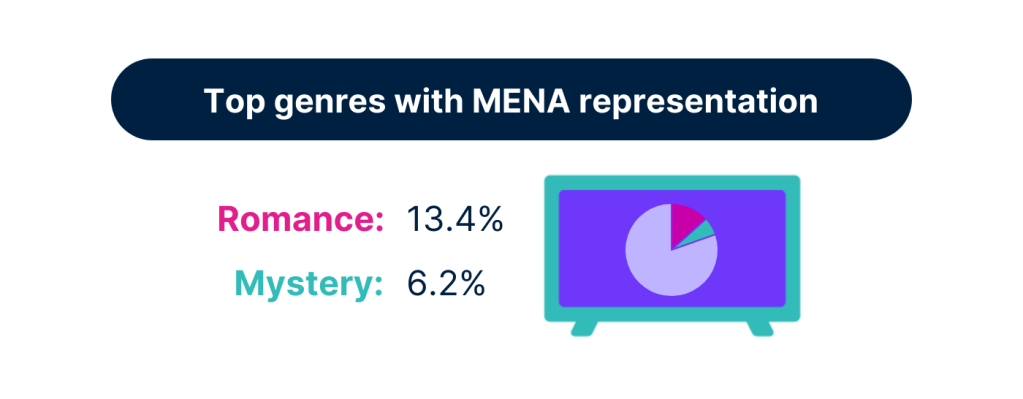
Historically,non-Arabs would play Arab roles and would use costumes and accents to convey Arabness. Anthony Quinn, who was Mexican, played Arab characters in several movies: The Road to Morocco, Lawrence of Arabia (1962), and Lion of the Desert (1981). As recently as 2014 and 2016, Gerard Butler was in Gods of Egypt, and both Christian Bale and Joel Edgerton in Exodus: Gods and Kings were all painted brown to play MENA Characters. Most of the roles left available for MENA actors over the last two decades have been stereotypical characters. Even when MENA talent is present, there is still a need to expand the stories that are told about them. Nielsen’s Gracenote Inclusion Analytics data shows that romance was the top genre where MENA talent appeared on screen in 2021—almost twice more than in mystery, which is the genre with the second highest MENA share of screen. And when we look at the programs under the romance genre, 40% is in Spanish-language novelas, which is limited to the Spanish audience.
Luckily, we have content creators like Ramy and Nasim Pedrad helping to change the landscape. But we need more streamers and networks to buy MENA content from MENA creators and put it on air. With TV more global than ever, there is a market for it. We’ve seen a concerted and notable effort in Hollywood to expand and improve representations especially in response to the Muslim Travel Ban proposed in 2015. As a result, we saw an increase in representations of Muslims outside of terrorism. It is quite refreshing. These include CBS’ FBI, Fox’s 9-1-1: Lonestar, the CW’s DC Legends of Tomorrow, Freeform’s The Bold Type, NBC’s Transplant, Hulu’s Ramy, Peacock’s We Are Lady Parts, and most recently Disney+ Moon Knight. These shows have been impacting the MENA audience in moving ways for their accurate and thoughtful representation.
P: O que mais pode ser feito para promover a mudança?
A abordagem mais eficaz será aquela que busca retificar um histórico de representações em vez de uma crise momentânea.
Dra. Evelyn Alsultany
Over the last five years, some wonderful resources have emerged to support Hollywood in diversifying representations. The MENA Arts Advocacy Coalition, MAAC, works to educate the industry at large on the underrepresentation of MENA in entertainment and has created a database of MENA and South Asian creatives to connect emerging and established talent from these regions to the industry. The WGA launched a Middle Eastern Writers Committee to create awareness for MENA Writers, and SAG-AFTRA recently created a National MENA Committee to advocate for performers.
But devising effective solutions requires developing a fuller understanding of the problem. The problem is not one movie or TV show, but how a history of stereotypical representations has constructed negative meanings about Arabs (and Muslims) that have real world consequences. The problem is that MENA performers have been portrayed as terrorists so many times that it has come to represent the entire community of 300 million people. Therefore, we need to encourage streamers and networks to invest in MENA talent and hire MENA writers.
Temos a tendência de tentar resolver os problemas quando eles surgem ou quando há uma crise, como a proibição dos muçulmanos. Mas a abordagem mais eficaz será aquela que busca retificar um histórico de representações em vez de uma crise momentânea.