Jika Anda tidak menceritakan kisah Anda sendiri, orang lain yang akan menceritakannya. Bagi orang-orang dari Timur Tengah/Afrika Utara (MENA), hal ini memang menjadi tantangan tersendiri dalam hal cerita yang mereka lihat di media. Data Nielsen menunjukkan bahwa kehadiran MENA di layar kaca hanya mencapai 2,5% di 1.500 acara TV siaran, kabel, dan streaming. Namun, bukan hanya media yang kurang merepresentasikan kelompok ini. Faktanya, Sensus AS masih mengklasifikasikan orang-orang MENA sebagai orang kulit putih, sehingga mereka harus berjuang lebih keras untuk mendapatkan sumber daya karena mereka kurang terwakili dan kurang dihitung. Jadi, apa yang dapat dilakukan industri media untuk meningkatkan representasi MENA di layar kaca dan menceritakan kisah-kisah yang lebih akurat tentang pengalaman mereka?
To explore some ideas and opportunities, we spoke with Dr. Evelyn Alsultany, Associate Professor, Department of American Studies and Ethnicity at University of Southern California, and educational consultant for the MENA Arts Advocacy Coalition (MAAC), an organization that advocates for greater visibility of Middle Eastern, North African, and South Asian talent in Hollywood.
"Kita telah mengkonsumsi begitu banyak gambar dan alur cerita yang menstereotipkan orang Arab, Iran dan Muslim, dan tentu saja banyak kelompok lainnya. Kerugiannya bukan pada satu cerita, melainkan pada pengulangan dan kurangnya keragaman gambar. Hasilnya adalah stereotip-stereotip tersebut menjadi representasi dari seluruh kelompok orang dan merampas kemanusiaan mereka."
Dr. Evelyn Alsultany
Q: From 2019-2021, Nielsen data shows that the genres where MENA talent is most often seen are biographies, action sports and dark comedies. From your research/experience, what stories about MENA culture are being told on screen? Are there stereotypes or accurate representation/depictions?
J: Film-film dan acara TV Hollywood bukanlah "sekadar hiburan". Gambaran stereotip dan pengulangannya sepanjang sejarah mempengaruhi dukungan terhadap kebijakan-kebijakan yang merugikan orang Arab dan Muslim. Mereka memiliki dampak dan konsekuensi yang luar biasa. MAAC membangun kesadaran yang lebih besar tentang MENA di industri Hiburan pada tahun 2017 sebagai kategori keragaman baru, membantu komunitas mendapatkan pengakuan dan memungkinkan perusahaan seperti Nielsen dan lainnya untuk mengukur dengan tepat seperti apa representasi MENA di layar. Namun, hal ini masih terus gagal.
There have been some notable changes over the last two or three decades. After 9/11, there was an increase in “good” Arab and Muslim characters in TV shows like 24, Tanah Air dan Jack Ryan. However, these characters appeared as U.S. patriots who either worked for the FBI or CIA or who were willing to fight and die for the U.S. to prove their patriotism. It is an improvement over portrayals as terrorists but it is nonetheless a very limiting character that defines Arabs and Muslims as “good” or “bad” in relation to terrorism and in relation to a very narrow conception of patriotism.
T: Seiring dengan meningkatnya streaming dan konten platform digital, apakah kita melihat lebih banyak budaya/orang MENA di layar?
Kita telah bergeser dari masa ketika kebanyakan orang menonton acara yang sama di televisi jaringan ke beragam program yang ditawarkan melalui layanan streaming. Kami juga memiliki lebih banyak akses ke produksi non-AS. Ada banyak potensi di sini dalam mendiversifikasi gambar yang kita konsumsi untuk masyarakat MENA.
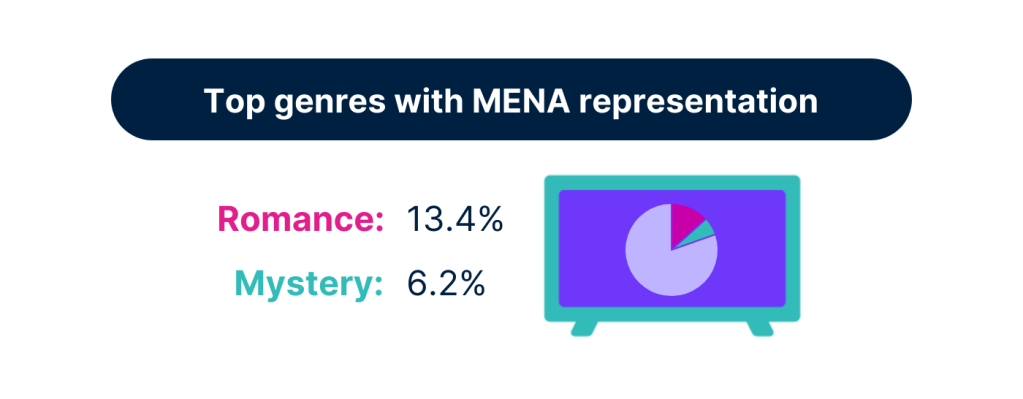
Historically,non-Arabs would play Arab roles and would use costumes and accents to convey Arabness. Anthony Quinn, who was Mexican, played Arab characters in several movies: The Road to Morocco, Lawrence of Arabia (1962), and Lion of the Desert (1981). As recently as 2014 and 2016, Gerard Butler was in Gods of Egypt, and both Christian Bale and Joel Edgerton in Exodus: Gods and Kings were all painted brown to play MENA Characters. Most of the roles left available for MENA actors over the last two decades have been stereotypical characters. Even when MENA talent is present, there is still a need to expand the stories that are told about them. Nielsen’s Gracenote Inclusion Analytics data shows that romance was the top genre where MENA talent appeared on screen in 2021—almost twice more than in mystery, which is the genre with the second highest MENA share of screen. And when we look at the programs under the romance genre, 40% is in Spanish-language novelas, which is limited to the Spanish audience.
Luckily, we have content creators like Ramy and Nasim Pedrad helping to change the landscape. But we need more streamers and networks to buy MENA content from MENA creators and put it on air. With TV more global than ever, there is a market for it. We’ve seen a concerted and notable effort in Hollywood to expand and improve representations especially in response to the Muslim Travel Ban proposed in 2015. As a result, we saw an increase in representations of Muslims outside of terrorism. It is quite refreshing. These include CBS’ FBI, Fox’s 9-1-1: Lonestar, the CW’s DC Legends of Tomorrow, Freeform’s The Bold Type, NBC’s Transplant, Hulu’s Ramy, Peacock’s We Are Lady Parts, and most recently Disney+ Moon Knight. These shows have been impacting the MENA audience in moving ways for their accurate and thoughtful representation.
T: Apa lagi yang bisa dilakukan untuk mendorong perubahan?
Pendekatan yang paling efektif adalah pendekatan yang berusaha untuk memperbaiki sejarah representasi dan bukannya krisis sesaat.
Dr. Evelyn Alsultany
Over the last five years, some wonderful resources have emerged to support Hollywood in diversifying representations. The MENA Arts Advocacy Coalition, MAAC, works to educate the industry at large on the underrepresentation of MENA in entertainment and has created a database of MENA and South Asian creatives to connect emerging and established talent from these regions to the industry. The WGA launched a Middle Eastern Writers Committee to create awareness for MENA Writers, and SAG-AFTRA recently created a National MENA Committee to advocate for performers.
But devising effective solutions requires developing a fuller understanding of the problem. The problem is not one movie or TV show, but how a history of stereotypical representations has constructed negative meanings about Arabs (and Muslims) that have real world consequences. The problem is that MENA performers have been portrayed as terrorists so many times that it has come to represent the entire community of 300 million people. Therefore, we need to encourage streamers and networks to invest in MENA talent and hire MENA writers.
Kita cenderung mencoba menyelesaikan masalah ketika masalah itu muncul atau ketika ada krisis, seperti larangan Muslim. Namun pendekatan yang paling efektif adalah pendekatan yang berusaha memperbaiki sejarah representasi, bukan krisis sesaat.