如果说媒体行业最喜欢什么,那就是缩写。
在媒体计划、演示文稿和新闻稿中,字母随处可见。但是,随着新媒体类型的出现--以及随之而来的简称--它们之间的区别就被混淆了。在谈论网络媒体时,有三个术语尤其容易混淆。
我们分析了 OTT、CTV 和流媒体之间的区别,广告在每种媒体上的运作方式,以及营销人员比以往任何时候都更需要了解它们的原因。
如何定义 OTT、CTV 和流媒体?
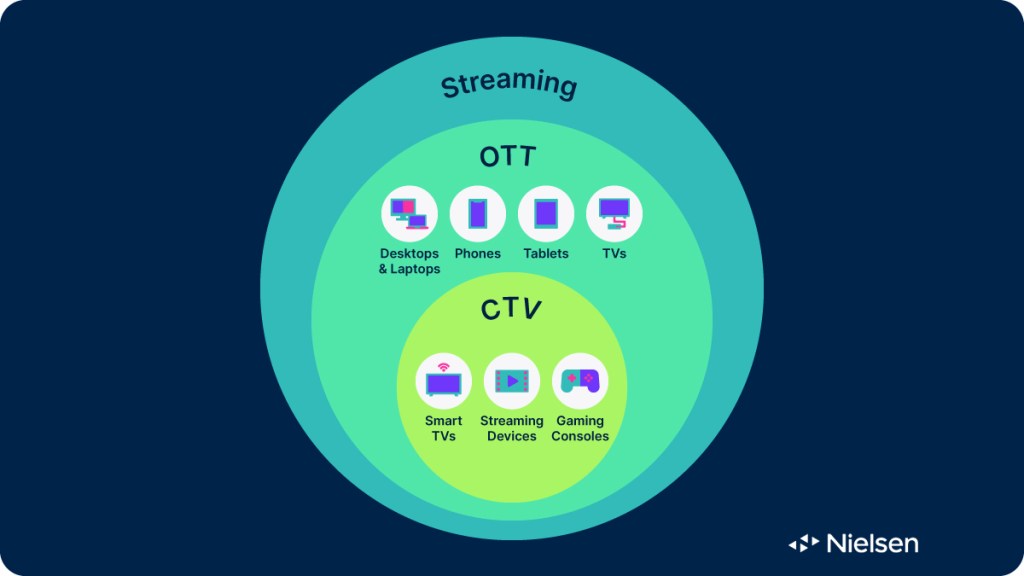
• Streaming — An umbrella term that describes audio and video content delivery to a user’s device through the internet. You can “stream” content across any device.
• Over-the-top (OTT) — The method of streaming content “over the top” of the internet across any device. OTT streaming requires a strong internet connection and a device that supports apps or browsers. OTT used to refer to only video content but now it’s expanded to include all the internet offers.
So, when you watch a rerun of 朋友 on your TV via cable, you are not watching OTT. However, if you switch over to your Apple TV system, open the HBO Max app, and begin streaming Friends, then you are watching OTT. The difference has to do with how you’re accessing the content, rather than what the content is.
• Connected TV (CTV) — The method of streaming content from the internet on a television screen. A standard television can become a connected TV via a streaming device, like a Roku or Amazon Fire TV stick, or through a gaming console, like a PlayStation or Xbox. It can also come with internet connectivity built in, in which case it would be called a smart TV.
OTT 和 CTV 之间的区别尤其令人困惑,因此值得重申的是,CTV 指的是电视设备本身。
还有其他类型的流媒体电视吗?
OTT 和 CTV 位于各自缩写词冰山的顶端。这是因为营销人员应该了解其中的几个子类别。
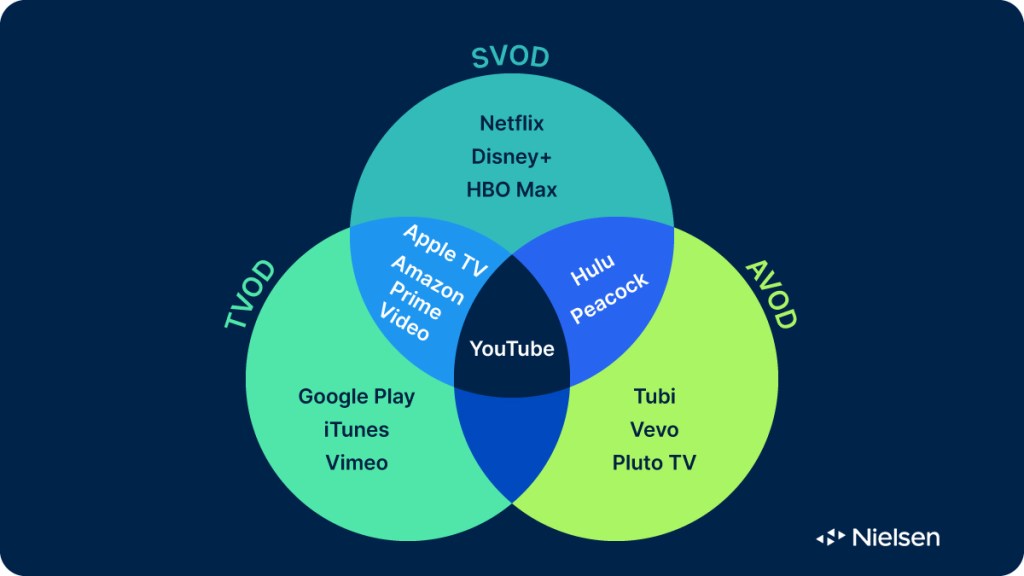
- Subscription Video On Demand (SVOD) — Audiences pay a monthly or yearly rate to access content, typically without ads. SVOD services include Netflix, Disney+ and HBO Max.
- Advertising-based Video On Demand (AVOD) — Audiences access AVOD content for free (or at a reduced rate) in exchange for watching ads. Many SVOD services now offer an AVOD tier. AVOD services include Tubi, VEVO, and PlutoTV.
- Transactional Video On Demand (TVOD) — Audiences access TVOD content on a pay-per-view basis. AVOD services include Google Play, iTunes and Vimeo.
Wait, there’s more! Streaming services are now making room for linear TV, too. Linear TV refers to scheduled programming that is accessed through a satellite or cable network. These services, in particular, are rising in popularity as viewers have to sift through more content and platform choices than ever.
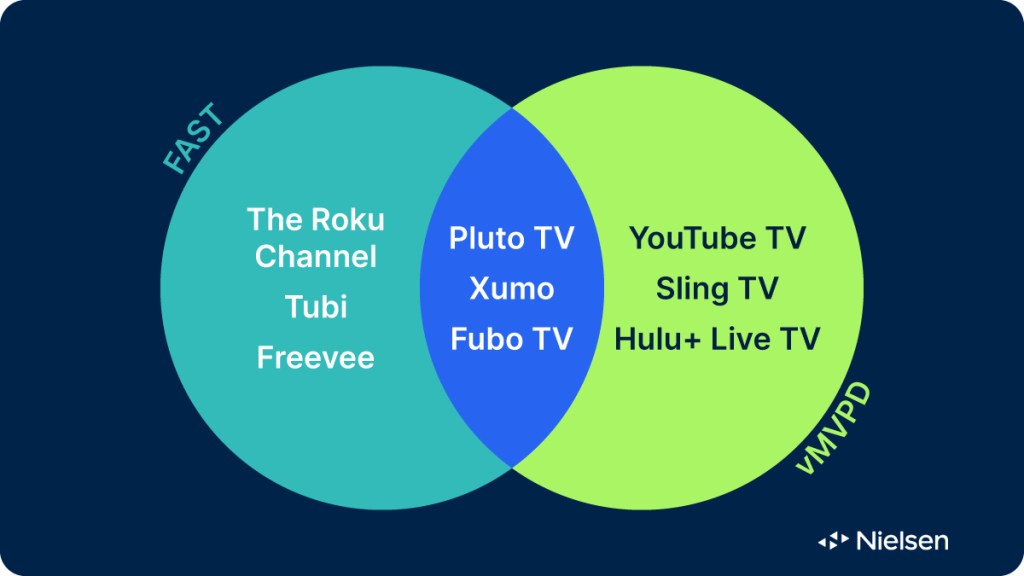
- Free Ad-supported Streaming Television (FAST) — An app, service or channel that streams scheduled programming—similar to a linear TV experience—through a connected device. FAST services include The Roku Channel, Tubi and Amazon Freevee.
- Virtual Multichannel Video Programming Distributors (vMVPD) — Services providers that bundle and deliver multiple channels to subscribers over the internet. vMVPD services include YouTube TV, Sling TV and Hulu + Live TV.
OTT 和 CTV 设备的广告体验有何不同?
Remember, when we talk about CTV, we’re always talking about the TV screen. OTT refers to CTV plus desktop, mobile and tablet streaming. So, naturally, that means CTV devices and all other OTT devices have both distinct and overlapping ad experiences.
流媒体广告的优势
- 精确: 流媒体广告可以利用移动、平板电脑和台式机设备上始终可用的详细用户数据,从而实现更先进的目标定位,减少浪费并更好地了解性能。
- 费用: 较小的屏幕和较低的参与度意味着 OTT 广告插播通常比其他电视购买(包括 CTV)便宜。
- 互动性: 用户只需点击或轻扫即可完成操作,观众可直接进入品牌网站或应用程序,在支持该功能的平台上创建一步到位的用户旅程
CTV 广告优势
- 订婚: 与其他 OTT 设备不同的是,大多数 CTV 广告是不可跳过的,而且广告片段通常比线性电视上的广告片段短,不太可能把观众赶出房间。
- 复原力: 单个用户的跟踪并不常见,这就迫使我们依赖于家庭数据和上下文线索。虽然这限制了目标定位能力,但也让 CTV 在没有 cookies 的世界里茁壮成长。
- 共同观看: 电视屏幕通常比其他 OTT 设备大得多。大屏幕,尤其是在家庭的公共场所,创造出的广告环境更有利于群体而不仅仅是个人观看。
两者的广告障碍
- 透明度: 无论是直接向流媒体提供商购买、程序化购买还是通过转售商购买,广告商往往无法选择或不知道他们的广告将围绕哪些内容。
- 支离破碎: 虽然在平台或计划层面进行购买能提供更多控制,但也会增加数据集和衡量方法。如果没有一套通用的衡量标准,营销人员就很难推断出整体绩效。
- 欺诈: 流媒体生态系统还没有统一的测量标准、用户或设备 ID,因此欺诈活动的时机已经成熟。
CTV 和更广泛的 OTT 渠道都有明显的优势,但营销人员很少需要选边站。它们的最佳合作方式是共同制定多渠道战略,为观众提供全面的流媒体体验。
是什么推动了流媒体的迅猛发展?
从 2000 年代初媒体领域的小众一角,发展成为美国电视收视的主流形式。1 And streaming’s trend line isn’t likely to dip down anytime soon for a few reasons:
- Younger viewers (18-34) spend considerably more time with streaming2 than any other TV source
- 亚马逊 Prime Video、Netflix 和 Peacock 等主要流媒体播放器都在投资体育和赛事直播节目,而这正是预约电视的最后堡垒。
- FAST streaming channels offer a familiar linear viewing experience without having to choose when or what to watch after picking a channel.
从 2000 年代初媒体领域的小众一角,发展成为美国电视收视的主流形式。
Growing CTV reach and usage is also supercharging the streaming boom. The reach of CTV devices in the U.S. has jumped to 75%, up from 58% at the start of 2020. Smart TVs, which often come pre-installed streaming apps, are nearing ubiquity3 in the U.S. And it’s not a U.S. only phenomenon. In Australia, 90%4 of the population 14 and older steam OTT content.
是什么阻碍了流媒体的发展?
虽然这些数字证明流媒体的前景依然一片光明,但地平线上可能会出现乌云。过去,消费者只需订购大约三种流媒体服务即可。但随着新玩家的加入和月租费的上涨,流媒体开始让人感觉像是更复杂、更昂贵的有线电视版本。
目前,大多数主要平台都提供了更便宜的广告支持层级,为观众提供了更多选择,也为广告商提供了更多机会,但定位、归因和统一测量却阻碍了 CTV 和 OTT 发挥最大潜力。在尼尔森,我们认为解决之道是进行个人层面的测量,以确定谁在观看、他们在看什么以及他们在现实世界中是如何行动的。
未来几年,流媒体营销人员要面对的另一件大事是不断变化的隐私法规。每一个新频道都有其狂野的西部实验时代,但随着 CTV 在广告支出中占据更多份额,围绕数据使用的审查也将随之而来。
We have thoughts on how to solve for that, too. Big data, validated by representative person-level panels, provides the most accurate view of an audience. It has the dual benefit of ensuring a privacy-safe solution for marketers across OTT and CTV channels.
电视的未来是什么?
现在,人们对电视的看法是二元对立的:线性和流媒体。但是,随着电视几乎完全数字化,这些曾经清晰的界限正在迅速模糊。我们对 OTT、CTV 甚至电视等术语的定义可能会发生变化。新的渠道会兴起,行为会转变。
营销人员希望了解受众所在的地方,并将他们带到那里,这一点不会改变。要做到这一点,营销行业需要可靠的测量方法和指标,这些方法和指标要能在受众发现自己的任何地方--今天和明天--发挥作用。
Nielsen’s Need to Know reviews the fundamentals of audience measurement and demystifies the media industry’s hottest topics. Read every article here.
说明
1As of November 2023, streaming (whether from digital-first or legacy TV companies) accounted for nearly 40% of total TV minutes according to Nielsen’s The Gauge.
260% of time spent with TV is on streaming for audiences 18-34 according to Nielsen’s 2024 Upfronts/NewFronts Planning Guide.
3As of 2023, Smart TV penetration is 70.6% among U.S. TV homes according to Nielsen’s National TV Panel
42023 S08 National Survey, September-October