There is no mistaking the impact of connectivity on how audiences are watching TV. In just the past five years, the number of households in the U.S. that get their TV content from an internet connection has increased by more than 210%1. The allure of an internet’s worth of content notwithstanding, a smaller, yet consistent, portion of TV homes continue to thrive on the over-the-air (OTA) broadcast programming they access for free using digital antennas—even when more than 70% of homes now have at least one smart TV2.
Nielsen’s 2024 Upfronts/NewFronts Guide revealed that, as of November 2023, more than 18% of U.S. TV households had at least one TV set enabled to receive free, broadcast programming. Given the many content options available to audiences, however, few homes rely solely on their digital antennas for TV content. Most complement their OTA access with content they can access from other sources. Sixty percent, for example, subscribe to a streaming video-on-demand service. The same is true of households that have cable or satellite services: In fact, nearly 4% have at least one OTA-enabled TV set.
While the way in which audiences access TV content continues to evolve, the concentration of OTA homes has remained consistent over the past five years. OTA homes represented 14.5% of U.S. TV households3 in third-quarter 2023.
包括虚拟多频道视频节目发行商(vMVPDs,如 Hulu Live、YouTube TV、Sling TV)在内的 OTA 节目访问的一致性,凸显了电视观众对传统线性节目的持续参与。事实上,在 2022 年 10 月至 2023 年 10 月期间,约有 92% 的电视家庭(无论分类如何)观看了某种形式的线性节目。
约 92% 的电视家庭观看某种形式的线性节目
In addition to highlighting the consistent appeal of traditional broadcast programming, the steadfast portion of homes that access this content with digital antennas is a critical audience measurement consideration, especially as big data gains momentum as a measurement source amid rising connected TV (CTV)4 usage.
With CTV usage accounting for just over 32% of TV usage among adults 18 and older5, it makes sense that companies are looking to leverage the data from smart TVs and set-top-boxes from multichannel video programming distributors (MVPDs; e.g., DirecTV, Cox, Comcast Xfinity, DISH). We know that these data sources can advance the science of audience measurement, but they don’t capture OTA viewing.
大数据可推动受众测量科学的发展,但无法捕捉到 OTA 收视情况
根据尼尔森公司对 2023-24 年电视市场的估计,美国有 1.25 亿个电视家庭,比上一年增长了 1%。这意味着不到 97% 的美国家庭至少拥有一台用于收看节目的电视。这些家庭拥有近 3.153 亿人口。
近 2300 万户美国家庭使用数字天线收看免费电视节目
在电视家庭中,有 1812.5 万户是 OTA 家庭,另有 462.5 万户是有线电视和卫星电视家庭,这些家庭也拥有支持 OTA 的电视机。总计有 2275 万户家庭通过 OTA 天线访问电视内容--这种设备不在大数据收集范围之内。
对线性规划的持续和大量参与值得注意,原因有二:
- 绝大多数电视家庭仍在收看传统的广告支持节目。
- 仅靠大数据源无法深入了解数百万使用数字天线收看电视的观众的收视行为。
在全国平均水平之外,OTA 的使用在部分城市发挥着更大的作用。例如,在休斯顿,超过 27% 的电视家庭至少有一台电视机可以接收免费的广播节目,近 24% 的家庭将天线作为收看电视的主要方式。在部分指定市场区域(DMA),使用 OTA 的比例甚至超过了 30%,其中俄克拉荷马市名列榜首:该市场 37.3% 的电视家庭至少拥有一台支持 OTA 的电视机。
Combined with person-level demographic information from Nielsen’s National TV panel, OTA audience data provides advertisers and agencies with insight that’s out of reach of big data. Nearly 60% of OTA households that don’t subscribe to a subscription video on demand (SVOD) service, for example, are households of one person, while 45% of OTA households that subscribe to an SVOD service but don’t use a vMVPD are home to three or more people. From an income perspective, however, OTA households that subscribe to an SVOD service and use a vMVPD are the biggest earners.
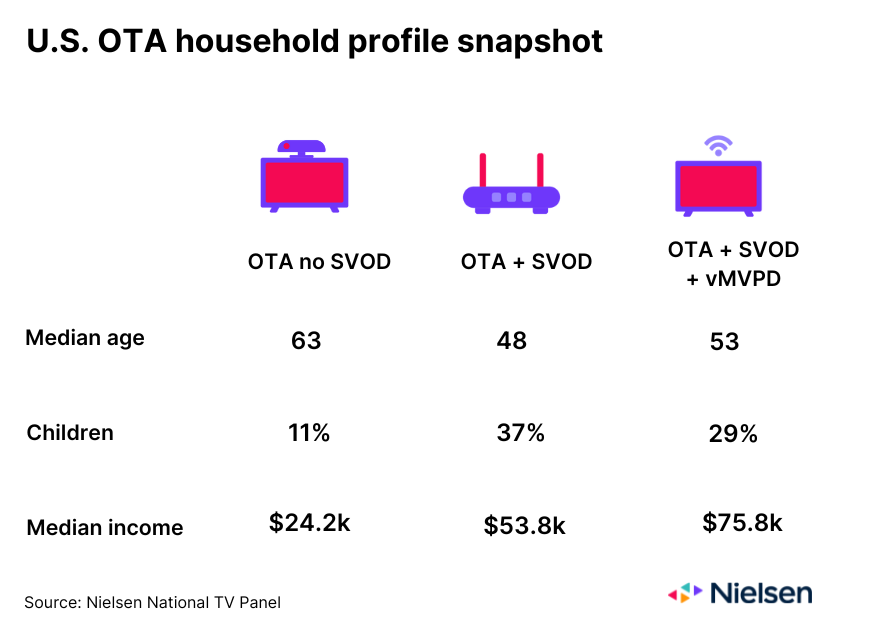
观众之间日益增强的连接性在观众如何获取电视内容方面继续发挥着重要作用,但免费的 OTA 广播节目仍然是近 20% 美国电视家庭的主要节目。从价值角度来看,广告商和广告代理公司需要深入了解近 2300 万观众对这些节目的偏好--这些节目不在大数据捕捉的范围之内。随着观众测量的发展,包括来自智能电视和有线电视盒的数据,人而不是大数据仍将是等式的中心,这一点至关重要。
Learn more about the power of big data and panel measurement here.
资料来源
1Nielsen National TV Panel; September 2019 vs. September 2023. This percentage reflects the increase in homes that stream TV content from the internet and/or access TV content through a vMVPD.
2尼尔森全国电视小组;2023 年 10 月
3This percentage includes homes that may have an vMVPD. Nielsen plans to reclassify homes with a vMVPD as Cable Plus homes in 2024.
4CTV refers to any television that accesses content from the internet. The most common use case is to stream video content.
5Nielsen National TV Panel; Q2 2023