There is no mistaking the impact of connectivity on how audiences are watching TV. In just the past five years, the number of households in the U.S. that get their TV content from an internet connection has increased by more than 210%1. The allure of an internet’s worth of content notwithstanding, a smaller, yet consistent, portion of TV homes continue to thrive on the over-the-air (OTA) broadcast programming they access for free using digital antennas—even when more than 70% of homes now have at least one smart TV2.
Nielsen’s 2024 Upfronts/NewFronts Guide revealed that, as of November 2023, more than 18% of U.S. TV households had at least one TV set enabled to receive free, broadcast programming. Given the many content options available to audiences, however, few homes rely solely on their digital antennas for TV content. Most complement their OTA access with content they can access from other sources. Sixty percent, for example, subscribe to a streaming video-on-demand service. The same is true of households that have cable or satellite services: In fact, nearly 4% have at least one OTA-enabled TV set.
While the way in which audiences access TV content continues to evolve, the concentration of OTA homes has remained consistent over the past five years. OTA homes represented 14.5% of U.S. TV households3 in third-quarter 2023.
仮想多チャンネル動画番組配信事業者(vMVPDs; Hulu Live、YouTube TV、Sling TVなど)の利用も含めたOTA番組へのアクセスの一貫性は、テレビ視聴者が伝統的なリニア番組に継続的に関与していることを浮き彫りにしている。実際、2022年10月から2023年10月までの間に、テレビ世帯の約92%は、分類に関係なく、何らかの形でリニア番組を視聴している。
約92%の家庭が何らかのリニア番組を視聴
In addition to highlighting the consistent appeal of traditional broadcast programming, the steadfast portion of homes that access this content with digital antennas is a critical audience measurement consideration, especially as big data gains momentum as a measurement source amid rising connected TV (CTV)4 usage.
With CTV usage accounting for just over 32% of TV usage among adults 18 and older5, it makes sense that companies are looking to leverage the data from smart TVs and set-top-boxes from multichannel video programming distributors (MVPDs; e.g., DirecTV, Cox, Comcast Xfinity, DISH). We know that these data sources can advance the science of audience measurement, but they don’t capture OTA viewing.
ビッグデータは視聴者測定の科学を進歩させるが、OTA視聴を捉えることはできない
ニールセンの2023-24年のTVユニバース予測によると、米国のTV世帯数は前年比1%増の1億2500万。これは、米国の97%弱の世帯が、少なくとも1台のテレビで番組を視聴していることを意味する。これらの世帯には約3億1530万人が住んでいる。
米国の約2300万世帯がデジタルアンテナを使って無料テレビ番組にアクセス
テレビ世帯のうち、1,812万世帯がOTA世帯であり、さらに462万5,000世帯がOTA対応テレビを持つケーブルテレビおよび衛星テレビ世帯である。合計すると、2275万世帯がOTAアンテナを通じてテレビコンテンツにアクセスしていることになる。
リニア・プログラミングが一貫して重要な役割を果たしているのは、2つの理由がある:
- テレビを見る家庭の大多数は、従来の広告付き番組を見続けている。
- ビッグデータ・ソースだけでは、デジタル・アンテナを使ってテレビを見ている何百万人もの視聴者の視聴行動をインサイト 。
全国平均から外れると、一部の都市ではOTAの利用がより大きな役割を果たしている。たとえばヒューストンでは、27%以上の家庭で少なくとも1台のテレビが無料の放送番組を受信できるようになっており、24%近くがテレビを見る主な手段としてアンテナを使っている。オクラホマシティを筆頭に、一部の指定市場地域(DMA)ではOTA利用の割合が30%を超えている:この市場では、37.3%の家庭が少なくとも1台のOTA対応テレビを持っている。
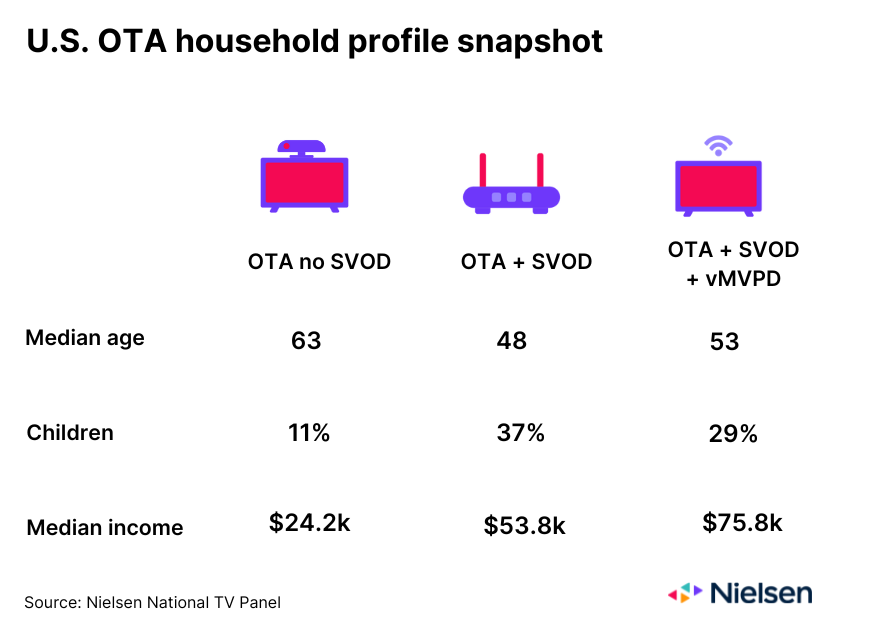
Combined with person-level demographic information from Nielsen’s National TV panel, OTA audience data provides advertisers and agencies with insight that’s out of reach of big data. Nearly 60% of OTA households that don’t subscribe to a subscription video on demand (SVOD) service, for example, are households of one person, while 45% of OTA households that subscribe to an SVOD service but don’t use a vMVPD are home to three or more people. From an income perspective, however, OTA households that subscribe to an SVOD service and use a vMVPD are the biggest earners.
視聴者間のコネクティビティの向上は、視聴者がテレビコンテンツにアクセスする方法において重要な役割を果たし続けているが、無料のOTA放送番組は、米国のテレビ世帯の20%近くにとって依然として定番である。価値観の観点から、広告主や代理店は、インサイト 、この番組-ビッグデータが捉える領域外の番組-に傾倒する約2,300万人の視聴者を把握する必要がある。視聴者測定がスマートTVやケーブルボックスからのデータを含むように進化するにつれ、ビッグデータではなく人々が方程式の中心であり続けることが重要になる。
Learn more about the power of big data and panel measurement here.
情報源
1Nielsen National TV Panel; September 2019 vs. September 2023. This percentage reflects the increase in homes that stream TV content from the internet and/or access TV content through a vMVPD.
2ニールセン全国TVパネル;2023年10月
3This percentage includes homes that may have an vMVPD. Nielsen plans to reclassify homes with a vMVPD as Cable Plus homes in 2024.
4CTV refers to any television that accesses content from the internet. The most common use case is to stream video content.
5Nielsen National TV Panel; Q2 2023