There is no mistaking the impact of connectivity on how audiences are watching TV. In just the past five years, the number of households in the U.S. that get their TV content from an internet connection has increased by more than 210%1. The allure of an internet’s worth of content notwithstanding, a smaller, yet consistent, portion of TV homes continue to thrive on the over-the-air (OTA) broadcast programming they access for free using digital antennas—even when more than 70% of homes now have at least one smart TV2.
Nielsen’s 2024 Upfronts/NewFronts Guide revealed that, as of November 2023, more than 18% of U.S. TV households had at least one TV set enabled to receive free, broadcast programming. Given the many content options available to audiences, however, few homes rely solely on their digital antennas for TV content. Most complement their OTA access with content they can access from other sources. Sixty percent, for example, subscribe to a streaming video-on-demand service. The same is true of households that have cable or satellite services: In fact, nearly 4% have at least one OTA-enabled TV set.
While the way in which audiences access TV content continues to evolve, the concentration of OTA homes has remained consistent over the past five years. OTA homes represented 14.5% of U.S. TV households3 in third-quarter 2023.
Spójność dostępu do programów OTA, w tym wirtualnych wielokanałowych dystrybutorów programów wideo (vMVPD; np. Hulu Live, YouTube TV, Sling TV), podkreśla ciągłe zaangażowanie widzów telewizyjnych w tradycyjne, linearne programy. W rzeczywistości około 92% telewizyjnych gospodarstw domowych, niezależnie od klasyfikacji, oglądało jakąś formę programowania linearnego w okresie od października 2022 r. do października 2023 r.
Około 92% domów telewizyjnych ogląda jakąś formę programów linearnych.
In addition to highlighting the consistent appeal of traditional broadcast programming, the steadfast portion of homes that access this content with digital antennas is a critical audience measurement consideration, especially as big data gains momentum as a measurement source amid rising connected TV (CTV)4 usage.
With CTV usage accounting for just over 32% of TV usage among adults 18 and older5, it makes sense that companies are looking to leverage the data from smart TVs and set-top-boxes from multichannel video programming distributors (MVPDs; e.g., DirecTV, Cox, Comcast Xfinity, DISH). We know that these data sources can advance the science of audience measurement, but they don’t capture OTA viewing.
Duże zbiory danych mogą przyczynić się do rozwoju nauki o pomiarach oglądalności, ale nie wychwytują oglądalności OTA
Według szacunków Nielsena dotyczących uniwersum telewizyjnego na lata 2023-24, Stany Zjednoczone mają 125 milionów gospodarstw domowych z telewizorami, co stanowi wzrost o 1% w porównaniu z rokiem poprzednim. Oznacza to, że prawie 97% amerykańskich gospodarstw domowych ma co najmniej jeden telewizor używany do oglądania programów. Gospodarstwa te zamieszkuje prawie 315,3 miliona osób.
Prawie 23 miliony amerykańskich domów ma dostęp do bezpłatnych programów telewizyjnych za pomocą anten cyfrowych.
Wśród gospodarstw domowych korzystających z telewizji 18,125 miliona to gospodarstwa domowe korzystające z OTA, a dodatkowe 4,625 miliona to gospodarstwa korzystające z telewizji kablowej i satelitarnej, które również posiadają odbiorniki telewizyjne obsługujące OTA. W sumie 22,750 mln gospodarstw domowych uzyskuje dostęp do treści telewizyjnych za pośrednictwem anteny OTA - urządzenia, które nie wchodzi w zakres gromadzenia dużych zbiorów danych.
Konsekwentne i znaczące zaangażowanie w programowanie liniowe jest godne uwagi z dwóch powodów:
- Zdecydowana większość domów telewizyjnych nadal ogląda tradycyjne programy z reklamami.
- Same duże źródła danych nie są w stanie zapewnić wglądu w zachowania milionów widzów, którzy oglądają telewizję za pomocą anteny cyfrowej.
Poza średnią krajową, korzystanie z OTA odgrywa znacznie większą rolę w wybranych miastach. Na przykład w Houston ponad 27% domów telewizyjnych ma co najmniej jeden odbiornik telewizyjny umożliwiający odbiór bezpłatnych, nadawanych programów, a prawie 24% używa anten jako głównego sposobu oglądania telewizji. Odsetek korzystania z OTA przekracza nawet 30% w wybranych wyznaczonych obszarach rynkowych (DMA), z Oklahoma City na czele listy: 37,3% domów telewizyjnych na tym rynku ma co najmniej jeden telewizor z obsługą OTA.
Combined with person-level demographic information from Nielsen’s National TV panel, OTA audience data provides advertisers and agencies with insight that’s out of reach of big data. Nearly 60% of OTA households that don’t subscribe to a subscription video on demand (SVOD) service, for example, are households of one person, while 45% of OTA households that subscribe to an SVOD service but don’t use a vMVPD are home to three or more people. From an income perspective, however, OTA households that subscribe to an SVOD service and use a vMVPD are the biggest earners.
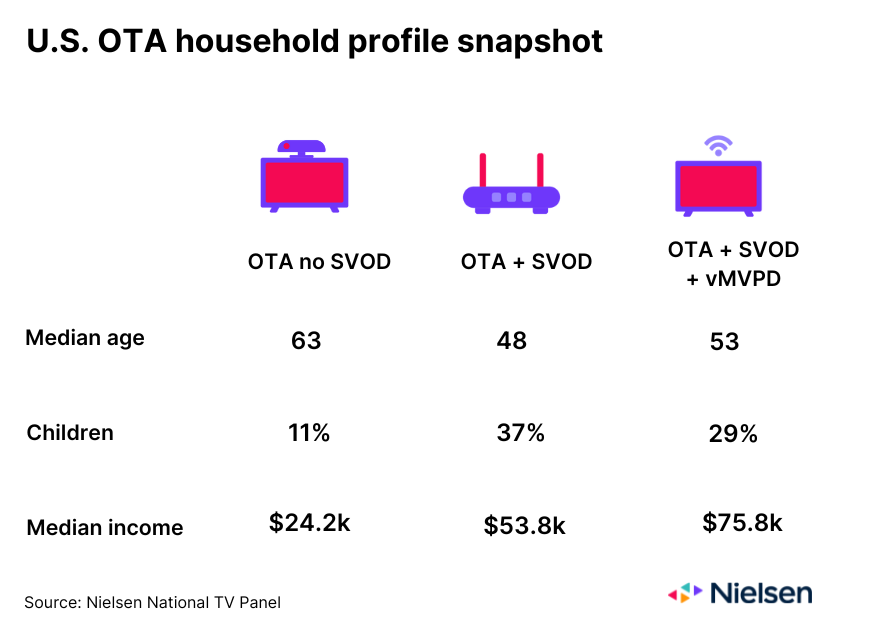
Rosnąca łączność wśród odbiorców nadal odgrywa znaczącą rolę w sposobie, w jaki widzowie uzyskują dostęp do treści telewizyjnych, ale bezpłatne programy OTA pozostają podstawą dla prawie 20% gospodarstw domowych w USA. Z punktu widzenia wartości, reklamodawcy i agencje potrzebują wglądu w prawie 23 miliony widzów, którzy skłaniają się ku temu programowaniu - programowaniu, które wykracza poza zakres tego, co rejestrują duże zbiory danych. W miarę jak pomiary oglądalności ewoluują w celu uwzględnienia danych z inteligentnych telewizorów i dekoderów telewizji kablowej, niezwykle ważne będzie, aby ludzie, a nie duże zbiory danych, pozostali w centrum równania.
Learn more about the power of big data and panel measurement here.
Źródła
1Nielsen National TV Panel; September 2019 vs. September 2023. This percentage reflects the increase in homes that stream TV content from the internet and/or access TV content through a vMVPD.
2Krajowy panel telewizyjny Nielsen; październik 2023 r.
3This percentage includes homes that may have an vMVPD. Nielsen plans to reclassify homes with a vMVPD as Cable Plus homes in 2024.
4CTV refers to any television that accesses content from the internet. The most common use case is to stream video content.
5Nielsen National TV Panel; Q2 2023