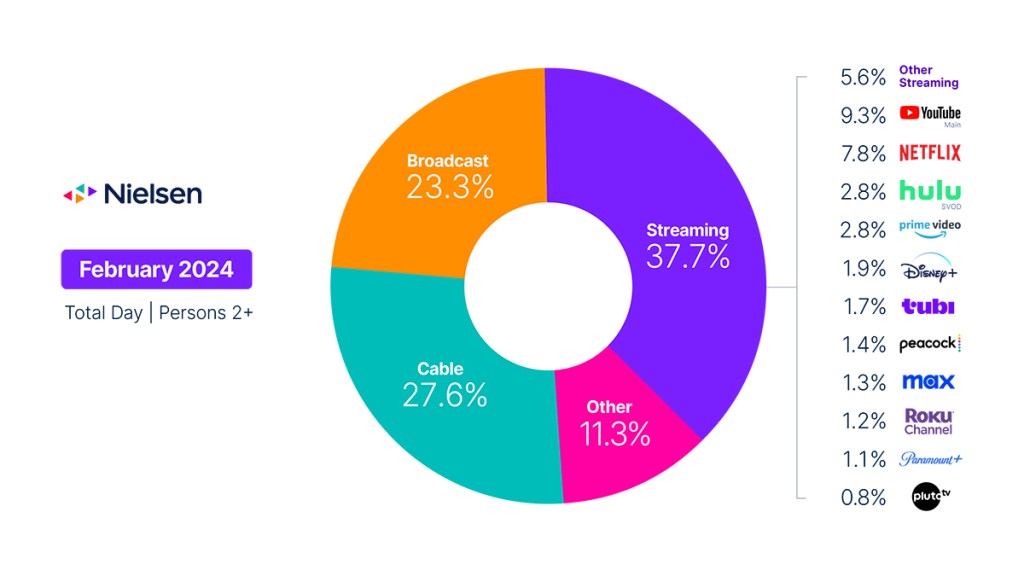
O uso total da TV caiu em fevereiro; o uso de streaming subiu para 37,7% da TV
In seasonal fashion, TV usage declined in February following the end of the NFL playoffs. While Super Bowl LVIII was a standout that attracted 123.7 million viewers, the 6.4% dip in viewership for the month was considerably larger than it was in the previous two years (5.7% and 5.1%, respectively). This fact, however, is more of a testament to how strong viewing was in January 2024 than in the previous two years.
In addition to attracting the largest TV audience on record, the Super Bowl played a big role in making Feb. 11, 2024, the day with the most TV viewing since The Gauge was launched in May 2021. In total, the game delivered 30 billion viewing minutes—5 billion more than last year’s game. Going into overtime, however, did contribute here.
Outside of the action around the Super Bowl, broadcast viewing receded following its climb into January, with viewing down 10% overall. The sports genre was a major factor in its decline, as sports viewing dropped 66% in the wake of the NFL playoffs. On a year-over-year basis, the overall drop in broadcast viewing is in line with last year’s 9.2% decline. With some new content in rotation, however, the drama category gained momentum to command 26% of broadcast viewing in February. With all eyes on the Super Bowl in February, CBS used the big game to get audiences excited for its new season, featuring Tracker, NCIS, FBI and the final season of Young Sheldon.
Em toda a TV a cabo, a exibição de notícias aumentou 7% à medida que o público se sintonizava na cobertura do ano eleitoral, enquanto a exibição de esportes caiu cerca de um terço. Mesmo sem tantos eventos esportivos, o gênero esportivo ainda apresentou os principais programas para a TV a cabo, com a transmissão simultânea do NBA All-Star Game 2024 na TNT, TBS e TruTV ocupando o primeiro lugar, seguido pelo NBA All-Star Saturday Night na TNT e TruTV.
Normalmente, a visualização de TV começa a diminuir à medida que a primavera se aproxima. Essa sazonalidade afeta toda a exibição de TV, mas teve menos impacto sobre o streaming em fevereiro do que nas outras categorias. Como resultado, o uso de streaming caiu 1,9%, mas a categoria conseguiu ganhar 1,7 ponto de participação, representando 37,7% do uso de TV, sua maior participação no total de TV desde agosto de 2023. Também está 3,4 pontos de participação acima de fevereiro de 2023.
As we’re not yet seeing a consistent release of new titles, acquired titles continued to attract the most viewership, with Young Sheldon (Netflix, Max) topping the rankings with 4.6 billion viewing minutes, followed by Azulado (Disney+) with 4.5 billion and Anatomia de Grey (Netflix) with 3.5 billion. Netflix’s Griselda added some new content to the rankings, coming in fourth with 3.2 billion.
As it does for the broadcast and cable categories, sports has started to make a mark in the streaming category when high-profile events are shown. After gaining in January as a result of its exclusive NFL Wildcard game, Peacock usage dropped 19%, while Paramount+ gained 24% in February as a result of its simultaneous carriage of the Super Bowl alongside CBS. Both platforms have also benefited from the appeal of new original programming, namely Ted e the Traitors on Peacock (1.3 billion minutes combined) and Halo on Paramount+, accounting for 1.2 billion viewing minutes.
Fevereiro também foi um grande mês para os serviços FAST, pois a Pluto TV, a Tubi e o Roku Channel registraram ganhos de 10%, 8,3% e 8,1%, respectivamente. O YouTube também registrou a melhor participação da plataforma em fevereiro, capturando 9,3% do uso total da TV.
Tendências de dados de fevereiro com Brian Fuhrer
Metodologia e perguntas frequentes
Como o "The Gauge" é criado?
The data for The Gauge is derived from two separately weighted panels and combined to create the graphic. Nielsen’s streaming data is derived from a subset of Streaming Meter-enabled TV households within the National TV panel. The linear TV sources (broadcast and cable), as well as total usage are based on viewing from Nielsen’s overall TV panel.
Todos os dados são baseados no período de tempo para cada fonte de visualização. Os dados, que representam um mês de transmissão, baseiam-se na visualização Live+7 para o intervalo do relatório (Observação: Live+7 inclui visualização de televisão ao vivo e visualização até sete dias depois para conteúdo linear).
What is included in “other”?
Within The Gauge, “other” includes all other TV usage that does not fall into the broadcast, cable or streaming categories. This primarily includes all other tuning (unmeasured sources), unmeasured video on demand (VOD), audio streaming, gaming and other device (DVD playback) use.
Beginning with the May 2023 interval, Nielsen began utilizing Classificações de conteúdo de streaming to identify original content distributed by platforms reported in that service to reclassify content viewed via cable set top boxes. This viewing will credit to streaming and to the streaming platform which distributed it. It will also be removed from the other category, where it was previously reflected. Content not identified as original within Streaming Content Ratings and viewed through a cable set top box will still be included in other.
O que está incluído em "outro streaming"?
As plataformas de streaming listadas como "outros tipos de streaming" incluem qualquer streaming de vídeo de alta largura de banda na televisão que não esteja separado individualmente. Os aplicativos projetados para fornecer transmissão ao vivo e programação a cabo (linear) (aplicativos vMVPD ou MVPD, como Sling TV ou Charter/Spectrum) estão excluídos de "outro streaming".
Qual é a contribuição do streaming linear?
Linear streaming (as defined by the aggregation of viewing to vMVPD/MVPD apps) is excluded from the streaming category as the broadcast and cable content viewed through these apps credits to its respective category. This methodological change was implemented with the February 2023 interval.
E quanto à transmissão ao vivo no Hulu e no YouTube?
O streaming linear por meio de aplicativos vMVPD (por exemplo, Hulu Live, YouTube TV) é excluído da categoria de streaming. "Hulu SVOD" e "YouTube Main" na categoria de streaming referem-se ao uso das plataformas sem a inclusão de streaming linear.