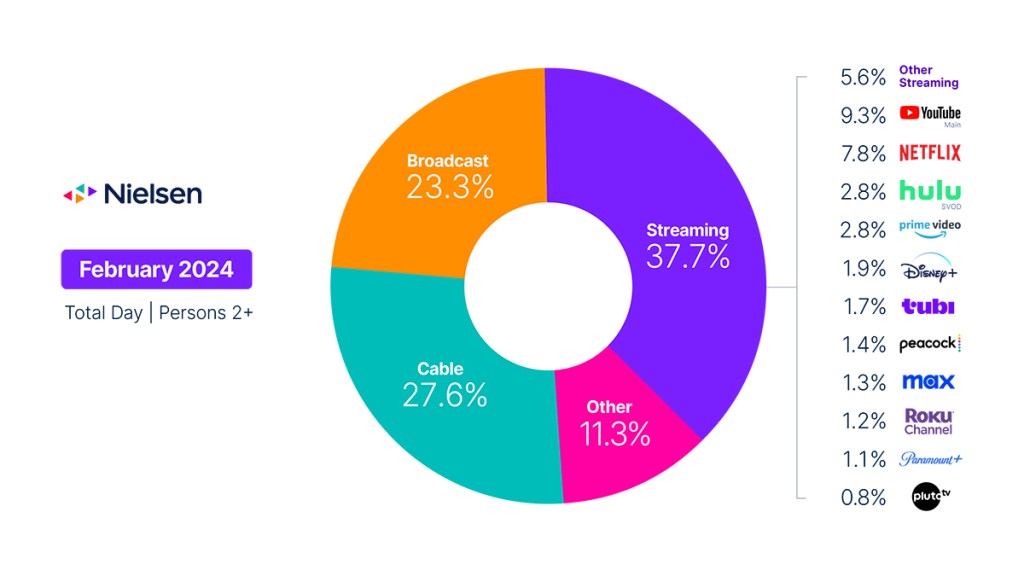
Całkowite wykorzystanie telewizji spadło w lutym; wykorzystanie streamingu wzrosło do 37,7% telewizji
In seasonal fashion, TV usage declined in February following the end of the NFL playoffs. While Super Bowl LVIII was a standout that attracted 123.7 million viewers, the 6.4% dip in viewership for the month was considerably larger than it was in the previous two years (5.7% and 5.1%, respectively). This fact, however, is more of a testament to how strong viewing was in January 2024 than in the previous two years.
In addition to attracting the largest TV audience on record, the Super Bowl played a big role in making Feb. 11, 2024, the day with the most TV viewing since The Gauge was launched in May 2021. In total, the game delivered 30 billion viewing minutes—5 billion more than last year’s game. Going into overtime, however, did contribute here.
Outside of the action around the Super Bowl, broadcast viewing receded following its climb into January, with viewing down 10% overall. The sports genre was a major factor in its decline, as sports viewing dropped 66% in the wake of the NFL playoffs. On a year-over-year basis, the overall drop in broadcast viewing is in line with last year’s 9.2% decline. With some new content in rotation, however, the drama category gained momentum to command 26% of broadcast viewing in February. With all eyes on the Super Bowl in February, CBS used the big game to get audiences excited for its new season, featuring Tracker, NCIS, FBI and the final season of Young Sheldon.
W całej telewizji kablowej oglądalność wiadomości wzrosła o 7%, ponieważ widzowie dostroili się do relacji z roku wyborczego, podczas gdy oglądalność sportu spadła o około jedną trzecią. Nawet bez tak wielu wydarzeń sportowych, gatunek sportowy nadal dostarczał najlepsze programy dla telewizji kablowej, z symulacją NBA All-Star Game 2024 na TNT, TBS i TruTV na pierwszym miejscu, a następnie NBA All-Star Saturday Night na TNT i TruTV.
Oglądalność telewizji zazwyczaj zaczyna spadać wraz ze zbliżaniem się sezonu wiosennego. Ta sezonowość wpływa na oglądanie telewizji, ale miała mniejszy wpływ na streaming w lutym niż na inne kategorie. W rezultacie wykorzystanie streamingu spadło o 1,9%, ale kategoria była w stanie zyskać 1,7 punktu procentowego i stanowić 37,7% wykorzystania telewizji, co stanowi jej największy udział w telewizji ogółem od sierpnia 2023 roku. Jest to również o 3,4 punktu procentowego więcej niż w lutym 2023 roku.
As we’re not yet seeing a consistent release of new titles, acquired titles continued to attract the most viewership, with Young Sheldon (Netflix, Max) topping the rankings with 4.6 billion viewing minutes, followed by Bluey (Disney+) with 4.5 billion and Chirurdzy (Netflix) with 3.5 billion. Netflix’s Griselda added some new content to the rankings, coming in fourth with 3.2 billion.
As it does for the broadcast and cable categories, sports has started to make a mark in the streaming category when high-profile events are shown. After gaining in January as a result of its exclusive NFL Wildcard game, Peacock usage dropped 19%, while Paramount+ gained 24% in February as a result of its simultaneous carriage of the Super Bowl alongside CBS. Both platforms have also benefited from the appeal of new original programming, namely Ted oraz the Traitors on Peacock (1.3 billion minutes combined) and Halo on Paramount+, accounting for 1.2 billion viewing minutes.
Luty był również ważnym miesiącem dla usług FAST, ponieważ Pluto TV, Tubi i Roku Channel odnotowały wzrosty odpowiednio o 10%, 8,3% i 8,1%. YouTube odnotował również najlepszy udział w platformie w lutym, zdobywając 9,3% całkowitego wykorzystania telewizji.
Lutowe trendy w danych z Brianem Fuhrerem
Methodology and frequently asked questions
Jak powstaje "The Gauge"?
The data for The Gauge is derived from two separately weighted panels and combined to create the graphic. Nielsen’s streaming data is derived from a subset of Streaming Meter-enabled TV households within the National TV panel. The linear TV sources (broadcast and cable), as well as total usage are based on viewing from Nielsen’s overall TV panel.
Wszystkie dane są oparte na okresie czasu dla każdego źródła oglądania. Dane reprezentujące miesiąc nadawania oparte są na oglądalności Live+7 w raportowanym przedziale czasowym (Uwaga: Live+7 obejmuje oglądanie telewizji na żywo oraz oglądanie do siedmiu dni później w przypadku treści linearnych).
Co obejmuje pozycja "inne"?
Within Wskaźnik, “other” includes all other TV usage that does not fall into the broadcast, cable or streaming categories. This primarily includes all other tuning (unmeasured sources), unmeasured video on demand (VOD), audio streaming, gaming and other device (DVD playback) use.
Beginning with the May 2023 interval, Nielsen began utilizing Oceny treści przesyłanych strumieniowo to identify original content distributed by platforms reported in that service to reclassify content viewed via cable set top boxes. This viewing will credit to streaming and to the streaming platform which distributed it. It will also be removed from the other category, where it was previously reflected. Content not identified as original within Streaming Content Ratings and viewed through a cable set top box will still be included in other.
Co wchodzi w skład "innych transmisji strumieniowych"?
Platformy streamingowe wymienione jako "inne transmisje strumieniowe" obejmują wszelkie transmisje strumieniowe wideo o wysokiej przepustowości w telewizji, które nie są indywidualnie podzielone. Aplikacje zaprojektowane do dostarczania transmisji na żywo i programów kablowych (liniowych) (aplikacje vMVPD lub MVPD, takie jak Sling TV lub Charter/Spectrum) są wyłączone z "innych transmisji strumieniowych".
Co wnosi streaming liniowy?
Linear streaming (as defined by the aggregation of viewing to vMVPD/MVPD apps) is excluded from the streaming category as the broadcast and cable content viewed through these apps credits to its respective category. This methodological change was implemented with the February 2023 interval.
A co z transmisjami na żywo w Hulu i YouTube?
Liniowe transmisje strumieniowe za pośrednictwem aplikacji vMVPD (np. Hulu Live, YouTube TV) są wyłączone z kategorii transmisji strumieniowych. "Hulu SVOD" i "YouTube Main" w kategorii streamingu odnoszą się do wykorzystania platform bez uwzględnienia linearnego streamingu.