Also known as the “Big Game” in the U.S., the Super Bowl is typically one of the most viewed TV moments. In fact, in 2024 Super Bowl LVIII, featuring the Kansas City Chiefs and the San Francisco 49ers, had the largest TV audience for a single-network telecast. It’s also a sports event that audiences will frequently watch together. But it’s not the only programming audiences gather for. Our research shows that Americans watch TV with other people (friends, family, even strangers at the bar) 47% of the time, on average, and alone the rest of the time.
コ・ビューイング(Co-viewing)とは、少なくとも1人の他人と一緒にテレビを見ることで、テレビ体験の不可欠な部分であり、理解するのは簡単な概念ですが、測定するのは簡単ではありません。そのため、メディアプランナーの中には、デバイスの指標を個々の視聴者数に変換するための近道として、いまだに平坦な共同視聴係数を使用している人もいます。共同視聴率とは?例を挙げましょう:午後2時にはテレビ画面1つあたり1.2人の視聴者を、午後8時には1.5人の視聴者を期待する必要があります。急速に変化し、非常に細分化された今日のテレビ市場では、もはやそれだけでは十分ではありません。
平板な共同視聴要素がいかに不十分かを説明するために、ここ数年のスポーツ番組中の共同視聴活動を見てみよう。
スポーツ番組の共同視聴は時代によって大きく異なる
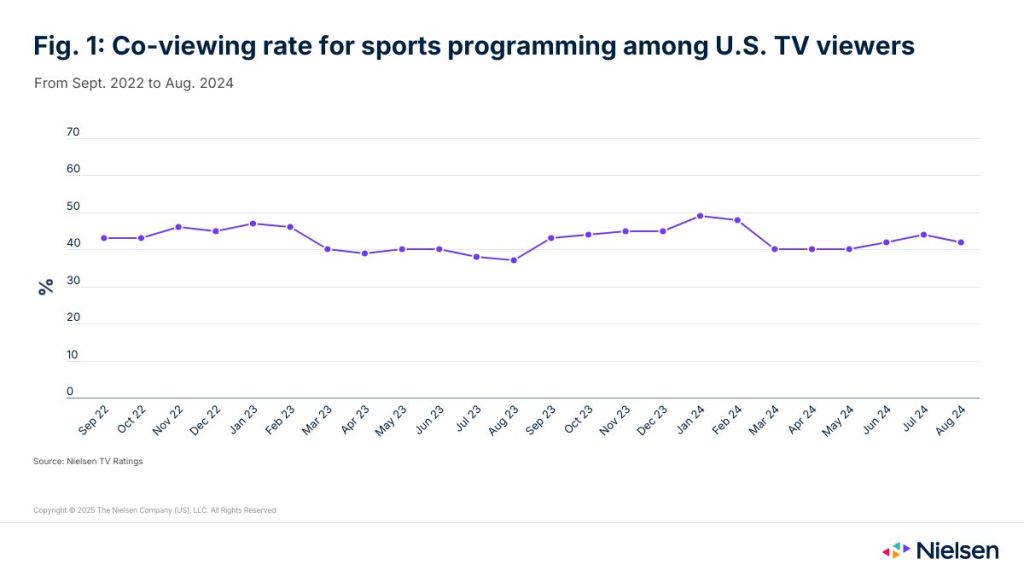
Figure 1 shows the co-viewing rate (the percentage of total viewing time spent co-viewing rather than viewing alone) for all TV viewers in the U.S. from September 2022 to August 2024, across all sports programming and regardless of platform (broadcast, cable and streaming). The month-to-month variations are substantial, dipping as low as 37% in August 2023 and reaching close to 50% in January and February of 2024.
The peaks correspond to tentpole sporting events, like the Super Bowl or Copa América, but marquee events taking place outside of the U.S. led to comparatively poor co-viewing rates. That doesn’t mean that the 2022 FIFA World Cup in Qatar and the 2023 Women’s World Cup in Australia and New Zealand had poor ratings in the U.S.—quite the opposite, in fact—but it’s more difficult to gather family and friends to watch the matches when they’re broadcast in the middle of the night or in the early morning. As for March Madness, it seemed to attract more alone viewing than average, even though we can see a small bump in co-viewing associated with the record-breaking 2024 tournaments.
人口統計による主な共同視聴格差
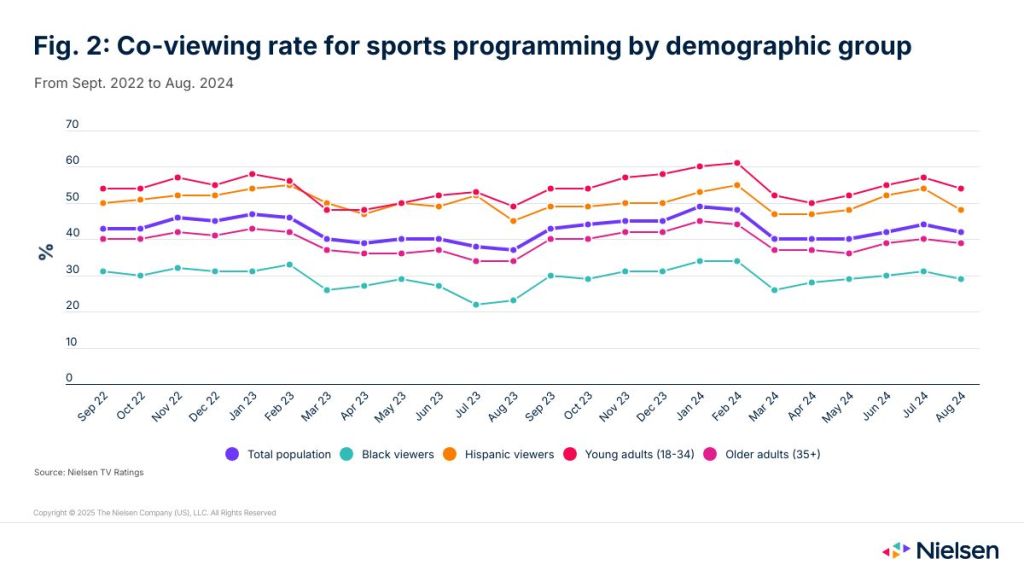
共視聴率は人口統計グループによっても大きく異なる。同じ2年間で、図2はヒスパニック系視聴者と黒人視聴者の間でスポーツ番組の共同視聴率に20ポイントの開きがあること、若年層と高齢層の間で10ポイントから15ポイントの開きがあることを示している。
Household size is a factor (Hispanic viewers live in larger households), but there are cultural factors at play as well. For instance, young adults might be more willing to go out and watch sports broadcasts with groups of friends. They’re watching considerably less TV than their older counterparts, especially linear TV, but the little they’re watching, they’re doing as a group.
スポーツは他の番組ジャンルと比べてどうですか?
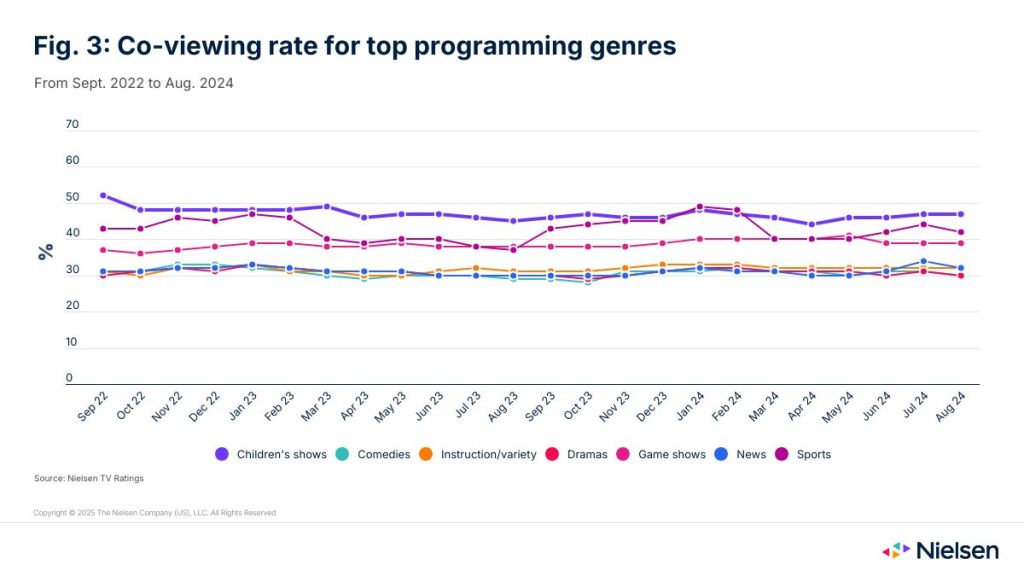
図3では、少し視野を広げて、スポーツ番組での共同視聴と、ドラマ、ニュース、バラエティなど他のトップ番組ジャンルでの共同視聴を比較している。
We can see that over that same two-year time period, children’s shows consistently produced more co-viewing than sports—not surprising considering that kids, especially young kids, often have a parent around when they’re watching TV—and showed more stability over time as well. Game shows performed really well too, a good reminder of the effect that streaming has had in recent years in broadening the genre’s appeal beyond its traditional (read: older) linear TV audience. And the rest of the top programming genres stayed within a narrow co-viewing band just above the 30% mark.
広告主とメディア・オーナーへの主な影響
以上の洞察からどのような結論を導き出すべきか?
- First and foremost, there’s no such thing as a flat co-viewing factor. That’s clearly evident when we look at sports, but there are subtle variations for other genres as well (and more so if we start to drill down at the program level).
- If you’re an advertiser planning to target a specific demographic group or a more advanced audience, you should throw your co-viewing assumptions out the window and get your hands on co-viewing insights based on actual real-life behavior for that target group.
- If you’re a media owner, understanding whether people are watching alone or with other people can help you finetune your own shows and improve how you monetize your audiences.
あなたの世界でコ・ビューイングが実際にどのようなものかを探求する準備はできているだろうか?
In a recent blog post, we reviewed how Nielsen’s co-viewing calculations rely on robust people-based measurement solutions inside and outside the house, as well as advanced algorithms to assign viewership to individuals when the only available data comes from devices, as is typically the case with big data from set-top boxes and smart TVs.
Learn more about how and when audiences watch television, or contact us to discover how to use co-viewing to your advantage.