The media ecosystem is changing—70.6% of U.S. TV homes have a smart TV, up from 62.3% two years ago1. With widespread connected TV (CTV) adoption2 and increasing high-speed internet availability, new ways of watching have introduced new (and bigger) data sets. Innovations in audience measurement are critical to keep pace with audiences’ evolving media habits. They also present opportunities for both buyers and sellers to better understand how content—and ads—are performing.
At Nielsen, we’re committed to innovating on our industry-accepted 电视观众测量 to ensure the media industry can trade with confidence. To that end, we’ve invested a decade of research in integrating big data sets into our methodologies in innovative ways that also ensure continuity with our currency measurement. For the ‘24-’25 TV season in the U.S., we have enhanced our Big Data + Panel stream to include Comcast data (in addition to DISH, DirecTV, Roku and Vizio).
Learn how we’re balancing the need for innovation and continuity in audience measurement.
Read more>
我们的大数据集包括 4,500 万个大数据家庭和 7,500 万台设备,与其他任何测量提供商相比都毫不逊色。通过将我们的大数据与我们由大约 42,000 个美国家庭(包括 101,000 多名真人)组成的黄金标准面板相结合(并进行验证),我们能够利用大数据的规模和覆盖范围,以及我们行业领先面板的粒度和代表性,深入洞察受众。
为了帮助行业顺利过渡,我们的 "大数据+面板 "和 "面板 "测量数据都将用于下一季的电视节目。2023年,尼尔森测量的每场电视直播都有两个美国观众视角,我们不可避免地会看到一些差异。每当测量样本发生变化,观众估计值也会随之变化。根据不同的电视网、节目或电视直播,估计值可能会上升或下降,但更大的样本量有利于进行更全面的测量。为了帮助业界利用大数据和面板更好地规划和协商今年的电视季,我们比较了过去一年的平均总体电视使用率以及节目和类型的使用率。
电视总使用量有何变化?
与单独的电视面板数据相比,通过大数据+面板,2023 年大多数年龄组中使用电视的美国家庭总数略有增加。当我们按种族和民族细分电视使用情况时,我们看到了类似的趋势。在使用大数据+面板数据的各个年龄组中,使用电视的西班牙裔和黑人家庭数量也普遍增加。在所有人口统计数据中,各年龄组数据集的差异各不相同,但在三个细分市场中,老年群体(65 岁以上)的增长最为显著。
除了通过大数据+面板了解不同年龄、种族和民族的受众是如何变化的,了解全天的变化对于媒体规划也很重要。当我们观察全天的收视情况时,电视使用率在一天中的每个时段普遍略有增长。午夜时段的增幅最小。
With 45 million big data households and 75 million devices, our Big Data + Panel approach expands coverage and scale. Greater coverage and scale allow for the measurement of even more people and programs. For both buyers and sellers, this opens up more opportunities to understand and engage with viewers. Audiences today are eager to see themselves in both the content and ads on TV, especially Black 和 西裔 audiences. Understanding reach across segments and dayparts can help you connect audiences with the right content (and ads) at the right time.
While the big data brings scale, combining it with our panel data plays a key role in unlocking these audience insights. Our gold-standard panel allows media buyers and sellers to go beyond households to understand the people consuming media. They’re able to ask deeper questions, such as: Who lives in the home? How old are they? What race and ethnicity do they identify as? Who is watching the television at a given point in time? As a result, our Big Data + Panel data stream is able to provide demographic, geographic, over-the-air and broadband only household information, as well as out-of-home (OOH) viewing.
节目收视率如何变化?
虽然各年龄段人群的总体电视使用率普遍上升,但各个电视网、节目和电视广播的收视率却各不相同。对 2023 年广播、有线电视和联合播出的 111,000 多个节目进行平均,大多数节目的收视率几乎没有变化或出现积极变化。事实上,在 2 岁以上人群中,87.5% 的节目收视率几乎没有变化或有积极变化。与整体电视使用情况类似,不同年龄段的节目收视率确实存在差异,老年人群的收视率变化更大,包括正面和负面变化。
为了了解方法变化对不同节目的影响,我们还对节目类型进行了研究。在广播、有线电视和联播节目中,几乎所有类型节目的 2 岁以上观众在 "大数据+面板 "和 "电视面板 "之间的月平均百分比变化都有所增加。
随着数据集的扩大,我们的测量样本确实发生了变化,一些节目(和类型)收视率的变化可能反映了这些数据的差异。然而,节目收视率也会像人们的行为一样发生真正的波动。一个节目的收视率在不同的电视节目中会有波动,这些平均值也会反映出一些自然的变化。
将大数据添加到我们的面板测量中的主要好处之一是提高了粒度和测量稳定性。随着数据集的深入,收视估算的稳定性也会提高,抽样误差会减少,无收视报告(零收视)节目的数量也会减少。在广播、有线电视和辛迪加节目中,零收视率节目的比例随着收视人数的增加而减少。
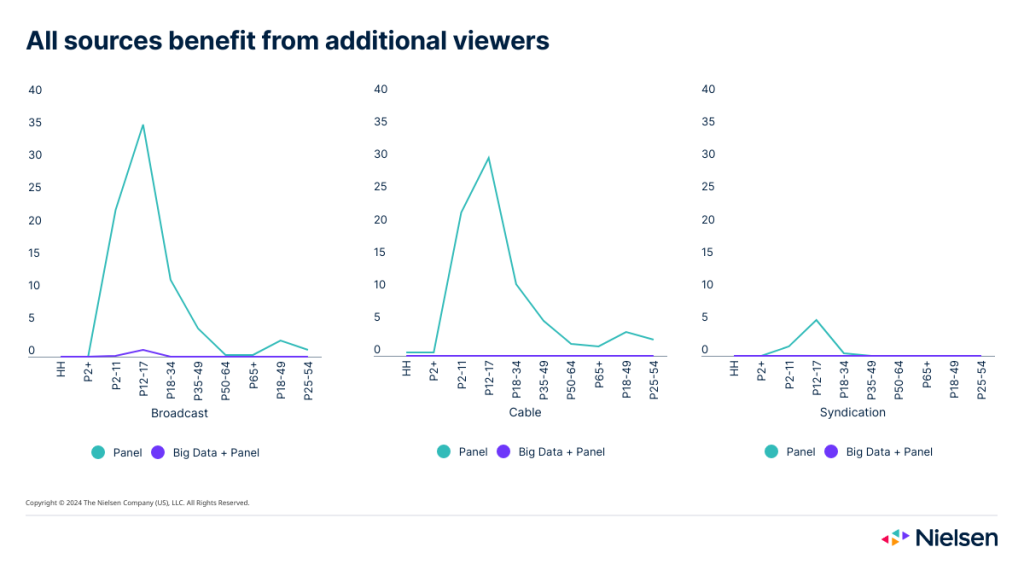
大数据的好处 + 小组讨论
大数据并不能消除数据中的变异性,我们也不指望它能消除数据中的变异性,因为人口中确实存在变异性。但是,我们的 "大数据+面板 "方法在我们已经达到黄金标准的面板数据基础上进行了创新,以提供敏感、稳定的总体收视率,从而几乎消除了零收视率,减少了电视转播的变异性。对于出版商而言,大数据+面板数据流的颗粒度和稳定性的提高意味着更多的全国电视库存可以货币化:从 88% 提高到 99.9%。
对于广告商和代理商来说,这意味着有更多机会与受众建立联系。通过将大数据的规模与来自我们面板的个人级别信息相结合,我们能够提供更先进的定位功能,以释放利用线性寻址功能以及先进的受众细分的能力。
最终,尼尔森相信,单一货币(由二级指标支持)将带来更高效的市场。但在这一过渡时期,同时拥有大数据+面板和面板测量,将有助于行业驾驭这一变化,并充满信心地进行交易。
To learn more about how Nielsen is moving audience measurement forward, explore Nielsen ONE.
资料来源
1Nielsen National TV Panel, October 2023.
2CTV refers to any television that is connected to the internet. The most common use of the internet connection is to stream video content.