数字测量与电视测量相比有何优势?
In a lot of ways, it’s similar: It involves panels, big data and technology to capture what people are doing online and who they are. As with TV, publishers use measurement to gauge the popularity of their content and value their ad inventory, and advertisers use it to verify that their campaigns are running and reaching their intended audience at the right frequency1.
虽然电视和数字测量的基本原则和最终目标相似,但所涉及的工具、流程和生态系统却大相径庭。
让我们深入了解如何衡量数字受众和营销活动的细微差别。
数字测量 "到底是什么意思?
At the most basic level, digital measurement means monitoring a user’s exposure to ads and content delivered over the internet. When we talk about digital measurement in the media industry, we generally focus on two dominant digital experiences: walled gardens and the open web.2
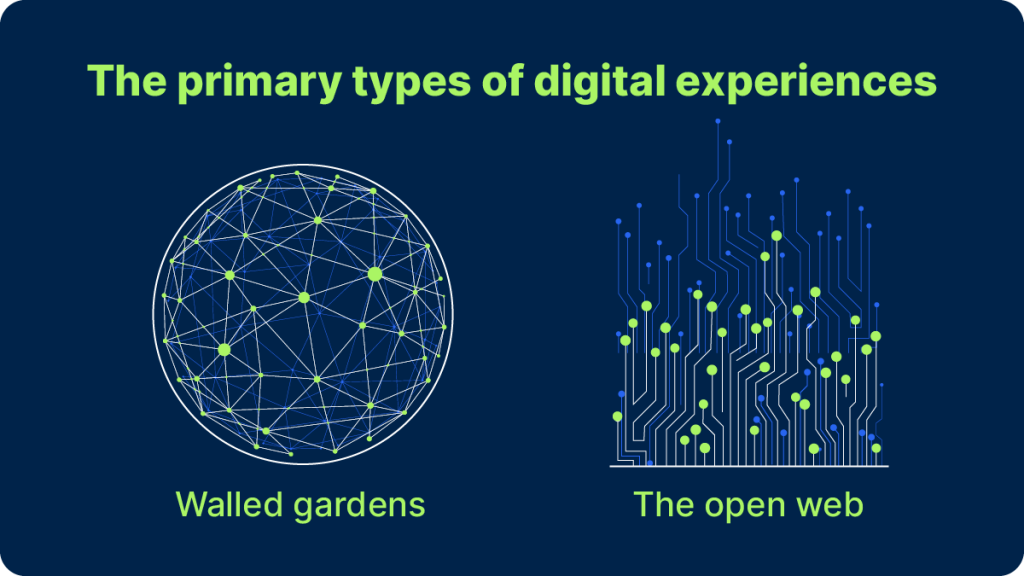
两者之间的主要区别在于,围墙花园限制访问其第一方数据--你知道,就像一个被锁在墙后面的花园,而开放网络则没有。社交媒体网站就是围墙花园的一个例子,而 Weather.com、Words With Friends 和 CNN 等网站和应用程序则是开放网络的一部分。
这对于衡量目的来说是一个重要的区别:从技术上讲,"围墙花园 "应该能够非常清楚地知道谁在其平台上访问内容和观看广告。但是,如果其他公司想在这些 "围墙花园 "内测量广告或内容消费,一般来说,他们必须建立符合隐私法规的定制集成。
虽然开放网络上的网站可以拥有强大且经过验证的第一方数据,但这并不总是必然的。在这种情况下,一般网站通常依赖代理 ID 和其他广告技术解决方案来识别、定位和衡量用户。
当前行业面临的挑战
On the open web, the ongoing deprecation of third-party cookies and device IDs is making it more difficult to identify users and is forcing stakeholders to rethink their measurement approach. Apple’s decision in 2021 to change default app tracking permissions (from opt-out to opt-in) wiped out three-fourths of IDFAs (Apple’s mobile ad IDs) from consideration. And Google is scheduled to phase out third-party cookies in the second half of 2024, the final blow to an ID system that held up for the most part, but was always an imperfect solution. Cookies aren’t people, after all.
For walled gardens, the practice of sharing granular subscriber data with outside parties is largely a thing of the past, even for anonymized measurement purposes. To comply with major data global privacy regulations, walled gardens are now sharing activity data with advertisers and measurement companies in aggregate form, if they’re sharing it at all.
这些都是测量工作面临的严峻挑战,迫使业界另辟蹊径,寻找消费者的标识符、信号和属性。而这一切都始于印象。
什么是数字 "印象"?
在了解现代数字测量流程的细节之前,我们先来了解一下什么是印象。
印象衡量的是广告或内容在数字设备上的传播次数。虽然印象数能为您提供广告或内容的总曝光量,但它并不能衡量有多少人真正看到了广告或内容(这就是到达率)。(举例来说,如果有 5 个人看了您的 LinkedIn 广告两次,这意味着您的营销活动印象数为 10。
目前的数字媒体可视性准则规定,广告必须在用户屏幕上至少有 50% 的焦点,例如,不能隐藏在另一个窗口后面,或在后台播放,显示广告至少播放 1 秒钟,视频广告至少连续播放 2 秒钟。印象时间和可视性阈值为广告商和出版商制定媒体交易条款提供了坚实的基础。
既然我们已经了解了要测量的数字活动,那就来谈谈如何测量。
数字测量流程的 5 个关键步骤
在尼尔森,我们将数字测量视为一个五步流程:
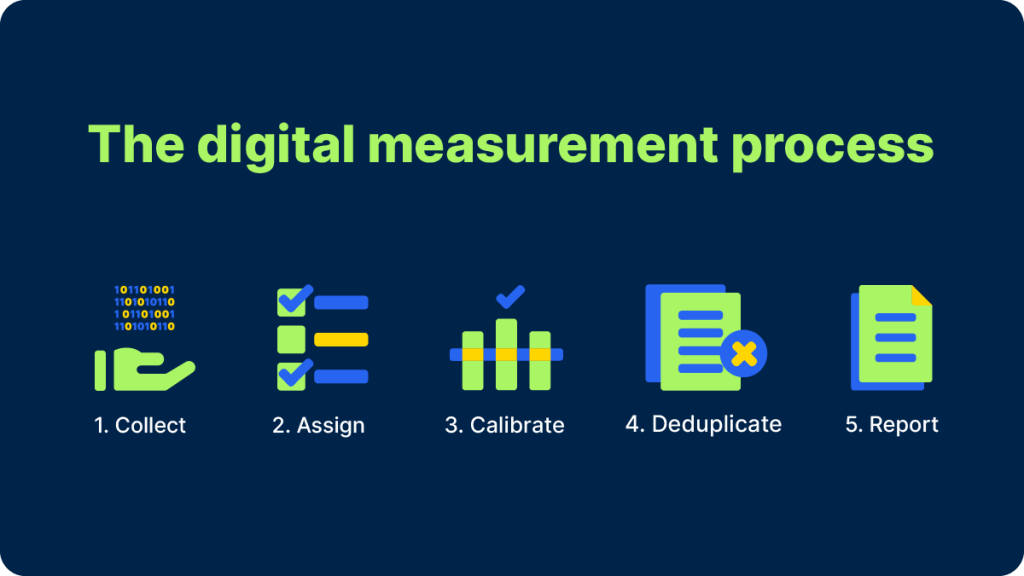
步骤 1:收集
The first step in the process is to make sure that the content and ads data is all properly captured and identified. For web content, a page URL is an acceptable identifier, but there might be multiple ads on a single url that will need to be uniquely identified. For content measurement, clients’ integrate Nielsen’s SDK3 within their websites or apps. For ads measurement, we either use direct integrations with publishers, or ask advertisers or their agencies to integrate Nielsen tags in their ads when they traffic campaigns. When ads are delivered to the user’s browser or app, those Nielsen tags ping our servers with information about the ad that was delivered along with important meta-data information that enables us to filter out any invalid robotic traffic. Javascript tags, on top of all the campaign data, capture additional signals for measuring second-by-second viewability data (for display and video ads) and audio volume levels (for video ads). This allows us to accurately collect all the impression data.
步骤 2:分配
The next step is to assign those impressions to a person. With the ecosystem changes discussed above, we’re now transitioning to a system where cookies are replaced with alternate identifiers and first-party data provided by clients—such as hashed email addresses, Unified ID 2.0 or self-reported demographic labels—and verified against our own growing ID graph. The goal is to get as close as possible to the demographic profile of the person who was exposed to the content or ad, and if that’s not possible, at least attach some useful information about their behavior and interests.
步骤 3:校准
Then, you need to calibrate your data for demographic accuracy. It’s important to acknowledge that even the best demo assignment process in the world will still return many cases where the user couldn’t be identified, and those misses can’t be assumed to be randomly distributed across all demographic groups. This may lead an advertiser to draw erroneous conclusions about the impact of their campaign. A panel can be used as a source of truth to calibrate census-level impressions. At Nielsen, we maintain digital and participant panels of 725,000 for exactly that purpose. Some are equipped with a computer meter, others with a mobile meter to measure their app and web usage on smartphones and tablets. And we make sure we have accurate demographic and profiling data for everyone in the panel
步骤 4:删除
Next, you must ensure your campaign reach isn’t inflated across devices . Over the course of a campaign, people are typically exposed to it many times, especially when that campaign is running on multiple walled gardens and on the open web. Multiple exposures are generally a good thing—it takes a few impressions to make an impression—but advertisers are rightfully very mindful of ad waste4 and putting off consumers with repetitive ads. Deduplicating reach—that is, ensuring the same viewer isn’t counted multiple times—and calculating a campaign’s true frequency are critical steps in the measurement process.
步骤 5:报告
Finally, you need to monitor performance. Everything above needs to happen on a continuous basis, and actionable reports need to be available as quickly as possible to give marketers the insights they need to reallocate funds to their most effective channels and most receptive audiences while their campaign is still in flight and there’s still time to change course.
迈向跨媒体测量
测量行业面临着巨大的压力,必须适应数字生态系统已经发生的巨大变化。广告商需要清楚地了解跨数字设备的广告活动效果,对结果有信心,并需要可靠的工具来优化他们的广告活动。
But there’s even more pressure to get digital and TV impressions on a level playing field. This is an ongoing effort—what constitutes an impression on linear TV and on digital platforms aren’t the same yet—but thanks to the development of a common ID system and launch of Nielsen ONE, we’re already helping marketers deduplicate reach and frequency across select digital and linear platforms in key markets around the world.
At Nielsen, we’ve also recently launched ‘Always On’ digital measurement with proactive partners like YouTube to emulate the way that linear measurement is done and help marketers turn on digital measurement capabilities on a continuous basis, rather than campaign-by-campaign.
要在我们的行业中实现全面的跨媒体测量,还有更多的工作要做,但有了正确的优先事项、工具和流程,我们比以往任何时候都更接近目标。
Nielsen’s Need to Know reviews the fundamentals of audience measurement and demystifies the media industry’s hottest topics. Read every article here.
资料来源
1For an overview of TV measurement, read Need to Know: How Are TV Audiences Measured?
2Connected-TV platforms and retail media networks share many characteristics with both walled gardens and the open web. Stay tuned for a future Need to Know article on those fast-growing media channels.
3The Nielsen software development kit (SDK) is one of multiple framework SDKs that Nielsen provides to measure both static and video content across platforms.
4Nielsen’s Digital Ad Ratings estimate that 37% of digital ad spend is currently wasted on impressions that are off-target, out-of-view or SIVT.