From attacks on Chinese laborers in 1885 to the more than 3,000 anti-Asian hate incidents in the last year, attacks against the Asian American community are not new. But while this is not the first time in U.S. history that the Asian community has been subjected to violence, recent research shows the quantity and context of inclusion on TV for an identity group plays a role in learning—and unlearning—racist stereotypes that harm Asian Americans.
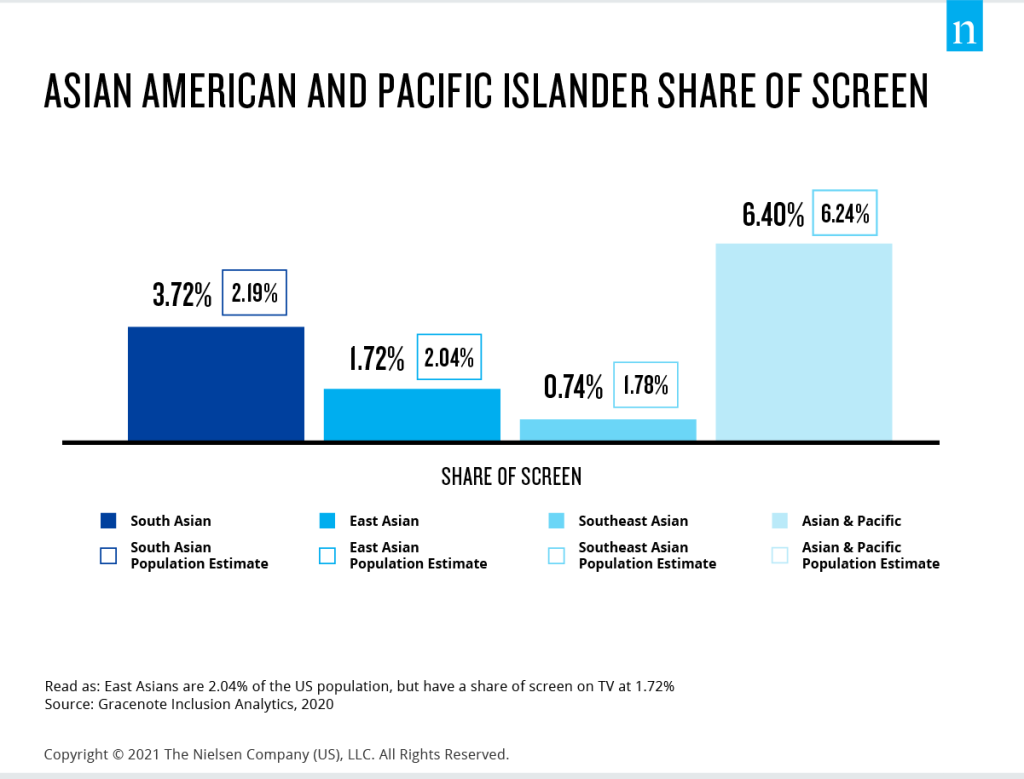
One clear challenge to disrupting stereotypes is the exclusion of diverse Asian American experiences from U.S. television content. Add amid the disruption of production schedules during 2020, Gracenote 融合分析 reveals that share of screen* for Asian American and Pacific Islanders (AAPI) remains limited. Particularly, East Asians and Southeast Asians appeared in leading roles on TV at a fraction of their presence in the U.S. population.
After more than a year living with the disruption and threat of COVID-19, our increased media consumption still offers two primary parallels of representation for Asian American and Pacific Islanders (AAPI) on television—news headlines and commentary stigmatizing the pandemic as the “China” or “Wuhan” virus and television roles that perpetuate the “model minority myth.”
But representation in TV programming isn’t the only place where progress is needed. A recent study published to PubMed by a group of academics found that increased media rhetoric in response to the pandemic has played a direct role in the escalation of violence and bias against Asian Americans. Researchers found a direct correlation in the increased media usage of terms like “China Virus” and “Kung Flu” with the increase in bias against Asian Americans. So much so that after years of declines of this sentiment, the initial weeks of pandemic coverage using this racist language in the media was powerful enough to erode more than three years of prior declines. This language directly evoked and activated a long historical legacy associating Asians with disease and xenophobic fear dating back to the “Yellow Peril.”
Nielsen research shows that the prominent themes that appear in television content inclusive of East, South or Southeast Asian talent on screen most often have to do with doctors, offices, courtrooms and courage and bravery during dangerous missions. Content exploring the everyday Asian American family can be hard to come by. In Hollywood, long-standing barriers keep options for AAPI representation limited, as Producer Sanjay Sharma, founder and CEO of Marginal MediaWorks explains: “When we pitch an Asian show, we often hear industry executives say “We already have an Asian sitcom in development,” as if that solves the diversity problem and it would be insane to have two or more. When I ask them to reflect on the composition of their portfolio of shows, they are nearly always mostly white. Of course we want parity in representation, but what’s more important is normalized and non-stereotypical representations—we want to be seen for our humanity and complexity.”

围绕冠状病毒的言论是一个极端,但将亚裔在电视内容中的表现局限于最成功的形象也会延续有害的刻板印象。虽然事业和经济上的成就往往在亚裔美国人的银幕形象中占据突出位置,但这只是美国数百年历史中的一部分。在通往成功的道路上所经历的磨难和胜利往往被忽视:争取公民权的斗争、追溯到19世纪的具有里程碑意义的争取教育平等的法律斗争,当然还有从公共街道到礼拜堂,再到现在的社区水疗中心等针对亚裔美国人的仇恨犯罪。
While Nielsen research confirms representation of the AAPI community is above parity in broadcast TV programming, the industry needs to consider the diversity of context in which the community is portrayed as well. For both Asian Americans who have been in the U.S. for generations and indigenous Pacific Islanders, the limited roles and storylines that focus on “good” immigrants is also concerning. With a share of screen for AAPI talent at less than 1% in top cable programming and under parity on streaming, narrow media representation continues to feed the “perpetual foreigner” bias among many other Americans tuning in. This harmful stereotype undermines Asians as “real” Americans and reflects a history of legalized discrimination and state-sanctioned racism against Asian Americans, such as the 1882 Chinese Exclusion Act and the internment of Japanese Americans in World War II.
Asian Americans are part of America, and they are intrinsic to the American economy as well as our culture. Many Asian Americans are on the frontlines fighting the pandemic: one of 11 nurses is AAPI. Their livelihoods have also been impacted. The number of active Asian business owners fell by 26% between February and April of last year. The number of Asian Americans in households making more than $50,000 declined as the pandemic began compared with an increase of 3% for Americans overall, according to Nielsen TV Universe Estimates. Television has an opportunity to expand the stories told about the AAPI community and eliminate narratives that fuel bias and violence. It’s time that on-screen content about Asian Americans reflect more of their lives and diverse contributions to #StopAsianHate.
*屏幕份额:在电视剧中经常出现的前 10 名演员中,身份群体(如亚裔、女性、LGBTQ)的代表性。
Additional Resources

希望与行动:亚裔美国人日益增长的影响力
Visit our Asian American community page to learn more about the Asian American population and breaking stereotypes.