Also known as the “Big Game” in the U.S., the Super Bowl is typically one of the most viewed TV moments. In fact, in 2024 Super Bowl LVIII, featuring the Kansas City Chiefs and the San Francisco 49ers, had the largest TV audience for a single-network telecast. It’s also a sports event that audiences will frequently watch together. But it’s not the only programming audiences gather for. Our research shows that Americans watch TV with other people (friends, family, even strangers at the bar) 47% of the time, on average, and alone the rest of the time.
A covisualização - assistir à TV com pelo menos uma outra pessoa por perto - é parte integrante da experiência de TV e um conceito simples de entender, mas não é fácil de medir. Como resultado, alguns planejadores de mídia ainda usam fatores planos de covisualização como atalhos para converter métricas de dispositivos em audiências individuais. O que é um fator de covisualização? Veja um exemplo: Você deve esperar 1,2 espectadores por tela de TV às 14 horas e 1,5 às 20 horas. No mercado de TV atual, em rápida mudança e altamente fragmentado, isso não é mais suficiente.
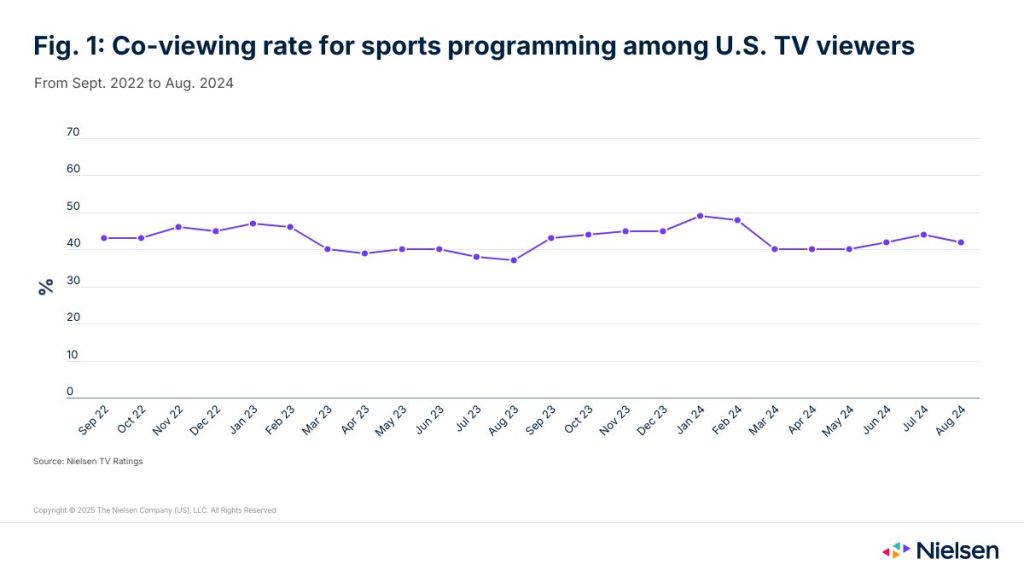
Para ilustrar a inadequação dos fatores planos de covisualização, vamos dar uma olhada na atividade de covisualização durante a programação esportiva nos últimos dois anos.
A co-visualização de programas esportivos varia muito ao longo do tempo
Figure 1 shows the co-viewing rate (the percentage of total viewing time spent co-viewing rather than viewing alone) for all TV viewers in the U.S. from September 2022 to August 2024, across all sports programming and regardless of platform (broadcast, cable and streaming). The month-to-month variations are substantial, dipping as low as 37% in August 2023 and reaching close to 50% in January and February of 2024.
The peaks correspond to tentpole sporting events, like the Super Bowl or Copa América, but marquee events taking place outside of the U.S. led to comparatively poor co-viewing rates. That doesn’t mean that the 2022 FIFA World Cup in Qatar and the 2023 Women’s World Cup in Australia and New Zealand had poor ratings in the U.S.—quite the opposite, in fact—but it’s more difficult to gather family and friends to watch the matches when they’re broadcast in the middle of the night or in the early morning. As for March Madness, it seemed to attract more alone viewing than average, even though we can see a small bump in co-viewing associated with the record-breaking 2024 tournaments.
Principais lacunas de covisualização por dados demográficos
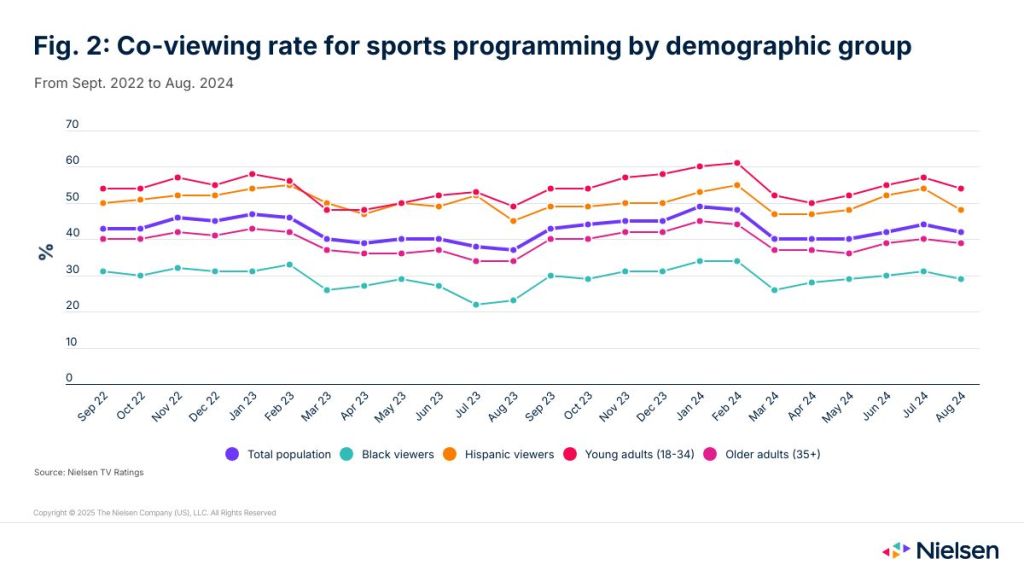
As taxas de covisualização também variam muito de acordo com o grupo demográfico. Para o mesmo período de dois anos, a figura 2 mostra uma diferença de 20 pontos na covisualização de programas esportivos entre espectadores hispânicos e negros, e uma diferença de 10 a 15 pontos entre espectadores mais jovens e mais velhos.
Household size is a factor (Hispanic viewers live in larger households), but there are cultural factors at play as well. For instance, young adults might be more willing to go out and watch sports broadcasts with groups of friends. They’re watching considerably less TV than their older counterparts, especially linear TV, but the little they’re watching, they’re doing as a group.
Como o esporte se compara a outros gêneros de programas?
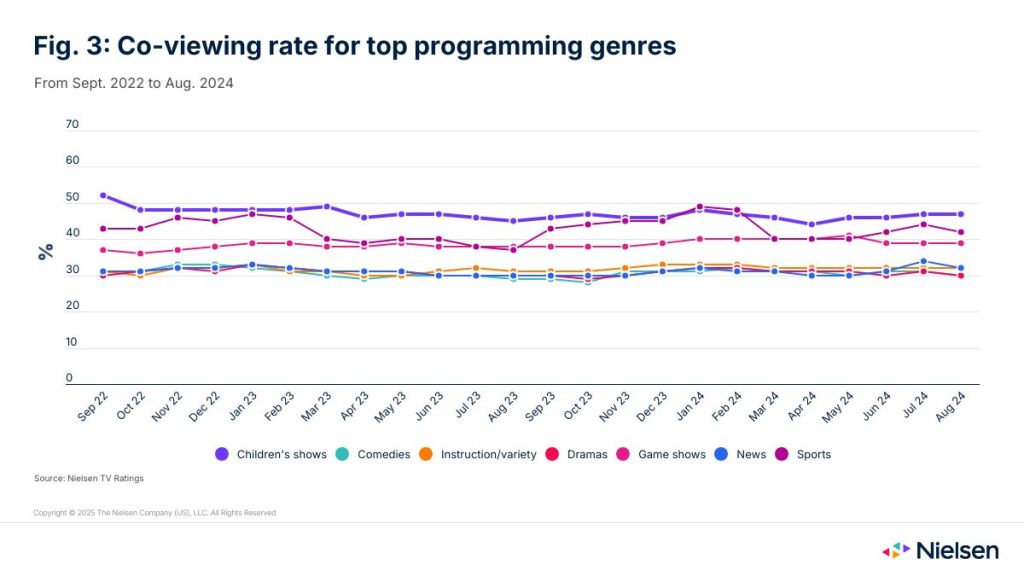
Na Figura 3, estamos ampliando um pouco a lente para comparar a covisualização durante programas esportivos com a covisualização de outros gêneros de programas importantes, como dramas, notícias e programas de variedades.
We can see that over that same two-year time period, children’s shows consistently produced more co-viewing than sports—not surprising considering that kids, especially young kids, often have a parent around when they’re watching TV—and showed more stability over time as well. Game shows performed really well too, a good reminder of the effect that streaming has had in recent years in broadening the genre’s appeal beyond its traditional (read: older) linear TV audience. And the rest of the top programming genres stayed within a narrow co-viewing band just above the 30% mark.
Principais implicações para anunciantes e proprietários de mídia
Que conclusões você deve tirar dos insights acima?
- First and foremost, there’s no such thing as a flat co-viewing factor. That’s clearly evident when we look at sports, but there are subtle variations for other genres as well (and more so if we start to drill down at the program level).
- If you’re an advertiser planning to target a specific demographic group or a more advanced audience, you should throw your co-viewing assumptions out the window and get your hands on co-viewing insights based on actual real-life behavior for that target group.
- If you’re a media owner, understanding whether people are watching alone or with other people can help you finetune your own shows and improve how you monetize your audiences.
Pronto para explorar como a covisualização realmente se parece em seu mundo?
In a recent blog post, we reviewed how Nielsen’s co-viewing calculations rely on robust people-based measurement solutions inside and outside the house, as well as advanced algorithms to assign viewership to individuals when the only available data comes from devices, as is typically the case with big data from set-top boxes and smart TVs.
Learn more about how and when audiences watch television, or contact us to discover how to use co-viewing to your advantage.