Jogar uma pandemia global nas marcas e nos profissionais de marketing, que já tiveram que suportar uma fragmentação épica da mídia para atingir seu melhor consumidor, é como jogar gasolina em uma fogueira.
Quaisquer aspirações de ROI se dissiparam quando a OMS declarou, em 11 de março, que a COVID-19 era de fato uma pandemia e resultou em uma venerável queima de conteúdo criativo.
For instance, ad inventory that was purpose-built and slated to be associated with the upcoming Olympic games, for travel and tourism purposes, or simply felt tone deaf in the wake of a fast-moving, unknown virus that prompted strict social distancing measures globally, was halted and marketers pulled back. In Italy, for instance, advertisements for a train service featuring people hugging were reported as late as March 8. Following COVID-19, marketing strategies as well as creatives needed to be looked at in a whole new light.
This during a time when unprecedented levels of video viewing were increasing significantly. In mid to late March, total use of television in the U.S., including the use of digital enablers, such as smart TVs, internet-connected devices and gaming consoles, was up 18% from early March. During that same time (March 13 to 31), daily app usage increased significantly as COVID-19 spread across the U.S. compared with the first two-and-a half months of this year (Jan. 1 to March 12). This pattern followed suit across many other countries, from Italy to South Korea. The irony to marketers was that while viewers were certainly tuning in, many were and still are ostensibly “shut ins,” venturing out very little to shop, dine and socialize. The discretionary spending that went with these habits slowed down.
No entanto, o silêncio sobre os consumidores é sempre uma aposta arriscada para os profissionais de marketing, mesmo para marcas com decisões orçamentárias difíceis de serem tomadas.
Consider this: Advertising cuts could mean an extended recovery period for the media market. Brands that go totally dark for the rest of 2020 could be facing revenue declines of up to 11% in 2021. When you take into account that it takes up to three to five years of solid and consistent brand building effort to recover from extended “dark periods” of media, marketers who maintain brand equity by adjusting their creatives—even if that means simply adding COVID-related brand awareness messages to existing campaigns—are poised to be better positioned following any recovery, immediate or prolonged.
Among some of the top advertising categories in the U.S., not only did the amount of creative units leading up to COVID (Jan. 27-March 8) see a decline following the pandemic status (March 9-April 19), from 15.3 million to 13.3 million respectively, but so too did the share of time these categories advertised. For instance, the amount of advertising for travel was down 60%, retail declined by 21% and telecommunication ads saw a 17% drop in units. This negation in units for these categories actually gave other categories, such as automotive and financial services, a larger share of the advertising time unit-wise thus allowing companies associated with these categories a larger voice. And both the beer and wine as well as the pharmaceutical categories actually increased the amount of ads that were running following COVID.
Essa contração do mercado de anúncios não foi isolada apenas nos EUA; países de todo o mundo também registraram quedas, dependendo de uma série de fatores, incluindo as respostas de suas nações à crise, o grau de exposição da população e o impacto em suas respectivas economias. Por exemplo, a Espanha, um dos países mais atingidos na Europa, viu os gastos com anúncios diminuírem 29% em março em relação ao mês anterior (fevereiro de 2020). Por outro lado, os gastos com publicidade na Austrália, que não viu a disseminação do vírus na comunidade, caíram 6% em relação ao mês anterior.
Os profissionais de marketing também perceberam a necessidade crítica de oferecer criativos com o tema COVID como uma forma de demonstrar apoio, oferecer bens e serviços que pudessem ajudar os consumidores, como coleta na calçada e entrega em domicílio sem contato, ou se envolver em alguma forma de caridade. Para muitas marcas, fazer isso foi uma maneira de manter o reconhecimento da marca, manter a continuidade com os consumidores, mas não ser visto como uma capitalização da crise em si.
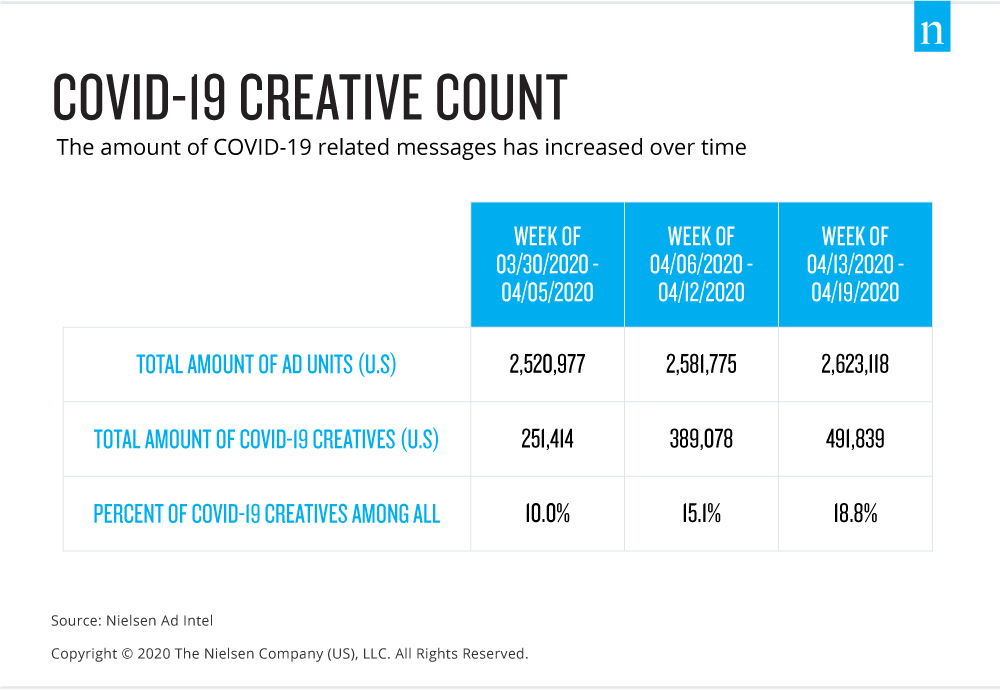
And companies did roll out an increasing amount of ads with COVID-related messages. Nielsen found that from the end of March through the middle of April alone, COVID-themed ads nearly doubled in just a few weeks alone. COVID creative units in the national and local markets jumped from 251,000 units during the week of March 30 to 492,000 units the week of April 13—a 96% increase that signals that brands understood going silent entirely was not an option for long-term health.
Consumers themselves were actually open to trying new brands that they saw as helping people during this time. A survey conducted by Nielsen and Wizer, a consumer insights platform backed by Nielsen, found that 72% of respondents cite a company’s efforts in helping people affected by COVID-19 as a reason they’d consider their brand of consumer packaged goods (CPG). What’s more is that 84% of respondents agreed that companies offering support as consumers comply with COVID restrictions are setting themselves apart from companies that do not.
But with a potential for a second wave of crisis in the fall or winter later this year in the U.S., dependent on states reopening and different emerging scenarios, these COVID-related messages are not simply ways to connect with consumers, but also a core indicator on not just the health of the media market, but also an aggregated look at how that market, and specifically marketers, think of the health of the actual consumers themselves. Declines in COVID-19 themes could act as a barometer for how ready brands think the market is for getting back to focusing on ROI and their traditional core messages. And getting back to business would be that crucial elixir that can help marketers as well as media owners revive any media stagnation.