Nielsen emmaCMV reveals that Australians rate the environment as a more important social issue than mental health, education, the ageing population, interest rates and obesity. The number of Australians who say they have a growing concern for the environment has increased 31% in the past year to 1.8 million people. We are already seeing this concern change the way consumers buy groceries and influence the way they travel. But does this growing concern for the environment help to shape one of the largest financial decisions Australians make: purchasing a motor vehicle?
Nonostante il forte desiderio degli australiani di "fare la propria parte" per migliorare l'ambiente e ridurre l'impronta di carbonio, la loro volontà di cambiare abitudini e acquistare veicoli elettrici è in fase di stallo.
Ad esempio, mentre le vendite di veicoli elettrici in Australia hanno raggiunto un massimo storico nel 2018, il numero è ancora molto basso se confrontato con altri mercati, con solo 1.352 veicoli venduti in Australia contro 1,2 milioni in Cina, 360.000 negli Stati Uniti e persino la Nuova Zelanda ha venduto 3.682 veicoli elettrici.
Per far ripartire l'industria automobilistica è necessario risolvere tre questioni:
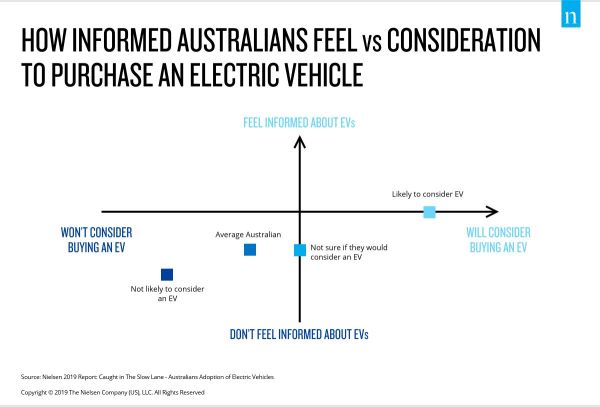
- Education and awareness – With only 16% of people believing that they are adequately informed about electric vehicles there is a real opportunity for the automotive industry to educate them regarding the unique benefits of electric vehicles. There are mixed results when it comes to awareness of brands offering electric cars – 16 % of respondents called out Tesla, 11% Toyota, and 5% BMW, Nissan and Hyundai. Interestingly, when asked to select a brand they thought sold electric vehicles in Australia, 23% selected brands which don’t and 12% reported no manufacturers sell these types of cars in Australia.
- Perceived value – 79% of Australians said price was the key factor to entice them to purchase an electric vehicle. As many as 50% said they would pay only $20-$30K. This is a major barrier to sales considering vehicles at the lower end, such as a Hyundai IONIQ retail from $45K plus on road costs, while a Nissan Leaf costs around $50K. It is, therefore, no surprise that luxury car buyers are driving electric vehicle sales as they can afford to pay the premium.
- Vehicle range and infrastructure – As many as 47% of people believe electric vehicles can only travel 100-300 kms before recharging. Yet, despite most people claiming to drive less than 80kms a day, the dangers of running out of charge on long road trips is a major deterrent to purchase. Furthermore, 77% of Australians say the lack of public infrastructure is another key deterrent. This is demonstrated by the fact that there are only 800 charging stations in Australia, compared to over 6,000 petrol stations.
To better understand what’s holding back electric vehicle sales in Australia, Nielsen interviewed 10 senior automotive marketers, 1,000 Australians, 18+ car owners and reviewed attitudinal and behavioural views from Nielsen emmaCMV. You can access these findings for free in Nielsen’s Australian Adoption of Electric Vehicle report.