Also known as the “Big Game” in the U.S., the Super Bowl is typically one of the most viewed TV moments. In fact, in 2024 Super Bowl LVIII, featuring the Kansas City Chiefs and the San Francisco 49ers, had the largest TV audience for a single-network telecast. It’s also a sports event that audiences will frequently watch together. But it’s not the only programming audiences gather for. Our research shows that Americans watch TV with other people (friends, family, even strangers at the bar) 47% of the time, on average, and alone the rest of the time.
Co-Viewing - das Fernsehen mit mindestens einer weiteren Person in der Nähe - ist ein integraler Bestandteil des TV-Erlebnisses und ein einfach zu verstehendes Konzept, aber es ist nicht einfach zu messen. Daher verwenden einige Medienplaner immer noch pauschale Co-Viewing-Faktoren als Abkürzungen, um Gerätekennzahlen in individuelle Zielgruppen umzurechnen. Was ist ein Co-Viewing-Faktor? Hier ist ein Beispiel: Um 14 Uhr sollten Sie mit 1,2 Zuschauern pro TV-Bildschirm rechnen und um 20 Uhr mit 1,5. Auf dem sich schnell verändernden und stark fragmentierten TV-Markt von heute reicht das nicht mehr aus.
Um zu verdeutlichen, wie unzureichend pauschale Co-Viewing-Faktoren sind, werfen wir einen Blick auf die Co-Viewing-Aktivitäten bei Sportübertragungen in den letzten Jahren.
Co-Viewing für Sportprogramme variiert stark im Laufe der Zeit
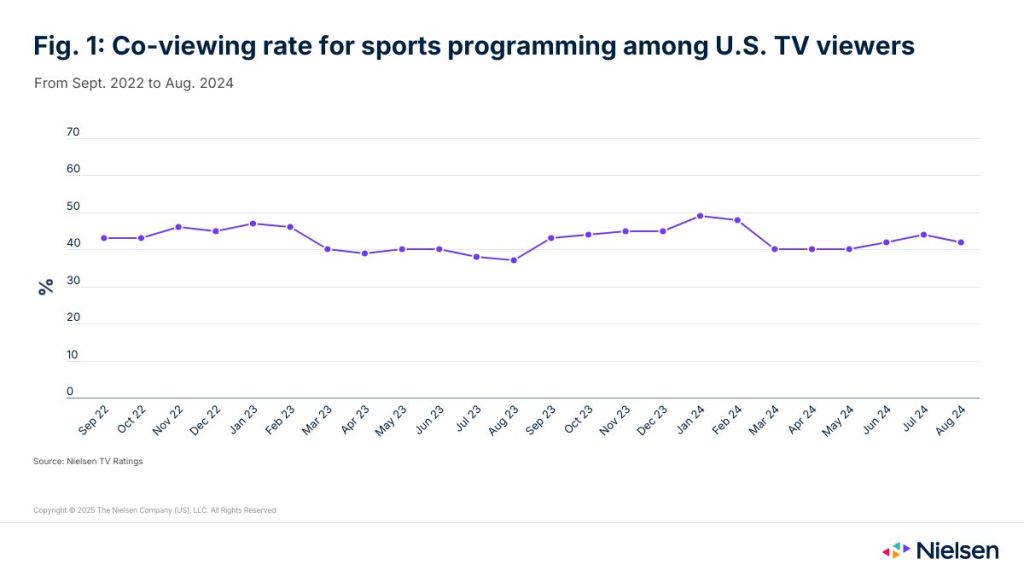
Figure 1 shows the co-viewing rate (the percentage of total viewing time spent co-viewing rather than viewing alone) for all TV viewers in the U.S. from September 2022 to August 2024, across all sports programming and regardless of platform (broadcast, cable and streaming). The month-to-month variations are substantial, dipping as low as 37% in August 2023 and reaching close to 50% in January and February of 2024.
The peaks correspond to tentpole sporting events, like the Super Bowl or Copa América, but marquee events taking place outside of the U.S. led to comparatively poor co-viewing rates. That doesn’t mean that the 2022 FIFA World Cup in Qatar and the 2023 Women’s World Cup in Australia and New Zealand had poor ratings in the U.S.—quite the opposite, in fact—but it’s more difficult to gather family and friends to watch the matches when they’re broadcast in the middle of the night or in the early morning. As for March Madness, it seemed to attract more alone viewing than average, even though we can see a small bump in co-viewing associated with the record-breaking 2024 tournaments.
Große Lücken beim Co-Viewing nach demografischen Merkmalen
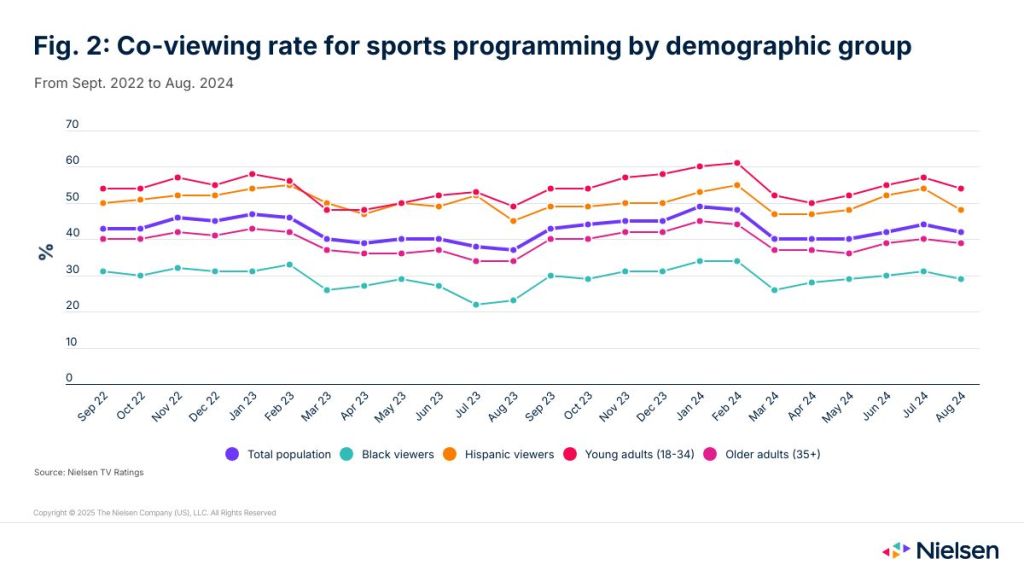
Die Co-Viewing-Raten variieren auch stark nach demografischen Gruppen. Abbildung 2 zeigt für denselben Zweijahreszeitraum einen 20-Punkte-Unterschied beim Co-Viewing von Sportprogrammen zwischen hispanischen und schwarzen Zuschauern und einen 10- bis 15-Punkte-Unterschied zwischen jüngeren und älteren Zuschauern.
Household size is a factor (Hispanic viewers live in larger households), but there are cultural factors at play as well. For instance, young adults might be more willing to go out and watch sports broadcasts with groups of friends. They’re watching considerably less TV than their older counterparts, especially linear TV, but the little they’re watching, they’re doing as a group.
Wie ist der Vergleich zwischen Sport und anderen Programmgenres?
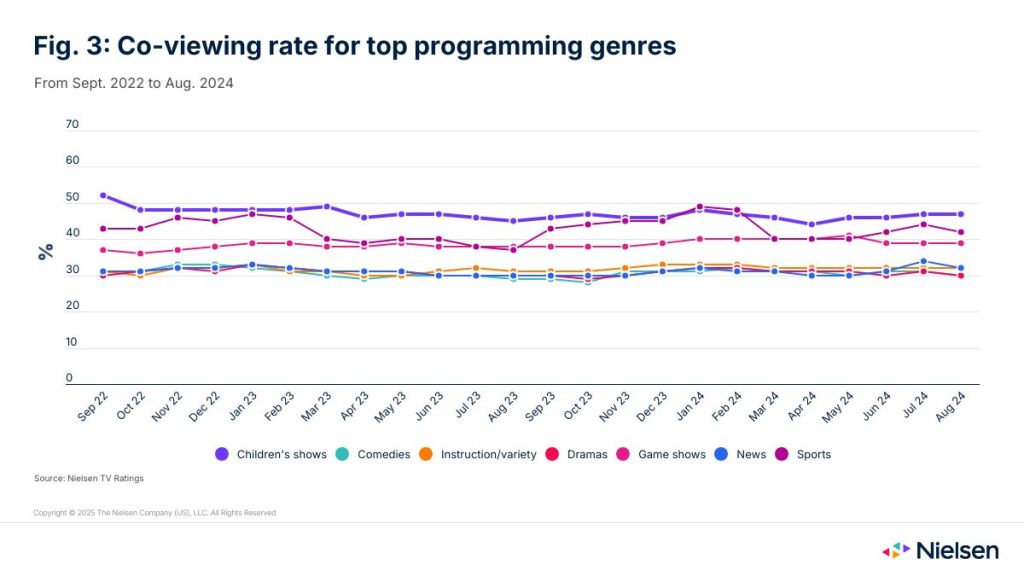
In Abbildung 3 erweitern wir den Blickwinkel ein wenig und vergleichen das Co-Viewing bei Sportsendungen mit dem Co-Viewing bei anderen wichtigen Programmgenres wie Dramen, Nachrichten und Varietés.
We can see that over that same two-year time period, children’s shows consistently produced more co-viewing than sports—not surprising considering that kids, especially young kids, often have a parent around when they’re watching TV—and showed more stability over time as well. Game shows performed really well too, a good reminder of the effect that streaming has had in recent years in broadening the genre’s appeal beyond its traditional (read: older) linear TV audience. And the rest of the top programming genres stayed within a narrow co-viewing band just above the 30% mark.
Die wichtigsten Auswirkungen für Werbetreibende und Medieninhaber
Welche Schlussfolgerungen sollten Sie aus den oben genannten Erkenntnissen ziehen?
- First and foremost, there’s no such thing as a flat co-viewing factor. That’s clearly evident when we look at sports, but there are subtle variations for other genres as well (and more so if we start to drill down at the program level).
- If you’re an advertiser planning to target a specific demographic group or a more advanced audience, you should throw your co-viewing assumptions out the window and get your hands on co-viewing insights based on actual real-life behavior for that target group.
- If you’re a media owner, understanding whether people are watching alone or with other people can help you finetune your own shows and improve how you monetize your audiences.
Sind Sie bereit zu erkunden, wie Co-Viewing in Ihrer Welt tatsächlich aussieht?
In a recent blog post, we reviewed how Nielsen’s co-viewing calculations rely on robust people-based measurement solutions inside and outside the house, as well as advanced algorithms to assign viewership to individuals when the only available data comes from devices, as is typically the case with big data from set-top boxes and smart TVs.
Learn more about how and when audiences watch television, or contact us to discover how to use co-viewing to your advantage.