8 billion: That’s the projected global population by 2030. It’s a staggering figure, and it poses massive challenges for the entire world. But perhaps the most urgent question is a very simple one: How does this growing global society sustain itself? As basic as the question is, it covers wide-sweeping facets that affect daily life everywhere—the availability of food, clean water, safe shelter, access to natural resources-needs that vary wildly around the globe, complicating the world’s challenges exponentially as our population continues to grow.
So how do we plan ahead to preserve and improve these outcomes while we still can? That question took center stage during the 68th United Nations Civil Society Conference, held Aug. 26-28 in Salt Lake City, Utah. With a focus on building inclusive and sustainable cities and communities (Sustainable Development Goal 11), the conference gave Nielsen an opportunity to discuss the role of professional services businesses in identifying and driving innovative solutions toward this urgent global goal. Within the event, the “How to Sustain a Global Population of 8 Billion” panel, hosted by The Demand Institute, addressed how emerging technologies and collaborations can shape long-term human needs planning.
"需求研究所经理萨拉-卡明斯(Sarah Cummings)说:"这次专题讨论会是一个很好的机会,让各组织参与讨论公私部门合作的重要性以及数据和技术在实现可持续发展目标中的作用。
Yamini Dixit, Director, Global Responsibility & Sustainability at Nielsen, kicked off the panel discussion by sharing highlights from Nielsen’s ESG (environmental, social, governance) journey, and our ongoing effort to be judicious in how our actions lead to socio-environmental impact in the communities we operate in. Speaking to Nielsen’s holistic sustainability approach, from internal footprint, to our grassroots efforts and stakeholder focus, Yamini emphasized on the importance of creating a ripple effect across our value chain to drive true impact. And to ensure success in this space, she also shared how Nielsen continues to create honest and open spaces for engagement with the partners, and extends the expectation of sustainable commitments to all to the table.
亚米妮特别强调,尼尔森作为一家历史悠久的数据和测量公司,拥有独特的能力帮助我们所支持的客户改变可持续发展的故事。有鉴于此,她谈到了 "可持续发展 "定义的不断变化和扩展,以及我们作为数据公司在帮助客户适应变化、了解不断变化的消费者偏好和行动方面所扮演的洞察力角色。
“But our role doesn’t end there,” she said. “We have the potential to make a wide-ranging impact in how sustainability plays out in the communities and cities we exist in. Let us not forget the power of our consumer in the story-we enable them to fulfil their own expectation of sustainable living, building healthy environments, and ‘doing right’ by their communities. In addition, these data measurements and our innovative attitude towards digitizing our solutions, can be key to predicting some of the changing needs of the growing population served.”
重要的是,亚米妮在谈到可持续发展的广泛含义时,强调了尼尔森在环境正义之路上的新叙事,并将气候变化的框架从其物理影响扩展到伦理和政治方面;承认其对可持续发展领域的影响:社会正义、性别平等、人权、集体权利等。
“The concept of sustainability is at the core of our existence—to sustain, live, evolve, and hopefully, thrive,” said Yamini. “Ultimately, the word defines itself. And when we connect the dots to look at environmental justice, we find ourselves at the powerful nexus of social, environmental and ethical change, where true sustenance sits.”
As a closing, Yamini ensured we brought the story back to the “power of one,” and how change starts with one thought, one action and one impact. “Everything starts with an individual,” she said “Let us not forget our governments are made of people, policies are voted on by individuals, bills are proposed per someone’s ideology, and activists rise to protect what is of value to them-change belongs to each of us, and when we come together to build an inclusive and sustainable community, no one gets left behind!”
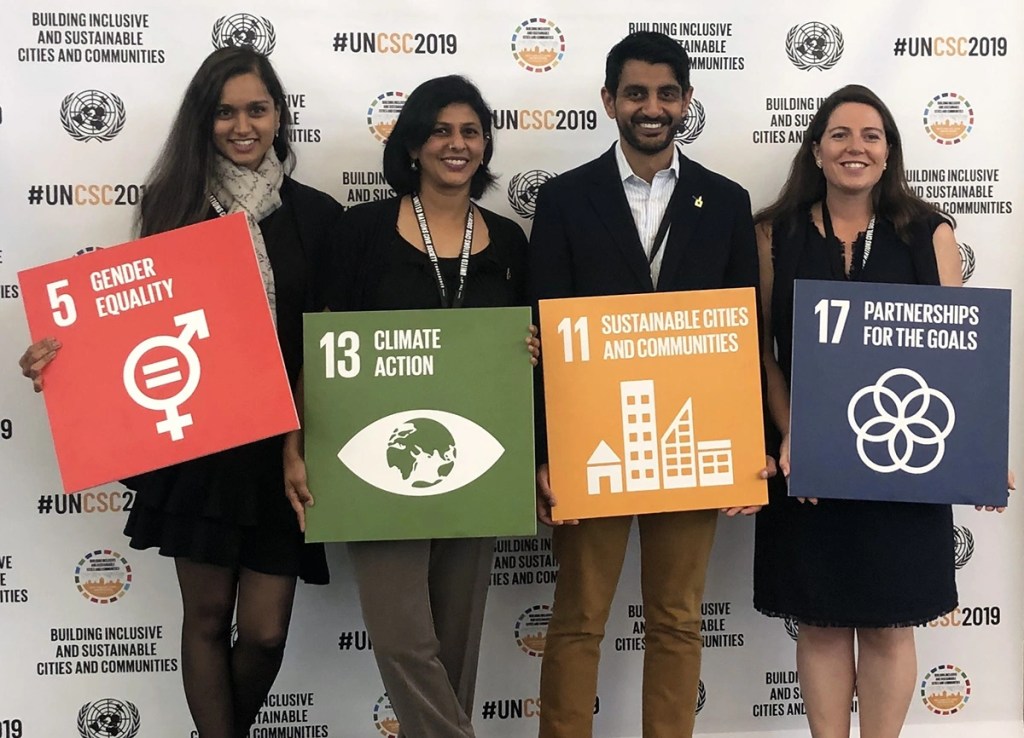
上图:尼尔森公司的 Yamini Dixit(左二)、Salesforce.org 公司的 Samira Khan、埃森哲公司的 Amit Patel 和需求研究所的 Sarah Cummings(右一)在联合国民间社会会议上进行小组讨论。
