There is no shortage of news and research about the effect that streaming is having on TV viewing behaviors. Most recently, U.S. streaming usage hit a new high in April, capturing more than 30% of audiences’ total TV time. For advertisers, this time of massive viewership fragmentation has considerable implications, yet many have remained focused on traditional TV, steadily increasing their ad spend since their COVID-driven pullbacks in the middle of 2020.
Streaming boom aside, the upside of traditional TV remains very high. In fact, audiences still spend twice the time with live TV than they do with content they access via their connected devices. From that perspective, TV remains a key channel for brand awareness, marketers’ top objective for the year ahead. And in the U.S., TV ad spending is very reflective of this goal, as brands allocated nearly 50% of their ad budgets to linear television last year.
There’s no discounting the importance of reaching the largest audience possible, but doing so requires more planning and strategy than it did when our media choices were far more finite. And while traditional TV remains a media mainstay, Nielsen Scarborough data shows that 47% of U.S. adults are either light or zero TV (weekly broadcast, cable) viewers. And those light viewers spend less than two hours each day watching traditional TV. This fragmentation of audience time can present challenges, but when advertisers have a clear understanding of channel usage, they’re better positioned to balance their spending for optimal returns.
It goes without saying that people who watch more TV see more ads than those who watch less. But when just under 30% of adults in the U.S. watch less than two hours of TV per day, reach and frequency strategies that lean heavily on TV can become challenging and expensive. For context, a typical national TV campaign running for three months will struggle to resonate with light TV viewers, who will see few ads. In a recent campaign, Nielsen 媒体影响 found that light viewers didn’t even see two ads. Comparatively, heavy TV viewers were over exposed, as they saw as many as 25 ads. Additionally, it can be difficult to regulate the number of ads audiences see if a campaign is too reliant on a single form of media.
一个品牌有可能通过狭窄的媒体组合来实现其覆盖和定位目标。但是,随着媒体行为的细分和受众花费更多时间在流媒体上,全面媒体组合的重要性也随之上升。许多营销人员正在积极转向受众花费更多时间的地方,以吸引受众,并越来越多地关注社交媒体和联网电视等新兴数字渠道。
According to the Nielsen 2022 Annual Marketing Report, marketers in North America dedicated more than half of their 2021 ad budgets on digital channels, with plans to increase digital spend again in the coming year. In fact, North America marketers planned to increase their social media spend by 61%, noting they believe it to be more effective than traditional channels like TV and radio (57% extremely/very effective vs. 49% and 41%, respectively).
As with any strategy and decision, data needs to be a marketer’s best guide. Said differently, perceived beliefs may not always pan out to be true. To better understand the ways in which different channels perform, we recently used Nielsen Media Impact to gauge the effectiveness of a single, one-month $5 million auto campaign simply by adjusting a typical media plan to include traditional radio—without adjusting the budget. Notably, according to Nielsen Ad Intel, automotive manufacturers spend an average of 67% of their monthly media spend on TV, followed by 27% on digital.
在优化后的活动中,汽车品牌的覆盖率提高了 26%,因为目标受众中又有 1900 万人接触到了这一活动。
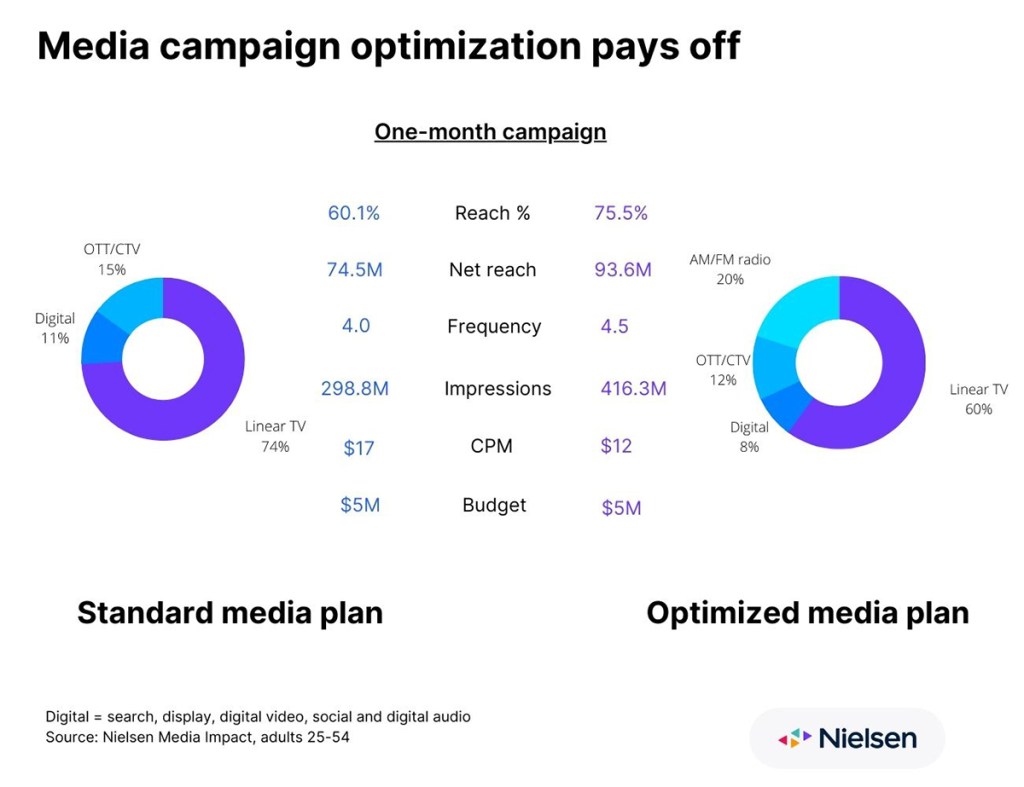
对于营销人员来说,媒体计划优化一直是确保跨渠道高效支出的重要因素。随着媒体渠道和设备的分散,优化变得更加重要。营销人员始终肩负着为投资带来切实回报的任务。这是营销的本质。但随着消费者的时间在新的平台和设备上分散,有效的营销计划将从目标受众、花费时间和信息频率的角度来考虑。