ลองหยุดคิดสักครู่ว่าคุณบริโภคสื่ออย่างไรในแต่ละวัน คุณอาจเริ่มต้นด้วยการฟังวิทยุหรือพอดแคสต์ระหว่างเดินทาง หรือเช็คข่าวสารบนแอปพลิเคชันมือถือ เลื่อนดูฟีดโซเชียล ฟังเพลงขณะทำงาน ดูรายการโปรดทางทีวีตอนเย็น หรือแม้แต่มองป้ายโฆษณาต่างๆ ระหว่างขับรถกลับบ้านจากที่ทำงาน โดยไม่รู้ตัว คุณอาจมีส่วนร่วมกับสื่อต่างๆ หลายสิบครั้งตลอดทั้งวัน ลองคูณด้วยพันล้านดูสิ แล้วคุณจะเริ่มเข้าใจถึงความหลากหลายอันมหาศาลของวิธีที่ผู้คนมีส่วนร่วมกับคอนเทนต์
For brands and marketers, this daily reality presents a significant challenge—where is the audience, really? Audiences aren’t just consuming content in one familiar place anymore; their attention is splintered across countless platforms. For example, you might still tune into your favorite show when it airs on TV, you could also be streaming it on demand later, catching up on clips on social media, or discussing it in a dedicated online community. Accurately navigating this complex landscape demands a fundamental understanding of what media fragmentation is to create strategies that grab audiences’ attention no matter where they’re watching.
การกระจายตัวของสื่อคืออะไร?
การกระจายตัวของสื่อหมายถึงการขยายตัวของช่องทางและแพลตฟอร์มสื่อ ส่งผลให้ผู้ชมถูกแบ่งแยกและกระจายตัวมากขึ้นในสื่อเฉพาะกลุ่มที่หลากหลาย แทนที่จะกระจุกตัวอยู่ในสื่อหลักเพียงไม่กี่แห่ง ประมาณทศวรรษที่ผ่านมา สื่อหลักเพียงไม่กี่แห่ง เช่น เครือข่ายโทรทัศน์รายใหญ่หรือหนังสือพิมพ์ สามารถเข้าถึงผู้ชมได้จำนวนมาก ปัจจุบัน การเติบโตอย่างก้าวกระโดดของแพลตฟอร์มดิจิทัล บริการสตรีมมิ่ง โซเชียลมีเดีย และผู้สร้างคอนเทนต์เฉพาะกลุ่ม ได้ขยายขอบเขตตัวเลือกสื่อทั้งหมดที่ผู้ชมกำลังรับชม ก่อให้เกิดทางเลือกที่ไร้ขีดจำกัด
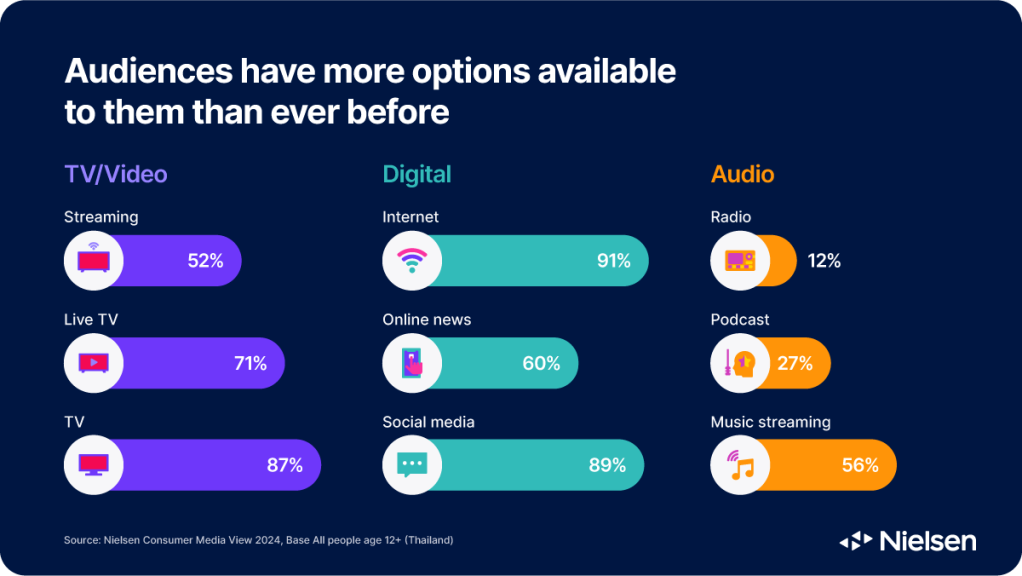
A clear indicator of this shift can be seen in how vast the array of options consumers engage with. Consider Thailand, for example—while a substantial 87% of the population still tunes into traditional TV, this now exists alongside a massive digital ecosystem where 91% are online and 89% are actively engaging with social media. For audio, the options have clearly multiplied, with music streaming services now attracting 56% of listeners, while traditional radio accounts for a smaller 12%.1 Hence, marketers face the challenge of navigating a highly fragmented media environment where reaching and engaging target audiences across a multitude of channels requires increasingly sophisticated strategies and data-driven insights.
Making this even more challenging are some digital platforms and RMNs that can function as walled gardens. These platforms control their own content and user data, meaning much user engagement is locked within their sealed environments. It limits how marketers can access comprehensive data, understand cross-platform customer journeys, and unify their marketing efforts.
Given the explosion of content sources, it’s easy to assume that the splitting of media automatically means the audience is doing the same. This often leads to a common misconception—confusing the fragmentation of media platforms with the actual dispersion of consumer attention.
มันต่างจากการกระจายตัวของผู้ชมหรือเปล่า?
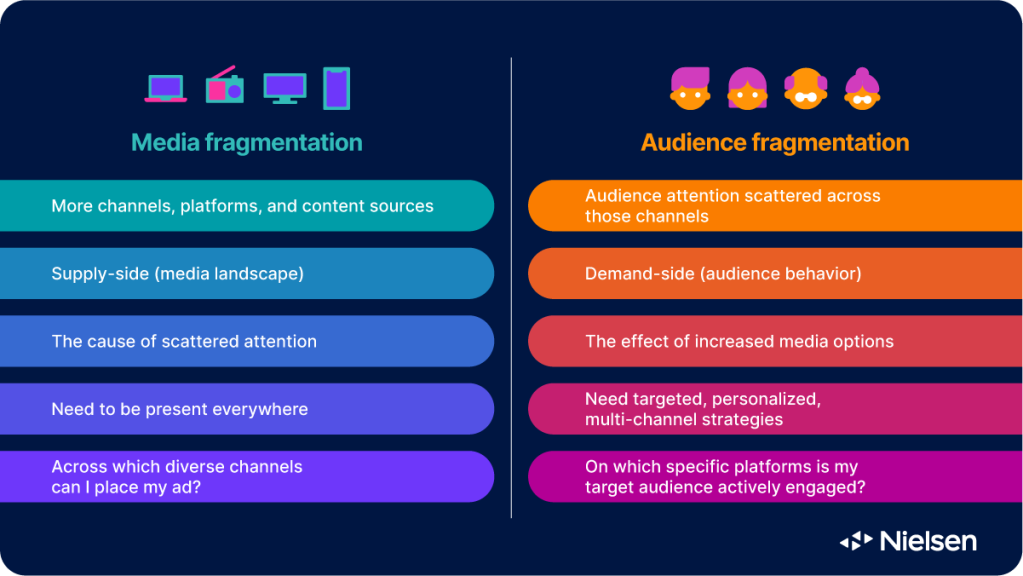
Yes, it is, and understanding the distinction is important to effectively strategize how to reach and engage today’s diverse audiences. While media fragmentation refers to the supply-side proliferation of channels—the sheer, ever-increasing number of media outlets, platforms and content options available—audience fragmentation describes the demand-side behavior of audiences actively scattering their attention across these many options.
The widespread availability of options has led to scattered attention, a reality that is seen in markets around the world. Recent data from Nielsen’s The Gauge report published in May 2025 shows that traditional broadcast and cable programming collectively accounts for 44.2% of time spent with the television set in the U.S. That share is now nearly matched by streaming services, which capture 44.8% of viewing time. Such a shift in media consumption highlights how audience attention is no longer concentrated in a handful of predictable spaces—it now flows across a wide array of platforms, reflecting increasingly fragmented viewing habits.
กลยุทธ์ในการนำทางสื่อและผู้ชมที่กระจัดกระจาย
With so much media and audience fragmentation, you really need to change how you connect with audiences. The old days of “one-size-fits-all” campaigns, designed for a time when everyone watched the same few TV shows, just don’t work anymore. That broad approach is much less effective now that audiences are spread across countless apps, websites, and platforms. What’s needed is a much more precise and relevant approach.
หากต้องการเข้าถึงผู้ชมภายในสภาพแวดล้อมสื่อที่กระจัดกระจาย คุณต้องให้ความสำคัญกับกลยุทธ์หลักเหล่านี้:
- Understand your audience deeply: Reliance on a handful of go-to channels is no longer a sufficient strategy. Marketers now need to really dig into what makes their audience tick, like their interests, behaviors, and how they actually use different platforms. Such granular insights enable the creation of audience segments based on genuine engagement patterns and demonstrated preferences, moving beyond superficial categories.
- Integrate multi-channel approach: Brands can elevate their potential by strategically integrating a multi-channel approach. Marketers need to activate diverse touchpoints—like niche online communities, new streaming services, podcasts, and traditional media to ensure they’re present precisely where audiences are engaging.
- Personalize content at scale: The ability to use data and technology to deliver customized content to individuals has shifted from a competitive advantage to a fundamental requirement. Going beyond basic demographic targeting, leveraging past interactions, stated preferences, and real-time actions delivers messages that are inherently more relevant and less intrusive, thereby enhancing the user experience and boosting campaign efficacy.
- Optimize content for platform native experiences: Delivering messages that intrinsically align with each platform’s unique format and the user’s mindset within that environment is important for impact. A concise, visually compelling video ad might thrive on fast-paced social feeds due to its immediate nature, while more in-depth, informational content finds its audience on specialized blogs or within targeted email newsletters where longer engagement is expected. Authenticity to the platform drives receptivity and better results, leading to more effective marketing decisions.
การรับประกันประสิทธิผลของกลยุทธ์ด้วยข้อมูลเชิงลึกข้ามแพลตฟอร์ม
ความสนใจของผู้ชมกระจายตัวอยู่ในจุดสัมผัสมากมาย ดังนั้นการวัดผลการมีส่วนร่วมและประสิทธิภาพของแคมเปญแบบองค์รวมจึงมีความสำคัญอย่างยิ่ง การพึ่งพาตัวเลขจากแพลตฟอร์มต่างๆ เพียงอย่างเดียวทำให้ภาพรวมของเส้นทางของผู้ชมดูแคบและไม่สมบูรณ์ ทำให้ไม่สามารถเข้าใจผลตอบแทนจากการลงทุน (ROI) หรือปรับปรุงกลยุทธ์ในอนาคตได้อย่างแท้จริง
Nielsen ONE provides a deduplicated and unified view of how audiences engage across all media channels—digital, traditional linear TV, and new platforms. It empowers marketers to understand how different touchpoints contribute to plan, optimize, and evaluate their campaigns with unmatched clarity, taking out the guesswork and allowing for smarter decisions.
หมายเหตุ:
1 Nielsen Consumer Media View 2024, Base All people age 12+
Nielsen’s Need to Know reviews the fundamentals of audience measurement and demystifies the media industry’s hottest topics. Read every article here.