Last year’s Super Bowl was the most watched TV program in U.S. history. With 106.5 million viewers, the game supplanted the long-time leading final episode of M*A*S*H (which had 105.5 million viewers in 1983). Will this year’s NFL championship game beat the record again? Many factors, from the competitiveness of the game to the weather, will come into play, but there is no question that football as a whole is more popular than ever on television.
A decade ago, the Baltimore Ravens – with a defense coached by Rex Ryan – beat the New York Giants in a lopsided 34-7 victory. Super Bowl XXXV was watched by 84.3 million viewers, down nearly 4 million from the year before. While that level of viewership was still high, the NFL’s prominence in the national consciousness and on television is stronger now, thanks to a perfect storm of social, media, cultural and technological developments in addition to some pretty savvy marketing.
It’s not just the Super Bowl that is drawing more viewers: Regular season ratings are also strong. In the past five years, ratings of NFL games have risen by more than one percentage point (from 9.3 in 2006 to 10.6 in 2010), accounting for more than 3.5 million additional viewers per game. In fact, eight out of the top ten primetime programs for the entire year were football games (and one – Undercover Boss – appeared immediately after the Super Bowl).
| Top 10 TV Programs – Single Telecast 2010 | ||||
|---|---|---|---|---|
| อันดับ | Telecast | Originator | Date Aired | Total Persons Rating |
| 1 | Super Bowl XLIV | ซีบีเอส | 2/7/10 | 36.5 |
| 2 | Super Bowl XLIV Post Game | ซีบีเอส | 2/7/10 | 25.8 |
| 3 | Super Bowl Kick-Off | ซีบีเอส | 2/7/10 | 20.8 |
| 4 | FOX NFC Championship | ฟ็อกซ์ | 1/24/10 | 19.8 |
| 5 | AFC Championship on CBS | ซีบีเอส | 1/24/10 | 16.1 |
| 6 | Academy Awards | เอบีซี | 3/7/10 | 14.3 |
| 7 | Undercover Boss | ซีบีเอส | 2/7/10 | 13.2 |
| 8 | FOX NFC Playoff-Sun | ฟ็อกซ์ | 1/17/10 | 12.9 |
| 9 | AFC Divisional Playoff-Sun | ซีบีเอส | 1/17/10 | 12.2 |
| 10 | FOX NFC Wildcard Game | ฟ็อกซ์ | 1/10/10 | 11.8 |
| Source: The Nielsen Company. |
What accounts for football’s hold on the television population? As usual, there isn’t only one answer, but here are some possibilities.
Cross Marketing
While most other professional sports are broadcast on two or three networks, the NFL is spread across five, including three of the four major broadcast networks. This ubiquity has the effect of creating a cross-platform promotional powerhouse. Although the networks ostensibly promote their own upcoming games, in reality they are promoting football in general and the average viewer is exposed to myriad football promotions throughout the season. As a consequence, the average viewer is virtually guaranteed exposure to football marketing and advertising.
More Female Fans
More American women watch the NFL than any other team sport, and not just the Super Bowl. In the regular season, the NFL has eclipsed Major League Baseball and the National Basketball Association in having the largest percentage of female viewers. In the past decade the NFL has launched several marketing and outreach programs, including coaching clinics, apparel that fits women and donning pink during breast cancer awareness month. Further, watching football tends to be a social event, with people watching in groups of varying gender composition. As a result, the percentage of the football audience that is female has grown from 32.6% in 2006 to 33.6% in 2010.
| Season | Household Rating | Total Audience Viewers (000) | Male Viewers (000) and % of audience | Female Viewers (000) and % of audience |
|---|---|---|---|---|
| 2006 | 9.3 | 14,430 100.00% | 9,732 67.44% | 4,697 32.55% |
| 2010 | 10.6 | 17,867 100.00% | 11,865 66.41% | 6,002 33.59% |
| Source: The Nielsen Company. |
Biggest markets have successful seasons
NFL has always relied on a mix of large and small markets, and with a strict salary cap and generous revenue sharing, teams from smaller markets such as Green Bay or Pittsburgh can compete financially with Chicago or New York. As a result markets and regions are not perpetually at a competitive disadvantage as they are in other sports. In 2010, a whopping 24 of 32 NFL Local Markets enjoyed higher regular season ratings, with New Orleans pulling in the highest rating (43.9, up 6%) and St. Louis posting the highest percentage growth (up 66%).
Nevertheless, this year, some of the largest markets had the most successful teams and their local regular season game ratings posted solid increases, which contributed to higher national ratings when these teams appeared in national broadcasts.
| Largest NFL Markets | ||
|---|---|---|
| Market | 2010 Local Rating | YOY Rating % Change |
| New York (Giants) | 14.7 | 18% |
| Boston | 30.9 | 16% |
| Chicago | 27.6 | 15% |
| New York (Jets) | 12.7 | 10% |
| Philidelphia | 28.3 | 5% |
| Source: The Nielsen Company. |
QBs have Become Stars, On and Off the Field
In 2001, journeyman Trent Dilfer led the Ravens to a Championship, creating the perception that a team can win a Super Bowl without a marquee quarterback. Most NFL teams now subscribe to the belief that the quarterback is the most critical cog, both on and off the field. The Cowboys, for example, lost QB Tony Romo to injury and saw their season and ratings go south.
In recent years, the NFL has tried to safeguard their stars, implementing rules to ensure that the QB isn’t tackled low, hit in the head or after the whistle. And to a large extent, the quarterbacks this year were healthy and able to serve as the marquee names for their teams.
Interest in quarterbacks goes beyond the stadium: they are making news off the field too. Many have been linked romantically to supermodels, actresses and singers, creating news in celebrity magazines and other non-traditional media. Others have generated publicity for less positive reasons.
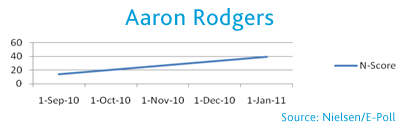
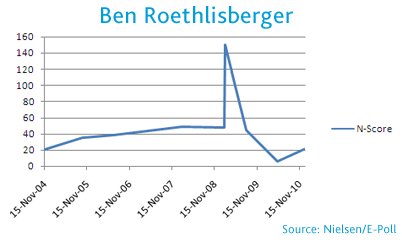
Leading the Super Bowl XLV teams are Aaron Rodgers of the Packers and Ben Roethlisberger of the Steelers. Rodgers is a rising star but Roethlisberger, who has already won two Super Bowl rings, saw his reputation suffer in the wake of sexual assault allegations that were brought against him.
These perceptions of Rodgers and Roethlisberger are borne out by their N-Scores. Together with E-Poll, Nielsen has devised a method of measuring the endorsement potential of more than 1,000 athletes and sports personalities. Neither Rodgers nor Roethlisberger have N-Scores that approach the best known and most popular quarterbacks:
| QB N-Scores | |
|---|---|
| Peyton Manning | 262 |
| Brett Favre | 196 |
| Tom Brady | 131 |
| Aaron Rodgers | 39 |
| Ben Roethlisberger | 24 |
| ที่มา: บริษัท นีลเส็น |
The trend lines further illustrate the challenges trajectory of Rodgers and Roethlisberger’s N-Score ratings:
Throughout 2010, football continued to break TV ratings records, showing that even in a fragmented media environment, it is still possible to generate large television numbers for programming that attracts viewers in all demographics. Nielsen cannot predict whether this year’s Super Bowl will have the largest TV audience in history, but it is all but certain to be the most-watched program of 2011.
For more historical information on Super Bowl viewing, please see the following historical table:
| Super Bowl Viewing, 1966-2009 | ||||||
|---|---|---|---|---|---|---|
| ซุปเปอร์โบว์ล | Season | Date | เครือข่าย | การจัดอันดับ | Avg. Number of Homes (000) | Avg. Number of Persons 2+ (000) |
| 44 เล่ม | 2009 | Feb 7, 2010* | ซีบีเอส | 45 | 51,728 | 106,476 |
| XLIII | 2008 | Feb 1, 2009* | เอ็นบีซี | 42 | 48,139 | 98,732 |
| XLII | 2007 | Feb 3, 2008* | ฟ็อกซ์ | 43.1 | 48,665 | 97,448 |
| เอ็กซ์แอลไอ | 2006 | Feb 4 2007 * | ซีบีเอส | 42.6 | 47,505 | 93,184 |
| เอ็กแอล | 2005 | Feb 5 2006 * | เอบีซี | 41.6 | 45,867 | 90,745 |
| XXXIX | 2004 | Feb 6 2005 | ฟ็อกซ์ | 41.1 | 45,081 | 86,072 |
| XXXVIII | 2003 | Feb 1 2004 | ซีบีเอส | 41.4 | 44,908 | 89,795 |
| XXXVII | 2002 | Jan 26 2003 | เอบีซี | 40.7 | 43,433 | 88,637 |
| XXXVI | 2001 | Feb 3 2002 | ฟ็อกซ์ | 40.4 | 42,664 | 86,801 |
| XXXV | 2000 | Jan 28 2001 | ซีบีเอส | 40.4 | 41,270 | 84,335 |
| XXXIV | 1999 | Jan 30 2000 | เอบีซี | 43.3 | 43,618 | 88,465 |
| XXXIII | 1998 | Jan 31 1999 | ฟ็อกซ์ | 40.2 | 39,992 | 83,720 |
| 32 ปี | 1997 | Jan 25 1998 | เอ็นบีซี | 44.5 | 43,630 | 90,000 |
| XXXI | 1996 | Jan 26 1997 | ฟ็อกซ์ | 43.3 | 42,000 | 87,870 |
| XXX | 1995 | Jan 28 1996 | เอ็นบีซี | 46 | 44,145 | 94,080 |
| ยี่สิบเก้า | 1994 | Jan 29 1995 | เอบีซี | 41.3 | 39,400 | 83,420 |
| XXVIII | 1993 | Jan 30 1994 | เอ็นบีซี | 45.5 | 42,860 | 90,000 |
| XXVII | 1992 | Jan 31 1993 | เอ็นบีซี | 45.1 | 41,990 | 90,990 |
| 26 ปีที่ 26 | 1991 | Jan 26 1992 | ซีบีเอส | 40.3 | 37,120 | 79,590 |
| 25 ปี | 1990 | Jan 27 1991 | เอบีซี | 41.9 | 39,010 | 79,510 |
| XXIV | 1989 | Jan 28 1990 | ซีบีเอส | 39 | 35,920 | 73,852 |
| XXIII | 1988 | Jan 22 1989 | เอ็นบีซี | 43.5 | 39,320 | 81,590 |
| ยี่สิบสอง | 1987 | Jan 31 1988 | เอบีซี | 41.9 | 37,120 | 80,140 |
| 21 ปี | 1986 | Jan 25 1987 | ซีบีเอส | 45.8 | 40,030 | 87,190 |
| XX | 1985 | Jan 26 1986 | เอ็นบีซี | 48.3 | 41,490 | 92,570 |
| สิบเก้า | 1984 | Jan 20 1985 | เอบีซี | 46.4 | 39,390 | 85,530 |
| สิบแปด | 1983 | Jan 22 1984 | ซีบีเอส | 46.4 | 38,880 | 77,620 |
| สิบเจ็ด | 1982 | Jan 30 1983 | เอ็นบีซี | 48.6 | 40,480 | 81,770 |
| สิบหก | 1981 | Jan 24 1982 | ซีบีเอส | 49.1 | 40,020 | 85,240 |
| 15. สิบห้า | 1980 | Jan 25 1981 | เอ็นบีซี | 44.4 | 34,540 | 68,290 |
| ๑๔ | 1979 | Jan 20 1980 | ซีบีเอส | 46.3 | 35,330 | 76,240 |
| สิบสาม | 1978 | Jan 21 1979 | เอ็นบีซี | 47.1 | 35,090 | 74,740 |
| สิบสอง | 1977 | Jan 15 1978 | ซีบีเอส | 47.2 | 34,410 | 78,940 |
| บทที่สิบเอ็ด | 1976 | Jan 09 1977 | เอ็นบีซี | 44.4 | 31,610 | 62,050 |
| X | 1975 | Jan 18 1976 | ซีบีเอส | 42.3 | 29,440 | 57,710 |
| เก้า | 1974 | Jan 12 1975 | เอ็นบีซี | 42.4 | 29,040 | 56,050 |
| 8. แปด | 1973 | Jan 13 1974 | ซีบีเอส | 41.6 | 27,540 | 51,700 |
| ปกเกล้าเจ้าอยู่หัว | 1972 | Jan 14 1973 | เอ็นบีซี | 42.7 | 27,670 | 53,320 |
| 6. หก | 1971 | Jan 16 1972 | ซีบีเอส | 44.2 | 27,450 | 56,640 |
| วี | 1970 | Jan 17 1971 | เอ็นบีซี | 39.9 | 23,980 | 46,040 |
| สี่ | 1969 | Jan 11 1970 | ซีบีเอส | 39.4 | 23,050 | 44,270 |
| ที่สาม | 1968 | Jan 12 1969 | เอ็นบีซี | 36 | 20,520 | 41,660 |
| ครั้งที่สอง | 1967 | Jan 14 1968 | ซีบีเอส | 36.8 | 20,610 | 39,120 |
| ฉัน | 1966 | Jan 15 1967 | ซีบีเอส | 22.6 | 12,410 | 26,750 | Source: The Nielsen Company. |