Find out who tops Nielsen’s Brand Sustainability Rankings for 2022
across 18 different industry categories*
Sydney, 25 November 2022 – Nielsen today released its Brand Sustainability Rankings for 2022 – a survey of 8,430 Australian consumers to find out how they rank the sustainability credentials of 247 core brands across 18 categories, including media, travel, retail, and banking.
Cada uma das 18 categorias recebeu uma classificação social, uma classificação ambiental e uma classificação geral (uma combinação das classificações social e ambiental). Essas classificações revelam as percepções das marcas dos consumidores em relação às principais métricas de sustentabilidade, e não o que as marcas estão realmente fazendo no mercado*.
O Bunnings Warehouse foi o número um na categoria Varejista de Artigos para o Lar em todas as três classificações. O Commonwealth Bank fez o mesmo, conquistando o primeiro lugar em Social, Environmental e Overall Ranking na categoria Banking. A SBS também ficou em primeiro lugar nas três classificações da categoria Mídia e Telecomunicações.
A Qantas foi a número um nas classificações ambientais para viagens, enquanto a Air New Zealand liderou a categoria de viagens nas classificações sociais e nas classificações gerais (classificações ambientais e sociais combinadas).
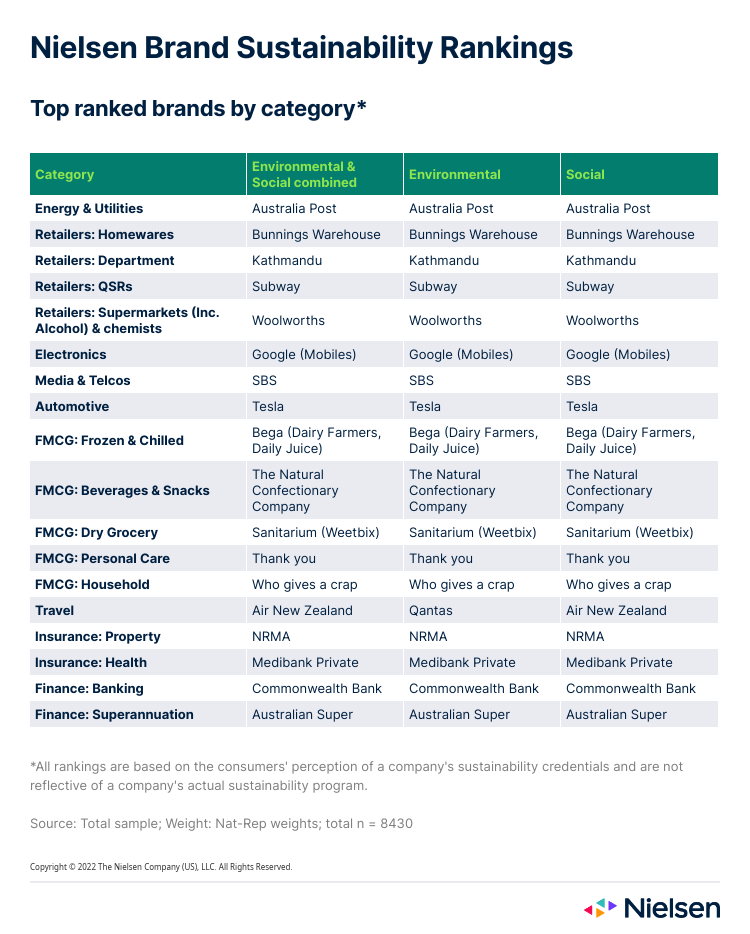
Nielsen’s Brand Sustainability Rankings are a key component of its recently released Brand Sustainability Report, compiled with support from Dentsu, AANA, and EDGE Environment.
The 18 broad product categories in the rankings were selected based on their relevance to the Australian consumer market, including market share, prominence, and information from Nielsen’s Ad Intel and Consumer & Media View (CMV).
Para manter a independência, nenhuma empresa foi envolvida no processo de seleção e nenhuma teve a opção de ser excluída.
To help consumers associate the relevant brand with the relevant organisation, where the company name is not directly associated with a brand, both the company name and brand name were shown together (e.g. Unilever’s brands were shown as Unilever – Ben & Jerry’s, Streets in the Frozen & Chilled category).
SAIBA MAIS SOBRE AS CLASSIFICAÇÕES E O RELATÓRIO DE SUSTENTABILIDADE DE MARCA DA NIELSEN
NOTE: *All rankings are based on the consumers’ perception of a company’s sustainability credentials and are not reflective of a company’s actual sustainability program. See below for more information and for the ranking methodology.
#ENDS#
Sobre o Relatório de Sustentabilidade da Marca da Nielsen
Categorias e marcas
Consumers were randomly assigned two categories to assess separately. For each category, they were asked to rank the environmental and social factors in order of importance to that specific category, with factors presented in random order. Subsequently, they were then asked to rate each of the brands against the top three environmental and social factors (brands were also presented in random order). These scores were then combined to form the rankings.
Brand ranking methodology
Both environmental and social sustainability were important areas for consideration in this research due to the macro yet nuanced nature of sustainability to consumers.
As such it’s not always a level playing field across all categories. For example, it’s more challenging for service-based categories to drive notable positive environmental change compared to categories that sell physical products which is why Social sustainability needs to be a key consideration.
While consumers increasingly view their consumption habits through a sustainability lens, their perspectives may shift depending on the situation. As important as the topic of sustainability is, it’s still one of several factors in a consumer’s decision-making process.
Da mesma forma, é fundamental que as marcas considerem não apenas o seu comportamento, mas também o comportamento de outras marcas da categoria, pois há um efeito de halo positivo e negativo entre as marcas. Como resultado, este é realmente o momento de pensar na categoria com relação à sustentabilidade
The process for determining a brand’s sustainability ranking* followed four broad steps.
Step 1.
Consumers were presented with a category and asked to rank various sustainability statements in order of importance when considering that specific category. This ranking allowed Nielsen to create weights for each statement, based on relevance.
Step 2.
Consumers were asked to score all brands within a category on their perceived delivery against their top three ranked statements.
Step 3.
Advanced statistical techniques were used to combine the statement weighting with the brand score for all brands within the category.
Step 4.
All data was combined to produce a ranking across categories.
Nielsen Brand Sustainability Rankings
Consumers rated brands across environmental and social sustainability factors, which were calculated in combination to provide an overall brand ranking.
Essas pontuações foram então combinadas para formar as classificações. Deve-se observar que uma visão holística deve ser adotada ao avaliar essas classificações, de modo que as diferenças entre duas marcas classificadas próximas (por exemplo, menos de cinco posições) não devem ser consideradas como uma diferença estatística. Entretanto, uma marca classificada aproximadamente 20 posições acima de seus concorrentes indicaria uma percepção de mercado muito melhor.
Sobre a Nielsen
Nielsen shapes the world’s media and content as a global leader in audience measurement, data and analytics. Through our understanding of people and their behaviours across all channels and platforms, we empower our clients with independent and actionable intelligence so they can connect and engage with their audiences – now and into the future. Nielsen operates around the world in more than 55 countries.
Saiba mais em www.nielsen.com e conecte-se conosco nas mídias sociais (Twitter, LinkedIn, Facebook e Instagram).
Media Contact
Dan Chapman
Associate Director, Marketing & Communications,
Pacific, Nielsen
dan.chapman@nielsen.com
+61 404 088 462
