As audiences continue to increase their streaming consumption, sports are ready to join the ranks of hit programs like Stranger Things, Somente assassinatos no prédio e Obi-Wan Kenobi. And with new streaming-exclusive deals involving the NFL and MLS in play, fans are ready, as more than one-third of U.S. homes now access TV programming strictly through an internet connection1.
While more than 90% of the homes in the U.S. have access to the internet, the growing abundance of video streaming services and content—both live and on-demand—provides audiences with ample choice outside of traditional TV options. And select sports leagues are transitioning as well. This year, the NFL’s Thursday Night Football (TNF) became exclusive to Amazon Prime Video; and starting next season, MLS matches will be exclusive to a new streaming service within the Apple TV app.
These two rights deals signal the shift that has been building as emerging digital platforms have progressively increased their stakes in sports rights. While some deals will continue to involve a mix of linear and streaming, such as the new Big Ten Conference deal, recent viewership trends illustrate how comfortable fans are in accessing sports content without traditional broadcast and cable access.
According to Insights de fãs da Nielsen, 80% of sports fans, 76% of NFL fans and 89% of soccer fans have regularly or sometimes watched sports on any streaming or online channel this year.
Do ponto de vista da visualização, o público parece estar muito mais envolvido com o streaming dos jogos da NFL na Amazon do que com a exibição dos mesmos na TV a cabo premium. Os dados de audiência da Nielsen TV mostram que os três primeiros jogos da TNF no Amazon Prime Video deste ano atraíram muito mais espectadores (13 milhões, 11 milhões e 11,7 milhões, respectivamente) do que cada um dos sete jogos de quinta-feira do ano passado que foram ao ar somente na NFL Network.
Esses dados de audiência destacam o quanto mudou desde que o Twitter transmitiu pela primeira vez 10 jogos do TNF durante a temporada 2016-17 da NFL, juntamente com as transmissões tradicionais, e os lares que obtêm seu conteúdo de TV por meio de uma conexão com a Internet estão prontos.
These homes, dubbed broadband-only homes2, spend an oversized amount of time with sports programming, along with local and national news. Across the top 56 U.S. local markets where Nielsen measures TV audiences, BBO households are 36% more likely to watch sports events than the average TV household. In some markets, they are twice as likely to view sports events3.
As a genre, sports has been slower to migrate to streaming platforms, but audiences’ appetite for over-the-top content continues to grow. In August 2022, streaming captured 35% of total TV time, capping six consecutive months of viewership highs. Access preference is even clearer when we look at the decline in the number of TV households that receive their content solely from a cable or satellite provider.
Não é de surpreender que a composição dos lares com BBO tenha se ampliado à medida que a porcentagem desses lares aumentou ao longo do tempo. Embora as pessoas de 25 a 34 anos sejam as mais propensas a viver em um lar com BBO (58,7%), a conectividade com a Internet, o acesso a ela e a disponibilidade de conteúdo inspiraram a adoção entre públicos muito mais amplos. Por exemplo, mais de 51% das crianças de 2 a 11 anos vivem em um lar com BBO, assim como quase um quarto dos adultos de 50 a 64 anos. Há apenas cinco anos, somente 2,1% dos adultos de 50 a 64 anos moravam em uma residência com BBO.
Mesmo com a composição cada vez mais ampla das residências BBO, a maioria é mais jovem, tem um tamanho maior e ganha mais do que a média das residências dos EUA. E, não surpreendentemente, as maiores concentrações de residências BBO estão nas principais áreas metropolitanas, simplesmente devido ao acesso à infraestrutura.
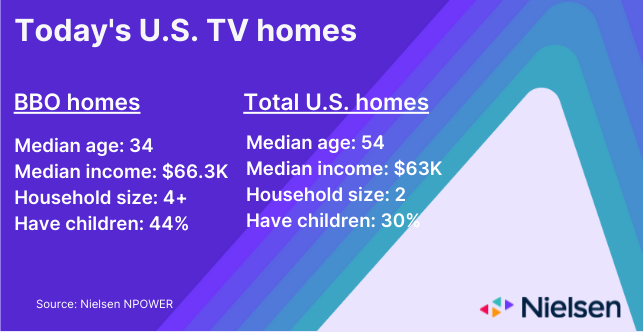
Nos próximos anos, esperamos que a composição dos lares BBO e suas concentrações geográficas se ampliem, em grande parte devido às muitas iniciativas que estão sendo introduzidas para fornecer acesso confiável e acessível à Internet de alta velocidade em áreas mal atendidas.
On Sept. 22, 2022, for example, the Biden-Harris administration announced $502 million in loans and grants in the third funding round of the USDA’s ReConnect Program to provide rural residents and businesses in 20 states with high-speed internet access. In total, Biden’s Bipartisan Infrastructure Law provides $65 billion to expand affordable, high-speed internet to all communities across the U.S. And at a more local level, an array of counties, cities and towns are making similar commitments to deliver and expand broadband infrastructure, such as Kenosha, Wis., rural North Carolina e Whiteside County, Ill.
The increasing focus on new broadband infrastructure, coupled with Americans’ plans to increase their streaming usage in the coming year, serves as additional evidence that audiences will continue gravitating to over-the-top, digital content options, including sports—one of two genres that remains a fixture within traditional linear TV programming. Given the strong appetite for sports and news among BBO homes, combined with the significant audience engagement with the first TNF game on Amazon, it’s likely that streaming services will continue to expand by offering different genres that BBO viewers are clamoring for.
Notas
- Nielsen NPOWER
- As residências que utilizam apenas banda larga recebem sua programação de TV por meio de uma conexão de alta velocidade à Internet
- Medição de TV local da Nielsen Julho de 2022
A version of this article originally appeared on Streaming Media.