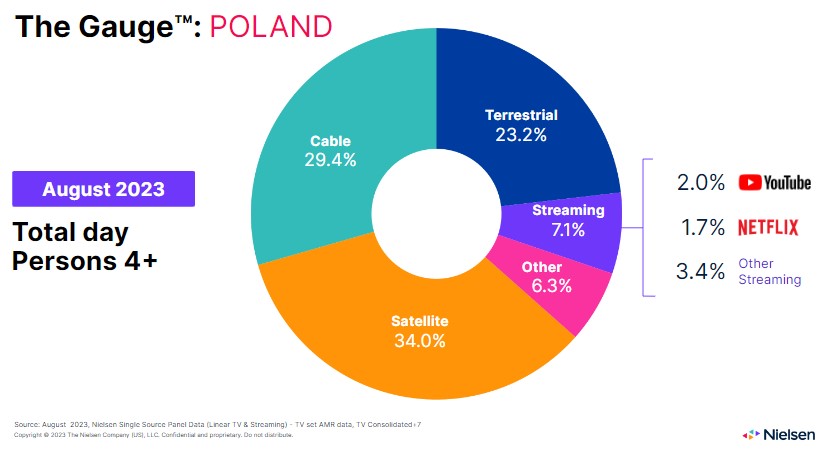
August and the whole summer is usually characterized by less time spent watching content on TV screens at home than other seasons. And this year’s August is no different – Poles were spending on average 3 hours and 32 minutes in front of TV screen, while during winter months the average time was 4 hours and 15 minutes. In August the largest share of TV viewing was generated by people watching satellite TV (34%), and traditional television accounted for 86.6% of TV viewing. On traditional television, as in July, the most popular programs were news and sports content. At the same time, streaming usage on TV reached a new record, rising 0.2 percentage points from July to 7.1%.
YouTube remained the most frequently watched streaming platform, accounting for 2% share in the time spent watching content on the TV screen, up 0.1 percentage from July). Netflix retained its 1.7% share of TV usage, unchanged from July.
None of the remaining streaming platforms grouped in the “Other streaming” category has yet reached the viewing threshold to be broken out separately in the Gauge.
Informazioni su Gauge
The Gauge™ è stato creato per fornire all'industria dei media un'analisi mensile dell'utilizzo della televisione attraverso le principali piattaforme di distribuzione televisiva. Nielsen ha pubblicato la prima edizione di The Gauge™ negli Stati Uniti nel maggio 2021.
Informazioni sulla metodologia Gauge
I dati provengono dal panel single-source di Nielsen composto da 3.500 famiglie e quasi 9.700 panelisti. Il Gauge™: Polonia si basa sui dati mensili di audience share AMR (Average Minute Rating). I dati sono presentati per le persone di età superiore ai 4 anni, suddivisi tra televisione via cavo, satellitare, terrestre (sia lineare che spostata nel tempo fino a 7 giorni) e audience da streaming (l'audience da streaming live di stazioni TV su piattaforme OTT è classificata come audience da streaming). La categoria "Altro" comprende le visualizzazioni di contenuti non riconosciuti.
Nielsen Polonia ha creato questa iterazione di The Gauge™ utilizzando metodologie concettualmente simili a quelle della versione statunitense. Le differenze metodologiche devono essere prese in considerazione quando si fanno dei confronti.
