TV has changed dramatically in recent years. New devices, distributors, streaming platforms, subscription models, and formats are transforming the industry and empowering viewers. But there’s one thing that hasn’t changed: People love to watch TV together.
It depends on the occasion, of course—what the program is, the time of day, the size of the screen, what room it’s in, the size of the family and whether anyone simply happens to be around. But people get together today to watch the Super Bowl or The Bachelorette for the same reason they got together to watch M*A*S*H or the Apollo 11 moon landing half a century ago: to have someone to share the experience with.
In the lingo of the media industry, that’s known as co-viewing. Let’s examine why it’s so important for measurement companies to get it right.
Quanto spesso le persone guardano la TV insieme?
Alla Nielsen studiamo il co-viewing da molto tempo. Le nostre soluzioni di misurazione storiche sono sempre state basate sulle persone, anche quando c'era solo una manciata di grandi reti televisive. Quindi abbiamo sempre avuto una fonte di verità affidabile per valutare la co-visione. Oggi, nelle case di tutta l'America, il 47%1 della TV lineare e connessa (CTV) viene consumato da più di una persona alla volta.
Today, there’s virtually no difference in co-viewing rates between linear TV and CTV, but it wasn’t always the case. Back in 2017, we ran a study with Roku and found a significant gap in co-viewing between linear TV (48%) and OTT (34%). Since then, smart TVs have become more widespread and large screens more affordable. And, increasingly, consumers don’t make the distinctions between linear and streaming or TV and digital. It’s all TV.
But that doesn’t mean that there aren’t any variations and that the same co-viewing factor can be applied across the board. There’s more co-viewing during primetime and on weekends, for sports and children programming, among men, young adults and in houses with more children. It also matters where the TV is located inside the house. Every case is different, and the only way to properly account for co-viewing is to measure it directly or model it separately for every ad impression.
Perché preoccuparsi se le persone guardano la TV insieme?
Most brands want to reach people, not households—and certainly not faceless devices. Wholesale ad impressions are nice, but they’re not enough. When they buy media, advertisers and their agencies spend top dollars to reach specific demographic targets (like 18-34 year-old women in Philadelphia, or 55+ in Arizona) or advanced audiences (like EV drivers who buy organic). They need guarantees that their ads are reaching the right people, and measuring co-viewing gets to the heart of that question.
Le aziende del settore dei media, dal canto loro, hanno bisogno di sapere chi guarda i loro contenuti per capire il loro pubblico, ottimizzare la programmazione e prezzare correttamente l'inventario pubblicitario. Se un nuovo programma ha un'audience particolarmente elevata tra i giovani adulti, ad esempio, possono ordinare nuove stagioni, dare il via libera a programmi simili e sviluppare un seguito di nicchia da monetizzare per aumentare gli abbonati o attirare gli inserzionisti desiderosi di raggiungere quegli spettatori.
Nel panorama televisivo odierno, altamente frammentato e ultra competitivo, le società di media non vendono più "tonnellate" e gli inserzionisti non comprano "bulbi oculari" indiscriminati. Tutti hanno bisogno di soluzioni di misurazione che li aiutino a deduplicare gli spettatori (all'interno e tra i vari dispositivi), a calcolare la distribuzione degli annunci on-target, a ottimizzare la portata e la frequenza e a migliorare gli indicatori chiave di performance delle campagne (come i tassi di efficienza dei demo target). Non è possibile raggiungere nessuno di questi obiettivi senza una misurazione a livello di persona.
Come misuriamo il co-viewing in Nielsen?
The most direct way to measure co-viewing is to monitor TV viewership at the individual level. That’s the case with our National TV Panel and top Local TV Markets. In these markets, our panelists “check-in” to the audience. But to add more depth and stability to our audience solutions—and provide more visibility into smaller audiences in smaller TV markets—we’re increasingly relying on big data based on ACR (for smart TVs) return-path data (for cable and satellite providers), or device and context identifiers (for ad impressions). And those technologies only capture viewing information at the household level.
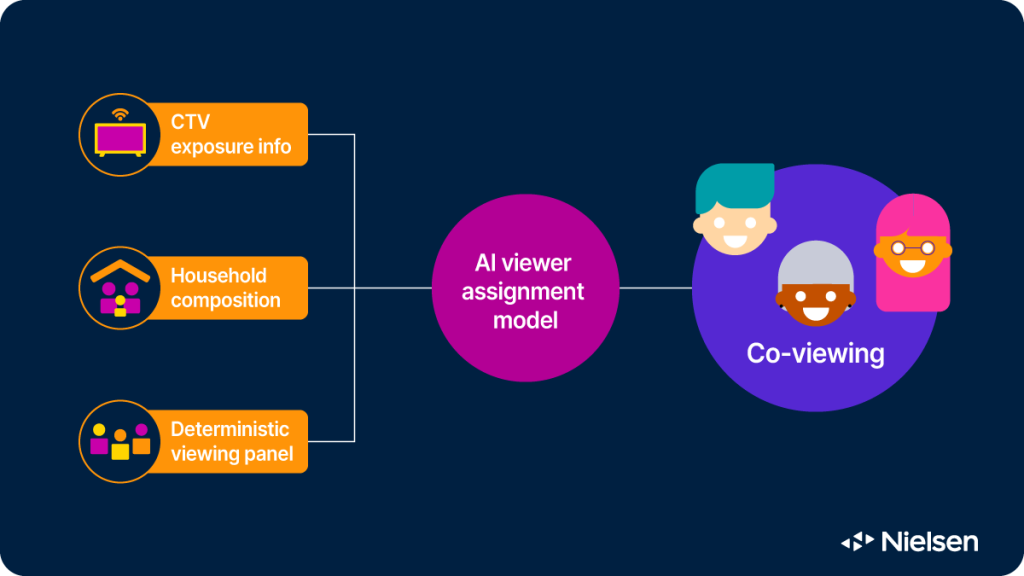
Nielsen is able to determine who is watching thanks to a process called Viewer Assignment that was developed a decade ago and has since been continuously refined. It uses advanced statistical techniques to match faceless viewing data from big data sources (like Roku, Vizio, Hulu, Netflix, YouTube and others) to our persons-level panel data for every possible viewing event and ad impression. The match is based on similarities in viewing behavior (down to the program level) as well as geography, household composition, device type and location inside the house, time of day, day of week, and other key predictors. The model never stops learning, and we’re constantly validating its performance to make sure it’s as close to reality as possible.
Avere a disposizione i dati del panel è un grande vantaggio per sfruttare al meglio queste nuove fonti di dati, ma è importante riconoscere che un processo come l'assegnazione degli spettatori non compensa tutti i casi di dati mancanti degli spettatori. A volte non c'è un riscontro affidabile per ciò che vediamo nei dati di visione, oppure la composizione del nucleo familiare non è facilmente disponibile. Per circa il 9% di tutti i dati CTV, rimane difficile assegnare anche semplici dati demografici degli spettatori, come l'età e il sesso. In questi casi, Nielsen si affida a solidi modelli predittivi per informare e fornire le assegnazioni degli spettatori.
What’s next?
Le recenti scoperte metodologiche ci hanno permesso di assegnare le caratteristiche degli spettatori a un numero maggiore di annunci, aumentando in modo significativo la nostra capacità di misurare la portata. I nostri modelli imparano costantemente dai vasti volumi di dati e segnali di Nielsen, consentendo alla nostra previsione degli spettatori di diventare sempre più completa.
La co-visione è sempre stata parte integrante dell'esperienza televisiva e non cambierà presto. Assicuratevi che sia parte integrante della vostra strategia di misurazione.
Nielsen’s Need to Know reviews the fundamentals of audience measurement and demystifies the media industry’s hottest topics. Read every article here.
Note
1Nielsen Panel Data