Se cercate una coperta con trama waffle su Amazon, un modello estivo da Target o una lavastoviglie da Best Buy, è molto probabile che i primi risultati della ricerca siano annunci sponsorizzati. Potreste anche vedere un banner promozionale nella parte superiore della pagina e un video con un bel marchio dopo uno o due scroll. Questo è il retail media al lavoro: pubblicità su misura per la vostra voglia di shopping.
Retail media networks are all about seizing the moment, so let’s jump right in.
Cosa sono le reti di media al dettaglio?
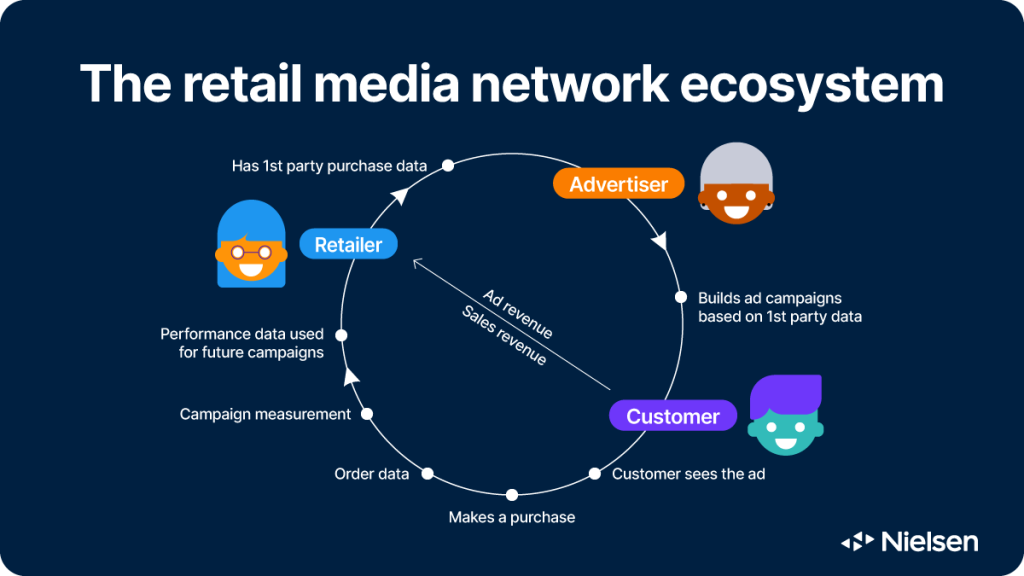
According to eMarketer, a retail media network is “an asset owned and operated by a retailer that publishes advertisements, or a third-party publisher with ads that leverage a retailer’s first-party shopper data.”
I rivenditori raccolgono dati sul vostro comportamento negli acquisti e li utilizzano per personalizzare la vostra esperienza, compresi gli annunci che vedete. Possono utilizzare il vostro profilo di acquisto e qualsiasi altra cosa apprendano su di voi dalle vostre interazioni con loro per influenzare gli annunci che vedete (o ascoltate) sui social media, sulla CTV e sulla radio digitale. Inoltre, le reti di media per la vendita al dettaglio sono in grado di collegare senza soluzione di continuità le impressioni alle vendite su una piattaforma, cosa che prima non era ampiamente disponibile.
Come sono nati i media al dettaglio?
Per la maggior parte degli osservatori del settore, la nascita dei media al dettaglio è stata il rilascio della soluzione pubblicitaria programmatica di Amazon, Amazon Ads Platform (AAP), nel 2012.
Learning from people’s shopping behavior, presenting them with relevant offers and reaching them at the point of purchase wasn’t exactly a new idea. Direct to consumer (DTC) brands, and brands with loyalty programs before them, had long used first-party shopper data to target consumers. And grocery chains and big box retailers have always featured in-store displays and promotions. But the scale and automation offered by Amazon were unprecedented.
From about $600 million that first year to $45 billion in 2023, the rise of Amazon’s ad business has been meteoric—and that was before the launch of its ad-supported Prime Video tier in early 2024. Over time, its success has drawn hundreds of other retailers into the media business. Walmart, Target, Kroger, Instacart, The Home Depot and others are fueling a sector that’s growing at twice the pace of social media (16.3% vs. 8.7% in 2023, according to the IAB) and is expected to overtake linear TV over the next couple of years.
Perché c'è tanto entusiasmo?
Le reti di media per la vendita al dettaglio sono un vantaggio per i rivenditori, i marchi e i consumatori.
For large retailers, scale and specialized audiences can represent a whole new revenue stream—with much stronger margins than their core retail business to boot. BCG estimates retail media margins in the 70% to 90% range for onsite ads and 20% to 40% for offsite ads, at a time when inflation, supply-chain issues and other macroeconomic conditions are putting intense pressure on retailers’ standard lines of business.
For brands, retail media networks offer a chance to create audiences based on recent shopping behavior and reach those audiences with finely tuned messages at a time when they’re likely to be more receptive to those messages. Relevant ads to the right people and in the right context is a great combination, especially now that third-party cookies and other legacy identifiers are (slowly) being deprecated. And retail media networks aren’t limited to lower-funnel campaigns either. No wonder 70% of global marketers say retail media networks are more important to their 2024 media plan than the previous year.
Anche i consumatori ci guadagnano, perché non vedono pubblicità di giacche da neve o crociere in Alaska quando stanno acquistando pantaloncini da snowboard e lezioni di snorkeling alle Hawaii.
Importanti considerazioni sul media mix
Sebbene i media retail siano indubbiamente un nuovo ed entusiasmante canale per gli inserzionisti, è necessario investirvi solo per le giuste ragioni. L'audience vale il costo maggiore? Potete raggiungere non solo i clienti esistenti, ma anche nuovi potenziali clienti? Come si integra con il resto del vostro media mix? Disponete di una reportistica coerente per confrontare le prestazioni di altre reti di vendita al dettaglio?
Sebbene i media al dettaglio rappresentino indubbiamente un nuovo ed entusiasmante canale per gli inserzionisti, è necessario investirvi solo per le giuste ragioni.
Too many marketers add retail media to their mix out of fear of missing out or out of concern that retailers might retaliate with inferior ‘shelf’ placement if they don’t buy advertising on the platform—something Forrester described as a form of hidden tax. Some advertisers are also under the impression that retail media networks solve the attribution puzzle with their closed-loop measurement because they’re so close to the moment of purchase. But last touch attribution isn’t any more reliable just because it’s on retail media.
Trattare i media retail come un canale qualsiasi
With hundreds of options on the market, over two-thirds of ad buyers (69%) are overwhelmed by the complexity of the current retail media buying process. While there are calls for standardization, it’s still largely siloed from other media transactions—to say nothing of the process of reconciling retail media buying with the rest of the media ecosystem. Four in ten ad buyers have only enough bandwidth to work with at most three retail media networks at a time.
In a sign that retail media is maturing, the IAB just proposed new standards in Europe to tear down silos between players and harmonize their offerings. At Nielsen, we think that’s a good first step. Brands need consistent, transparent and outcomes-minded measurement across all of their media partners to get a full picture and build confidence in their overall media spend.
I brand hanno bisogno di metriche coerenti, trasparenti e orientate ai risultati in tutti i loro partner media per avere un quadro completo e creare fiducia nella loro spesa media complessiva.
That confidence factor is essential to unlocking real spend. While advertisers are fine to shift some budget because of the measurable sales lift, there’s still uncertainty around the incremental value retail media can provide. The best thing that can happen to retail media is to be treated as just any other channel. And moving real budgets at scale will require comparability across all measurement metrics.
Opportunità emergenti per i media retail
This is the right time for standards. Online and offline retail media are merging thanks to the rise of digital “smart” shelves, in-store mobile experiences and loyalty programs that connect in-store and online data to build holistic consumer profiles. And retail media is already growing beyond lower-funnel activities and even retail, for that matter, with market leaders like Lyft, Marriott e Chase showing the way. It’s also crossing over into the CTV space, with trailblazing partnerships between Instacart and Roku, Walmart and Peacock, and of course Amazon and Prime Video.
Nielsen’s Need to Know reviews the fundamentals of audience measurement and demystifies the media industry’s hottest topics. Read every article here.