La stagionalità gioca un ruolo importante nel calo complessivo dell'utilizzo della televisione del 3% nel mese.
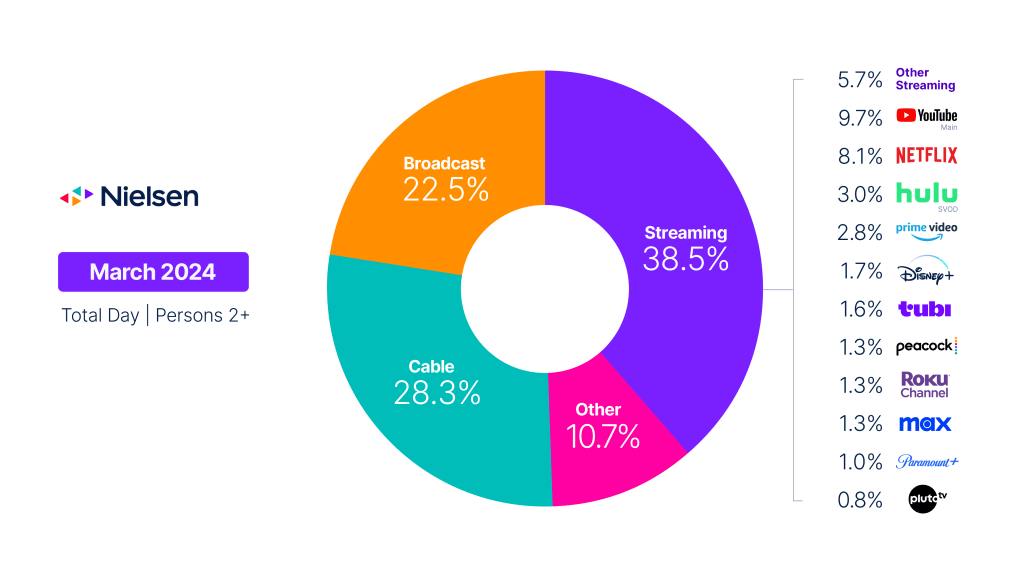
Following seasonal viewing trends that typically begin in February, overall television usage in the U.S. dipped again in March. Despite declines across categories, cable and streaming saw their share of TV viewing increase in this month’s report of The GaugeTM as a result of smaller declines in viewing in these categories compared with the overall decline of 3% on a monthly basis. While these changes follow similar month-over-month trends from last year, they also point at larger shifts happening to Americans’ media habits.
La crescente influenza dello sport femminile
Similar to March 2023, the NCAA “March Madness” tournament helped cable viewing hold steady and gain 0.7 share point, as the category saw a 43% bump in sports viewing, to finish the month with 28.3% of TV. However, unlike last year, which was driven almost exclusively by the men’s division, the NCAA women’s games charged onto TV screens this March.
Infatti, l'incontro di basket femminile NCAA tra le Iowa Hawkeyes e le West Virginia Mountaineers del 25 marzo su ESPN è stato tra le prime 10 trasmissioni via cavo del mese (settimo posto assoluto). L'anno scorso la stessa partita era entrata a malapena nella top 100 delle trasmissioni via cavo. Senza contare le partite dell'Elite Eight, della Final Four e del campionato, che si sono svolte in aprile.
The appeal of the tournament among sports fans highlights the impact that high-demand content has on viewership, regardless of platform or channel, and also highlights a larger trend we’re seeing in the rise of women’s sports.
Stagionalità o cambiamento delle abitudini mediatiche?
Al di là della March Madness, i cambiamenti da febbraio a marzo della TV nel 2024 sono quasi identici alla transizione che abbiamo visto l'anno scorso, riflettendo la stagionalità degli ascolti come risultato dei cambiamenti annuali del tempo, delle vacanze, delle ferie, ecc. Tuttavia, se analizziamo i dati più in profondità, possiamo notare l'esistenza di trasformazioni più ampie che interessano il settore.
Following seasonal trends similar to the past few years, broadcast viewing fell 6% in March to finish with a 22.5% share of television. To add some perspective, when Nielsen released the first edition of the GaugeTM in May 2021, the broadcast category accounted for 25% of television viewing, and despite the continued declines, the category has been fairly resilient, with a less sharp drop than some might have expected.
In confronto, la visione in streaming è diminuita solo dell'1% rispetto al mese scorso, ma ha guadagnato 0,8 punti di share, raggiungendo il 38,5% della visione televisiva a marzo. Nessuna categoria ha visto un cambiamento più drammatico dello streaming su base annua, poiché ha guadagnato il 12% rispetto a un anno fa e ha aggiunto 4,4 punti di share. Una parte di questo spostamento è stata determinata dai fornitori di canali FAST (PlutoTV, The Roku Channel e TubiTV), mentre una parte considerevole dei titoli è stata alimentata dai contenuti delle reti via cavo.
So while the cable category may be shrinking in terms of its share of television, cable content remains powerful with consumers. In addition to March Madness, the State of The Union address on March 7, which drew 32.2 million viewers in total (14.1 million on cable alone), reminds us that cable remains a news-driven category as six of the top 10 cable telecasts this month were related to the event. As we look toward November, cable will play a significant role in how audiences connect with news media ahead of the 2024 U.S. elections.
Tendenze dei dati di marzo con Brian Fuhrer
Metodologia e domande frequenti
How is ‘The Gauge’ created?
The data for The Gauge is derived from two separately weighted panels and combined to create the graphic. Nielsen’s streaming data is derived from a subset of Streaming Meter-enabled TV households within the National TV panel. The linear TV sources (broadcast and cable), as well as total usage are based on viewing from Nielsen’s overall TV panel.
Tutti i dati sono basati sul periodo di tempo per ciascuna fonte di visione. I dati, che rappresentano un mese di trasmissione, si basano sulle visualizzazioni Live+7 per l'intervallo di riferimento (nota: Live+7 comprende la visione della televisione in diretta e la visione fino a sette giorni dopo per i contenuti lineari).
Cosa si intende per "altro"?
Within The Gauge, “other” includes all other TV usage that does not fall into the broadcast, cable or streaming categories. This primarily includes all other tuning (unmeasured sources), unmeasured video on demand (VOD), audio streaming, gaming and other device (DVD playback) use.
Beginning with the May 2023 interval, Nielsen began utilizing Valutazioni dei contenuti in streaming to identify original content distributed by platforms reported in that service to reclassify content viewed via cable set top boxes. This viewing will credit to streaming and to the streaming platform which distributed it. It will also be removed from the other category, where it was previously reflected. Content not identified as original within Streaming Content Ratings and viewed through a cable set top box will still be included in other.
What is included in “other streaming”?
Streaming platforms listed as “other streaming” includes any high-bandwidth video streaming on television that is not individually broken out. Apps designed to deliver live broadcast and cable (linear) programming (vMVPD or MVPD applications like Sling TV or Charter/Spectrum) are excluded from “other streaming.”
Dove contribuisce lo streaming lineare?
Linear streaming (as defined by the aggregation of viewing to vMVPD/MVPD apps) is excluded from the streaming category as the broadcast and cable content viewed through these apps credits to its respective category. This methodological change was implemented with the February 2023 interval.
E lo streaming live su Hulu e YouTube?
Lo streaming lineare tramite app vMVPD (ad esempio, Hulu Live, YouTube TV) è escluso dalla categoria dello streaming. Hulu SVOD" e "YouTube Main" all'interno della categoria streaming si riferiscono all'utilizzo delle piattaforme senza l'inclusione dello streaming lineare.