Oltre a coinvolgere milioni di tifosi in tutto il Paese, lo sport è un grande business, soprattutto per quanto riguarda i diritti televisivi. E se guardiamo alle opportunità commerciali, niente è meglio del calcio, cosa che l'industria dei media ha sperimentato in prima persona con i recenti cambiamenti di membri delle principali conferenze NCAA.
I cambiamenti non influenzeranno probabilmente il fandom delle singole squadre, ma le modifiche, che sono le più ampie della storia recente, influenzeranno il modo in cui le squadre appaiono in TV e chi potrà vedere le loro partite.
Come per molti aspetti dell'industria dei media, l'audience è il fattore chiave del riallineamento delle conference, che non entrerà in vigore prima della stagione 2024. A quel punto otto squadre lasceranno la Pac-12 per unirsi a conferenze con accordi televisivi più vantaggiosi: Quattro si uniranno alla Big Ten e quattro alla Big 12.
Unlike the other Power Five1 conference members, the Pac-12 does not have a long-term TV rights deal, which has a direct impact on the revenue each member school receives. For example, the Big Ten expects its seven-year deal with CBS, FOX and NBC to be lucrative enough to distribute between $80 million and $100 million annually to each member school. The $8 billion deal is the biggest in the history of college athletics, and it gives the contract holders access to some of NCAA football’s highest-ranked and most-watched teams, including Michigan, Ohio State and Penn State.
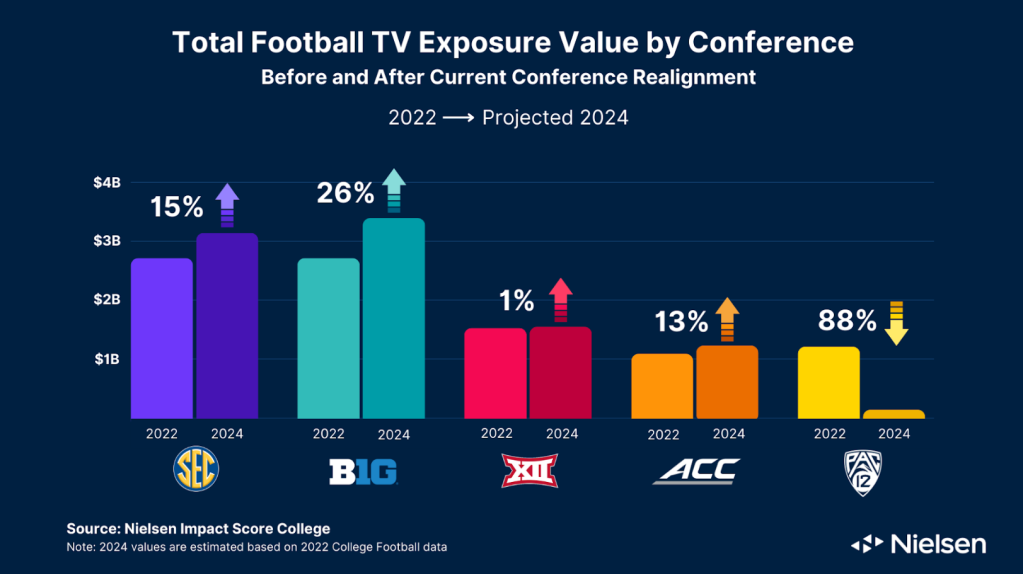
L'appartenenza a una conferenza influisce su tutti gli sport di ciascuna scuola membro, ma i cambiamenti degli ultimi anni sono stati tutti motivati dai diritti associati alle partite di calcio in diretta. Sulla base di un'analisi del valore associato all'esposizione televisiva di ciascuna conferenza durante la stagione 2022, i riallineamenti che entreranno in vigore l'anno prossimo avranno un impatto significativo per la SEC, la Big Ten e la Pac-12.
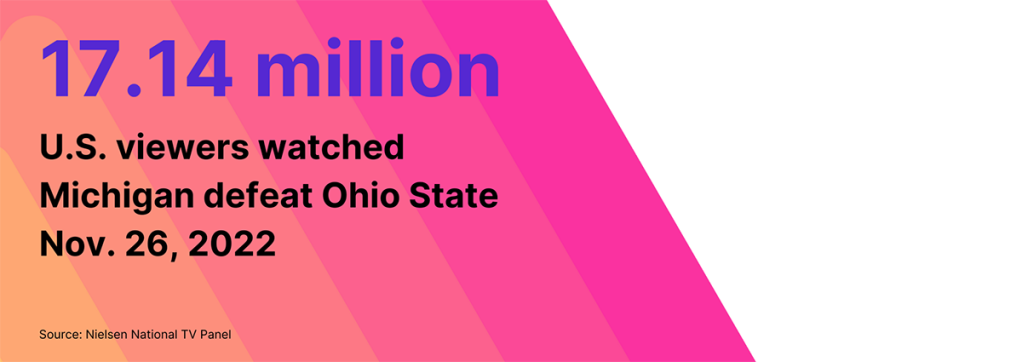
The value of TV exposure is clear. One-third of Americans say they’re college football fans2, making the league the fourth-most popular in the U.S. (behind the NFL, NBA and MLB). And big teams draw big viewership: More than 17 million viewers3 watched last year’s marquee late-season matchup between Ohio State and Michigan, the highest viewership of the regular season. For comparison, nearly 2.3 million viewers3 watched the Brooklyn Nets play the Philadelphia 76ers in the first round of last year’s NBA playoffs.
While top-ranking teams and storied rivalries will always command national TV coverage, the implications of the conference membership changes will have different outcomes at the local market level. Last year’s week 8 game between UCLA and Oregon (which will both leave the Pac-12 next year) attracted a national audience of 3.34 million3. Once these two teams join the Big Ten, they will expand the conference’s TV audience across the entire country and both coasts.
To better understand how the conference changes will shape local TV viewership beyond individual games, we examined the difference between Pac-12 and Big Ten TV viewing in Los Angeles, Portland and Seattle during the 2022 season. These designated market areas (DMAs) are home to four West Coast teams4 that will switch conferences next year.
Due to the size of these three markets, last season’s Pac-12 programming reached 123% more households and 151% more individual viewers than Big Ten programming did5. And while the 0.1 difference in co-viewing might seem insignificant at face value, it becomes far more meaningful when you multiply it by the total viewing population of the three DMAs.
Scomponendo le visualizzazioni aggregate della conferenza, possiamo vedere l'impatto che i cambiamenti della conferenza avranno su ogni singolo mercato. Nonostante la popolazione di Los Angeles, che ospita UCLA e USC, Portland è la città che otterrà il maggior incremento percentuale di telespettatori nella prossima stagione.
While the Big Ten will benefit next year from the arrival of USC, UCLA, Oregon and Washington, the Big 12 will benefit from the arrival of the University of Colorado, home to this year’s hottest college football story. The Colorado Buffaloes have been in the news ever since NFL legend Deion Sanders took over as head coach last year, but the team’s 3-1 start, including an upset over TCU (Texas Christian University) to open the season, has made their games must-see TV for football fans. In fact, the team’s double-overtime victory over Colorado State on Sept. 16 attracted 9.3 million viewers3 despite the fact that it didn’t start until after 10 pm ET. The team’s Sept. 23 game against Oregon attracted more than 10 million live and same-day viewers, the largest audience of the season.
Mentre la nostra analisi del valore dell'esposizione televisiva nazionale non suggerisce un cambiamento significativo (+1%) per la Big 12 quando Colorado entrerà a far parte della squadra il prossimo anno (insieme ad Arizona, Arizona State e Utah), l'impatto sull'audience televisiva locale è una storia diversa. L'impatto di Coach Prime è stato immediato: l'audience televisiva di Denver per la prima partita dei Buffaloes è stata del 117% superiore a quella dell'anno scorso. E questo era solo un punto di partenza.
Complessivamente, la maggiore attenzione è di buon auspicio per la Pac-12 quest'anno e per la Big 12 l'anno prossimo, dato che la media degli spettatori a livello domestico è aumentata del 976% e di oltre il 1.100% tra gli spettatori dai 2 anni in su. Il clamore suscitato dai Buffaloes sta facendo aumentare anche il co-viewing del 15% quest'anno.
Non c'è dubbio che il football universitario NCAA eserciti un grande fascino sugli appassionati di sport, soprattutto quando in città si disputano grandi incontri. Mentre le grandi rivalità avranno sempre un'esposizione televisiva nazionale, possiamo vedere come il pubblico televisivo dei mercati locali contribuisca al valore associato alle squadre coinvolte con i più recenti cambiamenti tra le Power 5 conference NCAA.
Fonti
1The five most prominent and highest-earning athletic conferences in Division I NCAA football: ACC, Big Ten, Big 12, Pac-12, SEC
2Nielsen Fan Insights; Q2 2023
3Nielsen National TV Panel; live + same day viewing (3 a.m.-3 a.m.)
4UCLA, USC, Oregon, Washington
5Nielsen Local TV measurement