Come si colloca la misurazione digitale rispetto a quella televisiva?
In a lot of ways, it’s similar: It involves panels, big data and technology to capture what people are doing online and who they are. As with TV, publishers use measurement to gauge the popularity of their content and value their ad inventory, and advertisers use it to verify that their campaigns are running and reaching their intended audience at the right frequency1.
Sebbene i principi di base e gli obiettivi finali della misurazione televisiva e digitale siano simili, gli strumenti, i processi e l'ecosistema coinvolti sono molto diversi.
Vediamo di capire le sfumature di come misurare il pubblico e le campagne digitali.
Cosa intendiamo per "misurazione digitale"?
At the most basic level, digital measurement means monitoring a user’s exposure to ads and content delivered over the internet. When we talk about digital measurement in the media industry, we generally focus on two dominant digital experiences: walled gardens and the open web.2
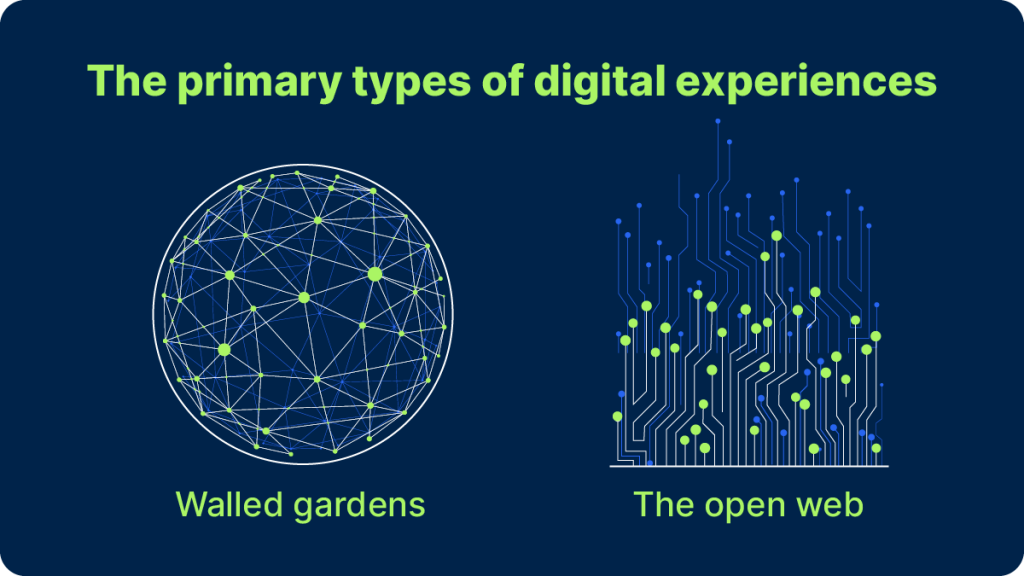
La differenza fondamentale tra i due è che i walled garden limitano l'accesso ai dati di prima parte, come un giardino chiuso dietro un muro, mentre l'open web non lo fa. I siti di social media sono un esempio di walled garden, mentre siti e app come Weather.com, Words With Friends e CNN fanno parte dell'open web.
Si tratta di una distinzione importante ai fini della misurazione: Tecnicamente, un walled garden dovrebbe avere un'idea abbastanza chiara di chi accede ai contenuti e vede gli annunci sulla sua piattaforma. Ma se altre aziende vogliono misurare il consumo di pubblicità o di contenuti all'interno di questi walled garden, in genere devono creare integrazioni personalizzate che siano conformi alle normative sulla privacy.
Sebbene i siti web aperti possano disporre di dati di prima parte solidi e autenticati, non è sempre scontato. In questi casi, i siti web generalisti si affidano spesso a ID proxy e ad altre soluzioni adtech per identificare, indirizzare e misurare gli utenti.
Le attuali sfide del settore
On the open web, the ongoing deprecation of third-party cookies and device IDs is making it more difficult to identify users and is forcing stakeholders to rethink their measurement approach. Apple’s decision in 2021 to change default app tracking permissions (from opt-out to opt-in) wiped out three-fourths of IDFAs (Apple’s mobile ad IDs) from consideration. And Google is scheduled to phase out third-party cookies in the second half of 2024, the final blow to an ID system that held up for the most part, but was always an imperfect solution. Cookies aren’t people, after all.
For walled gardens, the practice of sharing granular subscriber data with outside parties is largely a thing of the past, even for anonymized measurement purposes. To comply with major data global privacy regulations, walled gardens are now sharing activity data with advertisers and measurement companies in aggregate form, if they’re sharing it at all.
Si tratta di sfide serie per la misurazione, che hanno costretto il settore a cercare altrove gli identificatori, i segnali e gli attributi dei consumatori. E tutto inizia con un'impressione.
Che cos'è esattamente un'"impressione" digitale?
Prima di entrare nei dettagli di come si presenta un moderno processo di misurazione digitale, spieghiamo cos'è un'impressione.
Le impressioni misurano il numero di volte in cui un annuncio o un contenuto è stato trasmesso a un dispositivo digitale. Le impressioni indicano il volume totale di esposizione al vostro annuncio o contenuto, ma non misurano il numero di persone che lo hanno effettivamente visto. (Quindi, ad esempio, se cinque persone hanno visto il vostro annuncio su LinkedIn due volte, significa che le impressioni della vostra campagna sono state 10.
Le attuali linee guida sulla viewability dei media digitali per qualificare un'impression stabiliscono che un annuncio deve essere a fuoco per almeno il 50% sullo schermo dell'utente - non nascosto dietro un'altra finestra, ad esempio, o in riproduzione sullo sfondo - per almeno 1 secondo per gli annunci display e 2 secondi consecutivi per gli annunci video. Il tempo di impression e le soglie di viewability forniscono ora agli inserzionisti e agli editori una solida base per stabilire i termini delle loro transazioni mediatiche.
Ora che abbiamo capito quale attività digitale stiamo misurando, entriamo nel merito di come la misuriamo.
5 fasi chiave del processo di misurazione digitale
In Nielsen consideriamo la misurazione digitale come un processo in cinque fasi:
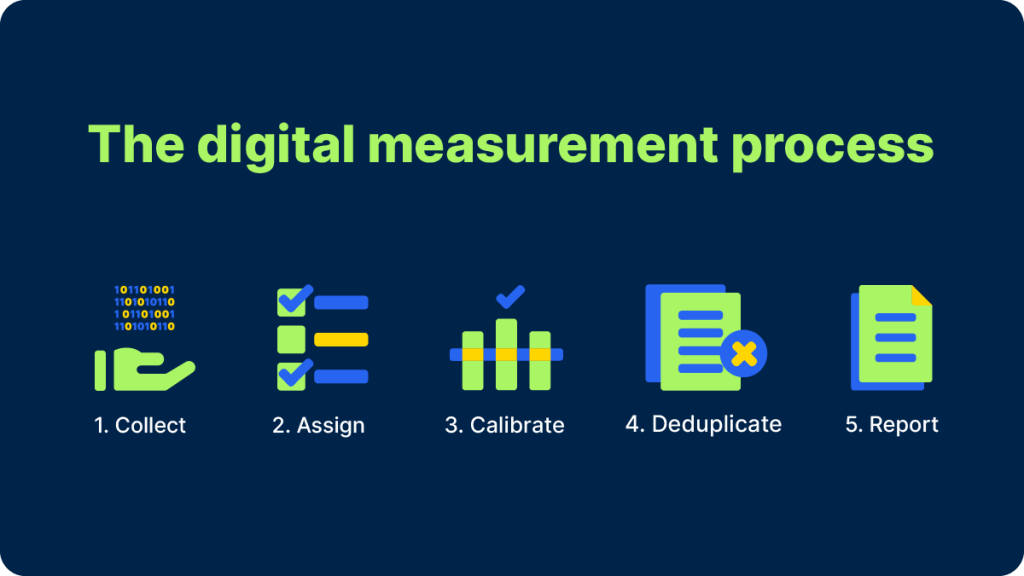
Fase 1: RACCOLTA
The first step in the process is to make sure that the content and ads data is all properly captured and identified. For web content, a page URL is an acceptable identifier, but there might be multiple ads on a single url that will need to be uniquely identified. For content measurement, clients’ integrate Nielsen’s SDK3 within their websites or apps. For ads measurement, we either use direct integrations with publishers, or ask advertisers or their agencies to integrate Nielsen tags in their ads when they traffic campaigns. When ads are delivered to the user’s browser or app, those Nielsen tags ping our servers with information about the ad that was delivered along with important meta-data information that enables us to filter out any invalid robotic traffic. Javascript tags, on top of all the campaign data, capture additional signals for measuring second-by-second viewability data (for display and video ads) and audio volume levels (for video ads). This allows us to accurately collect all the impression data.
Fase 2: ASSEGNAZIONE
The next step is to assign those impressions to a person. With the ecosystem changes discussed above, we’re now transitioning to a system where cookies are replaced with alternate identifiers and first-party data provided by clients—such as hashed email addresses, Unified ID 2.0 or self-reported demographic labels—and verified against our own growing ID graph. The goal is to get as close as possible to the demographic profile of the person who was exposed to the content or ad, and if that’s not possible, at least attach some useful information about their behavior and interests.
Fase 3: CALIBRARE
Then, you need to calibrate your data for demographic accuracy. It’s important to acknowledge that even the best demo assignment process in the world will still return many cases where the user couldn’t be identified, and those misses can’t be assumed to be randomly distributed across all demographic groups. This may lead an advertiser to draw erroneous conclusions about the impact of their campaign. A panel can be used as a source of truth to calibrate census-level impressions. At Nielsen, we maintain digital and participant panels of 725,000 for exactly that purpose. Some are equipped with a computer meter, others with a mobile meter to measure their app and web usage on smartphones and tablets. And we make sure we have accurate demographic and profiling data for everyone in the panel
Passo 4: DEDUPLICAZIONE
Next, you must ensure your campaign reach isn’t inflated across devices . Over the course of a campaign, people are typically exposed to it many times, especially when that campaign is running on multiple walled gardens and on the open web. Multiple exposures are generally a good thing—it takes a few impressions to make an impression—but advertisers are rightfully very mindful of ad waste4 and putting off consumers with repetitive ads. Deduplicating reach—that is, ensuring the same viewer isn’t counted multiple times—and calculating a campaign’s true frequency are critical steps in the measurement process.
Fase 5: RAPPORTO
Finally, you need to monitor performance. Everything above needs to happen on a continuous basis, and actionable reports need to be available as quickly as possible to give marketers the insights they need to reallocate funds to their most effective channels and most receptive audiences while their campaign is still in flight and there’s still time to change course.
Verso la misurazione crossmediale
Il settore della misurazione è sottoposto a forti pressioni per adattarsi ai massicci cambiamenti già in atto nell'ecosistema digitale. Gli inserzionisti hanno bisogno di una visione chiara delle prestazioni delle campagne sui dispositivi digitali, di fiducia nei risultati e di strumenti affidabili per ottimizzare le campagne in volo.
But there’s even more pressure to get digital and TV impressions on a level playing field. This is an ongoing effort—what constitutes an impression on linear TV and on digital platforms aren’t the same yet—but thanks to the development of a common ID system and launch of Nielsen ONE, we’re already helping marketers deduplicate reach and frequency across select digital and linear platforms in key markets around the world.
At Nielsen, we’ve also recently launched ‘Always On’ digital measurement with proactive partners like YouTube to emulate the way that linear measurement is done and help marketers turn on digital measurement capabilities on a continuous basis, rather than campaign-by-campaign.
C'è ancora molto lavoro da fare perché la misurazione crossmediale diventi realtà nel nostro settore, ma con le giuste priorità, gli strumenti e i processi in atto, siamo più vicini di quanto non lo siamo mai stati.
Nielsen’s Need to Know reviews the fundamentals of audience measurement and demystifies the media industry’s hottest topics. Read every article here.
Fonti
1For an overview of TV measurement, read Need to Know: How Are TV Audiences Measured?
2Connected-TV platforms and retail media networks share many characteristics with both walled gardens and the open web. Stay tuned for a future Need to Know article on those fast-growing media channels.
3The Nielsen software development kit (SDK) is one of multiple framework SDKs that Nielsen provides to measure both static and video content across platforms.
4Nielsen’s Digital Ad Ratings estimate that 37% of digital ad spend is currently wasted on impressions that are off-target, out-of-view or SIVT.