Come ogni fan può testimoniare, la musica fa molto di più che intrattenerci. Ha il potere di energizzarci, ispirarci e trasportarci. L'umore gioca un ruolo fondamentale in questo senso e gli interpreti della 67ª stagione dell'Eurovision Song Contest attingeranno a una gamma di emozioni nel tentativo di toccare le corde giuste con un pubblico entusiasta, a volte fanatico.
To do so, the performers plan to get intense with audiences by leaning into energetic moods and shifting away from the neutral moods that were more prevalent last year. In total, seven of this year’s 37 songs fall into the “energizing” mood category1—the most prominent primary mood descriptor2 across all of the entries. While we saw an equal number of “energizing” entries last year, this year’s contest will feature more songs with other energetic undertones.
L'anno scorso, ad esempio, lo "struggimento" era lo stato d'animo più diffuso (nove) tra le canzoni in gara; quest'anno sono solo quattro. Allo stesso modo, quest'anno non ci sono canzoni con un descrittore primario di stato d'animo "sensuale", mentre l'anno scorso ce n'erano cinque. Anche il numero di canzoni con "eccitato" e "sfidante" come stati d'animo primari è doppio: rispettivamente quattro e due.

The shift toward more energetic moods bodes well for competitors, as half of the 24 winning songs between 1998 and 2022 were characterized by five moods at the more energetic side of the spectrum: “energizing,” “excited,” “fiery,” “rowdy” and “urgent.” And in the last decade, seven of the last 10 winning songs have expressed at least one of these moods. This year, 19 of the 37 entries express “energizing,” “excited,” “fiery,” “rowdy” or “urgent” as their main mood.
Of these five moods, “fiery” is the most common among winners since 1998, including last year, when “Stefania,” Ukraine’s entry from hip-hop band Kalush Orchestra, took the top prize. “Stefania” was one of three entries with a “fiery” primary mood.
Dana International’s win for Israel in 1998 with her song “Diva” was the first entry with a “fiery” primary mood descriptor to take the top prize. Her win also kicked off a trend that we’ve seen hold through 2022: 14 winners have featured moods at the more energetic end of the spectrum. Israel’s win in 1998 was also more in tune with the pop music of the time—a shift that has carried through most of the contests in the years that followed.
In confronto, le canzoni vincitrici delle prime 42 edizioni del concorso, iniziato nel 1956, erano meno energiche: Solo quattro dei 45 vincitori (nel 1969 ci sono stati quattro co-vincitori) di questo periodo erano canzoni con uno stato d'animo più energico. Le altre avevano livelli di energia medi o inferiori alla media.
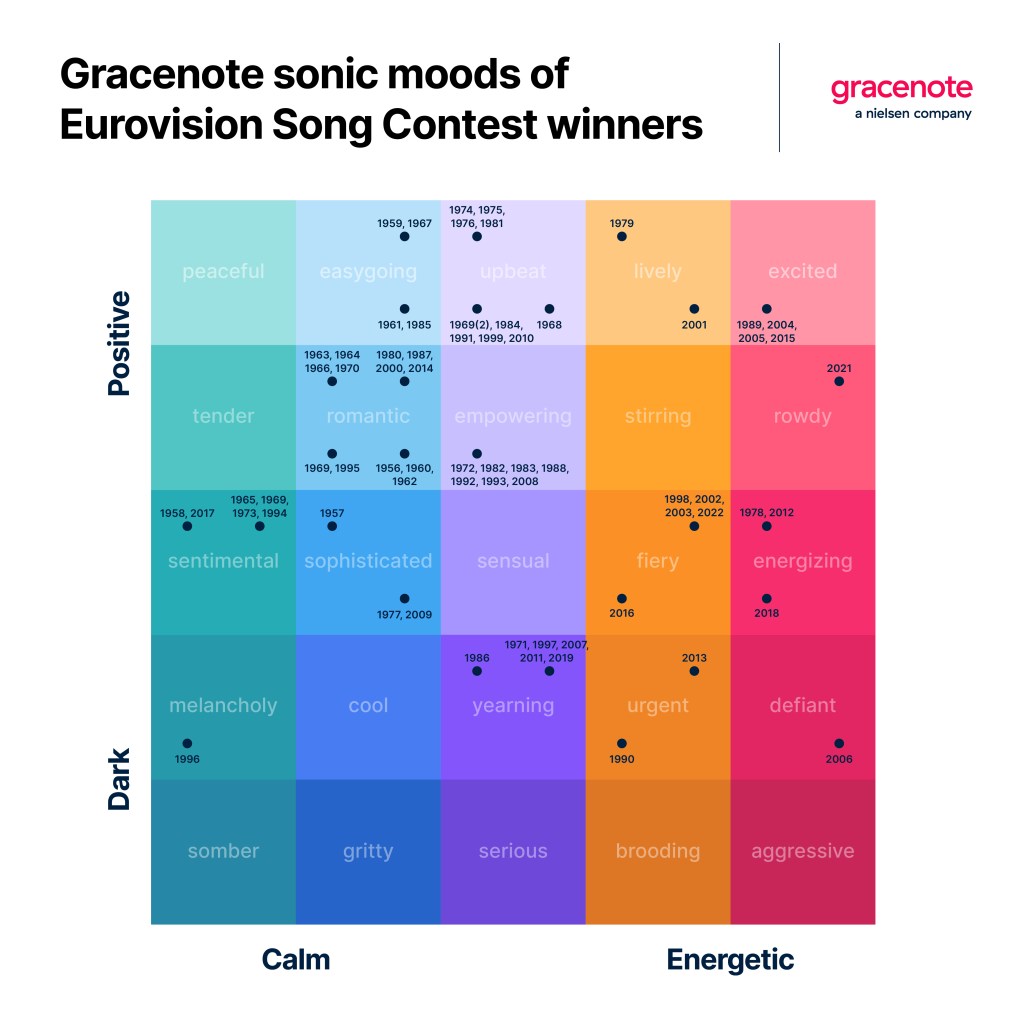
In total, this year’s entries cover less emotional range than last year, as the songs cover just 12 primary moods—down from 15 in 2022. Entries are more heavily stacked in the positive and energetic areas of the mood spectrum, which puts more songs in contention to win from a recent historical perspective. In looking at the top 10 contenders to win, based on the odds at eurovisionworld.com, seven exhibit one of the five moods that have dominated in recent years, suggesting that history will likely repeat itself when the final vote is tallied following this year’s contest.
Il concorso di quest'anno inizia il 9 maggio 2023. Le semifinali si terranno l'11 maggio e la finale il 13 maggio.
Note
1 As categorized by Nielsen’s Gracenote music data
2 Gracenote’s Sonic Mood Descriptors feature 25 level one mood descriptors. These descriptors indicate the most prominent and distinct elements in a song, such as rhythm, melody, and timbre. Combined, they provide a “mood profile” of a song, which indicates the primary mood and strength.