As audiences continue to increase their streaming consumption, sports are ready to join the ranks of hit programs like Stranger Things, Solo omicidi nell'edificio e Obi-Wan Kenobi. And with new streaming-exclusive deals involving the NFL and MLS in play, fans are ready, as more than one-third of U.S. homes now access TV programming strictly through an internet connection1.
While more than 90% of the homes in the U.S. have access to the internet, the growing abundance of video streaming services and content—both live and on-demand—provides audiences with ample choice outside of traditional TV options. And select sports leagues are transitioning as well. This year, the NFL’s Thursday Night Football (TNF) became exclusive to Amazon Prime Video; and starting next season, MLS matches will be exclusive to a new streaming service within the Apple TV app.
These two rights deals signal the shift that has been building as emerging digital platforms have progressively increased their stakes in sports rights. While some deals will continue to involve a mix of linear and streaming, such as the new Big Ten Conference deal, recent viewership trends illustrate how comfortable fans are in accessing sports content without traditional broadcast and cable access.
According to Approfondimenti sui fan Nielsen, 80% of sports fans, 76% of NFL fans and 89% of soccer fans have regularly or sometimes watched sports on any streaming or online channel this year.
Dal punto di vista dell'audience, il pubblico sembra molto più coinvolto nello streaming delle partite NFL su Amazon che nella visione via cavo. I dati televisivi di Nielsen mostrano che le prime tre partite del TNF su Amazon Prime Video quest'anno hanno attirato molti più spettatori (rispettivamente 13 milioni, 11 milioni e 11,7 milioni) rispetto a ciascuna delle sette partite del giovedì dell'anno scorso trasmesse solo su NFL Network.
Questi dati di audience evidenziano quanto sia cambiato da quando Twitter ha trasmesso per la prima volta 10 partite del TNF durante la stagione NFL 2016-17 insieme alle trasmissioni tradizionali, e le case che ottengono i loro contenuti televisivi attraverso una connessione internet sono pronte.
These homes, dubbed broadband-only homes2, spend an oversized amount of time with sports programming, along with local and national news. Across the top 56 U.S. local markets where Nielsen measures TV audiences, BBO households are 36% more likely to watch sports events than the average TV household. In some markets, they are twice as likely to view sports events3.
As a genre, sports has been slower to migrate to streaming platforms, but audiences’ appetite for over-the-top content continues to grow. In August 2022, streaming captured 35% of total TV time, capping six consecutive months of viewership highs. Access preference is even clearer when we look at the decline in the number of TV households that receive their content solely from a cable or satellite provider.
Non sorprende che la composizione delle famiglie BBO si sia ampliata con l'aumento della percentuale di queste case nel tempo. Sebbene le persone di età compresa tra i 25 e i 34 anni siano le più propense a vivere in una casa BBO (58,7%), la connettività a Internet, l'accesso ad essa e la disponibilità di contenuti hanno ispirato l'adozione da parte di un pubblico molto più ampio. Ad esempio, più del 51% dei bambini dai 2 agli 11 anni vive in una casa BBO, così come quasi un quarto degli adulti dai 50 ai 64 anni. Solo cinque anni fa, solo il 2,1% degli adulti 50-64 viveva in una casa BBO.
Anche se la composizione delle case BBO si è ampliata, la maggior parte di esse è più giovane, ha dimensioni maggiori e guadagna di più rispetto alla famiglia media degli Stati Uniti. E non sorprende che le maggiori concentrazioni di case BBO si trovino nelle grandi aree metropolitane, semplicemente per l'accesso alle infrastrutture.
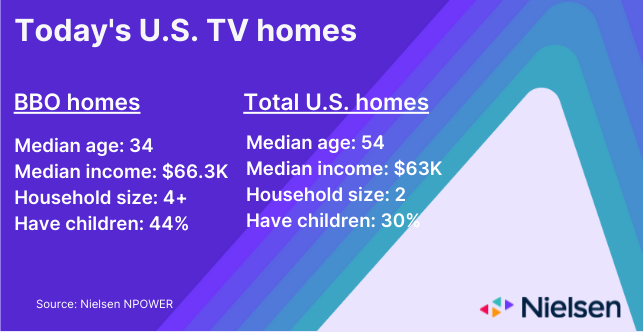
Nei prossimi anni, ci aspettiamo che la composizione delle case BBO e la loro concentrazione geografica si allarghino, soprattutto grazie alle numerose iniziative introdotte per fornire un accesso a Internet ad alta velocità affidabile e a prezzi accessibili alle aree meno servite.
On Sept. 22, 2022, for example, the Biden-Harris administration announced $502 million in loans and grants in the third funding round of the USDA’s ReConnect Program to provide rural residents and businesses in 20 states with high-speed internet access. In total, Biden’s Bipartisan Infrastructure Law provides $65 billion to expand affordable, high-speed internet to all communities across the U.S. And at a more local level, an array of counties, cities and towns are making similar commitments to deliver and expand broadband infrastructure, such as Kenosha, Wis., rural North Carolina e Whiteside County, Ill.
The increasing focus on new broadband infrastructure, coupled with Americans’ plans to increase their streaming usage in the coming year, serves as additional evidence that audiences will continue gravitating to over-the-top, digital content options, including sports—one of two genres that remains a fixture within traditional linear TV programming. Given the strong appetite for sports and news among BBO homes, combined with the significant audience engagement with the first TNF game on Amazon, it’s likely that streaming services will continue to expand by offering different genres that BBO viewers are clamoring for.
Note
- Nielsen NPOWER
- Le case che utilizzano solo la banda larga ricevono la programmazione televisiva attraverso una connessione Internet ad alta velocità.
- Misurazione Nielsen TV locale luglio 2022
A version of this article originally appeared on Streaming Media.