While the pandemic may have been the catalyst for accelerating streaming adoption among the masses, it’s clear that audiences are making streaming a permanent, and growing, part of their lives. In fact, April marked a milestone for streaming, as for the first time, audiences spent more than 30% of their total TV time watching over-the-top video content.
In addition to increased time spent, audiences, particularly AANHPI consumers, are finding more representation on streaming services than on broadcast and cable television. Last year, AANHPI representation on streaming services was more than double that of broadcast or cable. According to Nielsen Gracenote Inclusion Analytics, AANHPI share of screen grew by 80% last year. But inclusion isn’t just increasing across streaming services. Overall Asian representation across cable, broadcast and SVOD increased 31% last year.
Con un numero maggiore di programmi rappresentativi, si ottengono contenuti culturalmente più rilevanti. Questo aumento della rappresentatività sta unendo famiglie multigenerazionali per un'esperienza di contenuti condivisi. Su Disney+, ad esempio, i giovani spettatori asiatici americani di età compresa tra i 18 e i 24 anni hanno guardato i contenuti AANHPI con qualcuno di età compresa tra i 65 e i 74 anni quasi 8 volte di più rispetto al pubblico di Disney+ in generale. Questa tendenza continua su tutte le piattaforme di streaming: su Netflix, la co-visione tra questi due gruppi di età è stata 4,3 volte superiore rispetto al pubblico in generale.
Disney’s Turning Red, which was originally released direct to consumers in the U.S. on Disney+, highlights both the power of representational content and co-viewing. The family-friendly movie about a young girl coming of age struck a chord with AANHPI audiences of all ages. The movie was among the most streamed titles in first-quarter 20221, and drew a multigenerational Asian audience far exceeding the average audience.
Asian viewers aged 75+ streamed Turning Red with kids in the home at nearly 3x the rate of viewers in the age group overall. And, the week following its premiere, 1.5x the number of Asian American 65-74 year-olds watched the movie with kids in the home.
All of this co-viewing can mean big opportunities for content creators who want to tap into the booming U.S. AANHPI audience—the Asian American community has experienced 39% growth in the last 10 years2 and had 2.1 trillion minutes of viewing power in 20213.
Sebbene ci siano stati dei progressi nella rappresentazione degli asiatici americani sullo schermo, i contenuti dei media non riescono ancora a soddisfare le richieste del pubblico che desidera una rappresentazione più accurata. I risultati di una recente indagine Nielsen Attitudes on Representation on TV hanno rivelato che la maggior parte degli asiatici americani ritiene che non ci sia una rappresentazione sufficiente del loro gruppo identitario in TV e che, quando vengono visti sullo schermo, ritengono che la rappresentazione sia imprecisa.
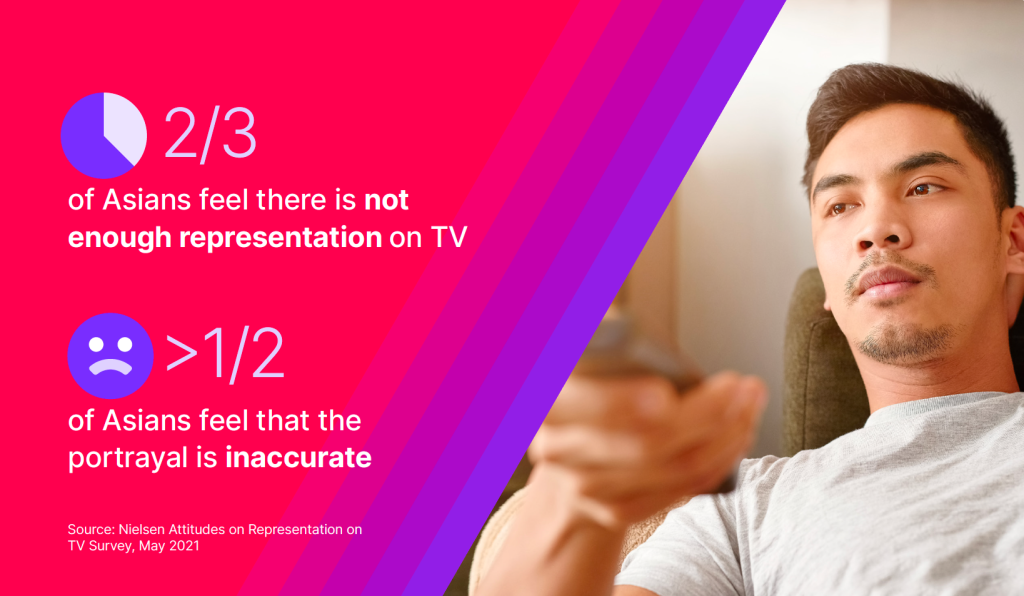
Il pubblico AANHPI vuole sentirsi visto e gravita sempre più verso contenuti culturalmente rilevanti e ricchi delle proprie esperienze, su piattaforme che offrono la massima scelta. I creatori di contenuti in grado di raccontare storie autentiche e ricche di sfumature sulla comunità asiatica americana possono attingere a un pubblico potente, impegnato e multigenerazionale.
For additional insights, download our AANHPI report—Confronting myth and marginalization: Asian American audiences and on-screen representation.
Note
- Classifiche Nielsen sui contenuti in streaming
- 2020 Ufficio del censimento degli Stati Uniti
- Minuti di visione Nielsen Media Impact 2021