
Two of my three daughters, ages 4 and 6, are the biggest women’s soccer fans you’ll find. My youngest, age 1, has started to dribble, but she’s still too young to know what a fan is. They frequently host front-yard matches that feature our beloved home team, the Washington Spirit, facing another team from the National Women’s Soccer League (NWSL). We’ve also had the pleasure of attending a few games in person, but our family ritual of watching the Spirit on TV is what really cemented their fandom—until recently.
In questa stagione, la maggior parte delle 24 partite di regular season degli Spirit è passata dalla nostra rete sportiva regionale (RSN) alle piattaforme di streaming. Così, poco prima dell'inizio della stagione, mi sono ritrovata a cercare di iscrivermi a Paramount+, che quest'anno trasmette 16 partite degli Spirit, solo per scoprire che l'app non è disponibile sul mio smart TV. "Per me è meglio vederle sul televisore", ha brontolato la mia figlia di mezzo mentre lottava con la sorella per avere una visione migliore dell'iPad. Abbiamo visto 30 minuti di azione prima che le bambine andassero a letto alle 20.00, ma è stato tutto, perché Paramount+ non offre repliche complete come i DVR.
Poco prima di gara 2, ho scoperto che era su Twitch, un'applicazione separata che trasmette cinque partite degli Spirit in questa stagione. Ma, come in passato, abbiamo dovuto guardarla sul tablet. "Papà, devo andare in bagno. Puoi mettere in pausa?", ha chiesto il mio figlio maggiore, al quale ho dovuto rispondere: "Mi dispiace, non mette in pausa come la TV".
Per noi non è stata l'esperienza di visione più fluida, ma continueremo a farlo. Le mie figlie non mi danno scelta e, fortunatamente, la nostra famiglia ha i dispositivi, la connettività a Internet e il budget per farlo. Ma il tifoso sportivo medio ha il desiderio, il tempo e le risorse per farlo? La risposta determinerà, con ogni probabilità, il futuro dello sport femminile (se non dello sport in generale).
Women’s sports have always been hard to find on TV. Aside from the Olympics, World Cup soccer, golf and tennis, women’s sports have taken a distant back seat to men’s for decades. Nielsen data show that in 2019, the last full pre-COVID season, 96% of televised professional basketball games were of the NBA, while only 4% were of the WNBA. Pro golf was slightly more equitable, with 77% of events with men, 18% women (and 5% both men and women), but still nowhere close to gender parity. One shouldn’t expect a multi-billion dollar industry with a status quo rooted in men’s sports to change overnight, but there’s a growing consensus that it must make progress and soon.
Why is gender equity in sports media so important? It’s not only the right thing to do, but it also has a profound effect on industry economics. There is a direct correlation between the audience size of a sports league’s televised events and the financial health of that league. By way of example, the 256 regular season NFL games last year delivered an average audience of over 15 million viewers, and seven games were among the top 10 highest rated primetime TV shows in 2020. So it’s not surprising that the NFL commanded a whopping $10 billion per year in its most recent media rights deal and provides a very comfortable minimum player salary of $610,000 per year.
Comparatively, only nine NWSL games were televised in 2020, with an average audience of 434,000 viewers, 35 times smaller than that of the NFL (1). So it’s understandable that the NWSL’s latest rights deal was also smaller, reportedly $1.5 million per year, leading to a much lower minimum player salary, $20,000 per year. Therefore, more viewers equals more money and, even in the year 2021, TV audience sizes still matter and quite a lot.
So if you’re a sports league or media partner of one, what should you do? You should maximize total viewership however possible, regardless of platform, using a strategic set of media channels, both streaming and linear TV. After all, if you’re trying to grow your fan base, shouldn’t you make your product available to as many people as possible? A best practice is what I’d call the “barbell strategy.” On one end of the barbell is streaming, also known as connected TV (CTV), which accounted for 27% of total TV usage in June 2021 in the U.S. An ideal approach would prioritize high-reaching, ad-supported streaming apps that are free to the consumer, which minimizes a viewer’s “barrier to entry.”
On the other end of the barbell is traditional, or linear, TV. Despite Americans increasingly “cutting the cord,” linear TV is still the overwhelming way that people watch TV, sports in particular. For example, in June 2021, 49 million households watched ESPN or a RSN. This compares with the 30 million who watched a network streaming app. The vast majority (73%) of ESPN/RSN watching households did not watch a network streaming app (2). Therefore, sports leagues, women’s included, just can’t afford not to have a strong linear TV presence (and putting just a few playoff games on broadcast networks is not enough). In a perfect world, TV distribution would leverage both RSNs (to foster and capitalize on home-team loyalty) and national TV networks (to drive reach and awareness among the general population).
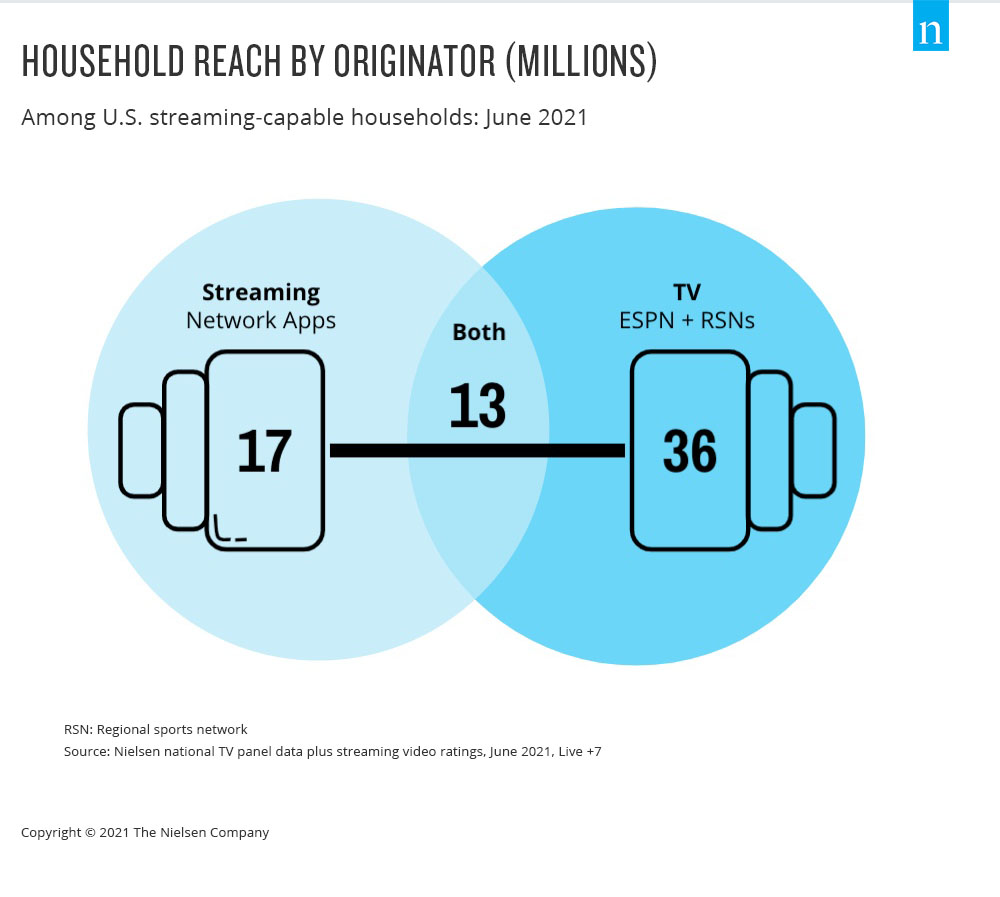
In generale, una strategia barbell ben eseguita massimizza la portata attraverso la scelta dei consumatori; gli spettatori che preferiscono lo streaming lo faranno e quelli che preferiscono guardare la TV, sia in diretta che in differita, lo faranno. La chiave è che questi due gruppi sono altamente complementari e si sommano per produrre il più grande pubblico possibile.
And for those who believe that such a strategy isn’t realistic because one can’t reasonably expect profit-driven TV networks to carry lower-viewership women’s sports, I’d offer two counterpoints. First, to paraphrase Cathy Engelbert, Commissioner of the WNBA, you first need to televise women’s sports sufficiently in order to give them a fair shot at achieving greater viewership. Rome wasn’t built in a day and the NFL has been on TV for 82 years. Second, small audiences for men’s boxing, drag racing, esports and soccer (3) (with Major League Soccer having lower 2021 average viewership than the NWSL) hasn’t prevented these sports from airing prominently on national TV.
Maximizing content reach has the added benefit of driving brand impact. The brand here is the league. You’d be surprised how few people are even aware that certain sports leagues exist. Harder still is producing the high level of awareness that’s required to drive viewership intent across large numbers of people. Key to the mix is not just the content itself, but also promotions, including paid, owned and earned, which further drive awareness and intent to view. Content and promotions reaching sufficient numbers of the right people creates a virtuous cycle.
La consapevolezza porta all'intenzione di vedere, che porta alla visione effettiva e, infine, a un grande pubblico ripetitivo che attrae grandi inserzionisti, accordi lucrativi sui diritti dei media e successo finanziario per le reti televisive, le app di streaming, le leghe e i giocatori. D'altra parte, l'alternativa di relegare gli sport femminili ad applicazioni di nicchia per lo streaming su abbonamento, per quanto di moda in questi giorni, e a qualche trasmissione televisiva simbolica, con ogni probabilità propagherà le attuali tendenze di relativa oscurità e di risultati finanziari insufficienti.
Per concludere con una nota personale, gli ultimi due anni hanno spinto molti di noi a cercare uno scopo più profondo nella propria vita professionale e, come padre di tre bambine, questo è il mio. Quando si parla di equità nei media, genere compreso, penso che noi del settore siamo in una posizione unica - e abbiamo un obbligo speciale - per far sì che ciò accada. La mia speranza è che quando le mie figlie avranno la mia età, gli sport femminili saranno accessibili e di successo come quelli maschili e che guarderanno a questo editoriale come a un pittoresco ricordo di anni passati, ormai lontani.
Note
(1) 434,000 viewers is the weighted average of the seven televised Fall Series games and the two televised Challenge Cup games
(2) Dati Nielsen National TV Panel più Streaming Video Ratings; tra le famiglie abilitate allo streaming, giugno 2021, live +7
(3) Dati Nielsen National TV Panel, P2+, gennaio-giugno 2021, live +7