There’s never a good time to reduce ad spend, but the challenges and uncertainties brought on by the COVID-19 pandemic were too great for most brands to ignore, driving widespread advertising cutbacks across channels and markets. The pause in spend likely had an adverse effect on brand awareness for many companies, which means that now is the time to get back in the game—but with a strategic, well-balanced approach.
È atipico che la notorietà di un marchio scenda a zero - anche quando i marchi si oscurano per lunghi periodi - ma la notorietà del marchio decade, ed è per questo che è normale vedere marchi molto noti mantenere campagne pubblicitarie robuste anche in condizioni di mercato normali. Il loro unico obiettivo è combattere il decadimento. È quindi probabile che gran parte dell'aumento della pubblicità negli Stati Uniti verificatosi in agosto si sia concentrato sulla consapevolezza piuttosto che sull'attivazione.
And that’s something that should continue as the ad market continues to come back online. On average, it takes three to five years to recover equity lost because of halted advertising, and long-term revenue can take a 2% hit for every quarter a brand stops advertising. Brand building and awareness campaigns are critical in long-term success, and companies that were able to frugally maintain their marketing efforts through the past three historic ad shocks were able to protect up to 9% of total sales annually. Said plainly, playing the long game is critical. In fact, the long-term impact of marketing is 88% higher than the short-term impact.
Sometimes it takes a bit of experimentation to get the balance right. For example, global sports brand Adidas reported last October that it needed to pivot after over-extending itself across digital channels and performance marketing in an effort to super-charge ROI. Ultimately, it found that the focus on cutting back had a negative effect on brand awareness.
Passare dalla consapevolezza all'interesse
L'interesse è l'altra considerazione critica dell'imbuto superiore ed è strettamente legato alla consapevolezza. I dati Nielsen sulle previsioni di vendita mostrano che esiste una relazione quasi lineare tra interesse e vendite (ad esempio, un aumento del 10% dell'interesse porterà a un aumento del 10% delle vendite). Data la natura sconvolta del mondo nel 2020, non sorprende che i marchi si stiano tirando indietro, coprendo le spese e concentrandosi su scommesse sicure, come sconti digitali e promozioni inviate per posta ai clienti attuali. Queste tattiche orientate all'attivazione sono importanti, ma non funzionano da sole. Inoltre, potrebbero non funzionare in situazioni in cui le aziende mettono in pausa gli sforzi di brand awareness in mezzo all'incertezza del mercato.
Understanding consumers’ reality is also critical. Given the depressed economy and resultant job losses, pitching financially constrained consumers with activation-geared marketing efforts after a period of silence might not generate the desired response. It could even turn consumers off for good. For example, in our “Adapting to a New Normal” webinar earlier this year, we noted that 41% of consumers are more likely to buy from a brand that uses its advertising to explain what it’s doing to help its employees and customers.
Considerato lo stato del panorama mediatico e pubblicitario, è probabile che i brand debbano concentrarsi sull'equilibrio tra la costruzione del marchio e le iniziative di promozione delle vendite, ma nessun marketer dovrebbe mai prendere decisioni sui canali e sull'allocazione senza disporre di metriche adeguate. I marketer devono bilanciare la costruzione del marchio e l'attivazione. Non sono intercambiabili, e concentrarsi su uno piuttosto che sull'altro senza un'adeguata metrica di misurazione può portare a una spesa inefficiente.
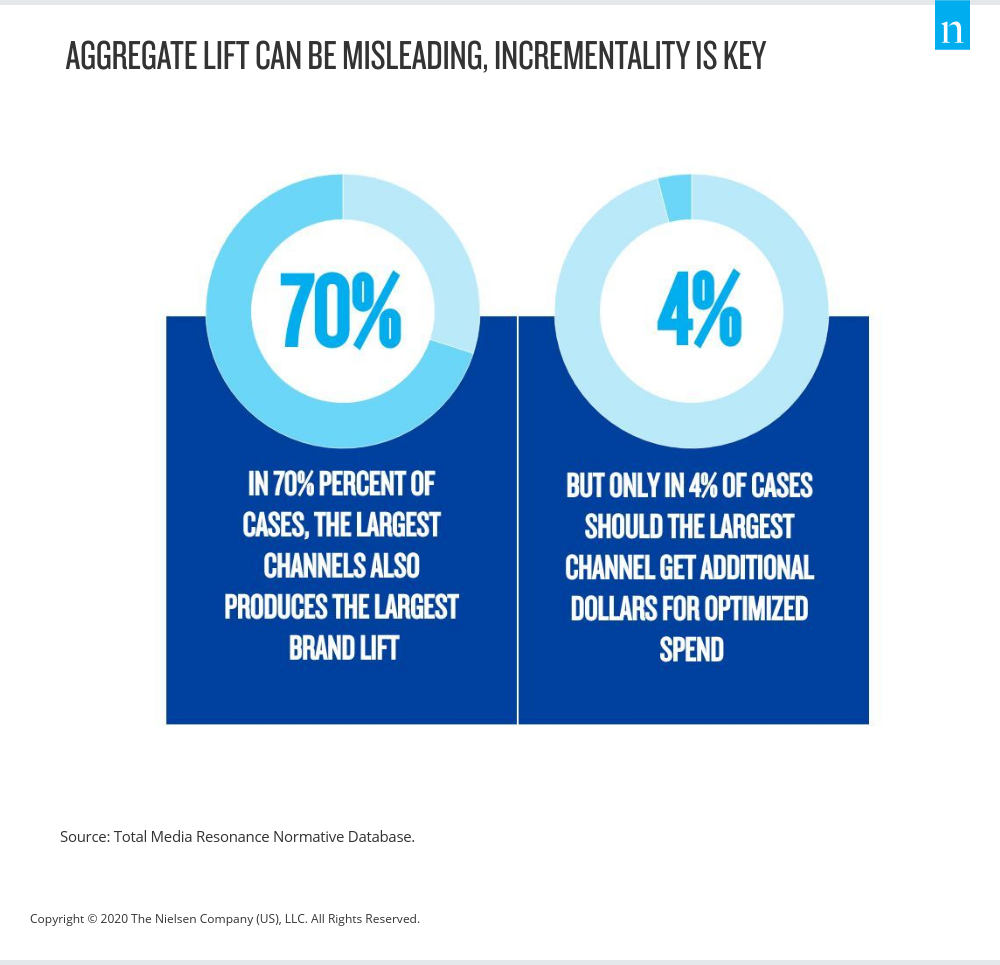
It’s also not wise to simply add additional spending to the areas that drive the greatest brand lift. Data from Nielsen Total Media Resonance shows that the channel with the greatest spend drives the greatest lift 70% of the time. So a brand should expect its biggest channel to drive the greatest brand lift, but that doesn’t mean additional spend there will automatically drive incremental lift. It likely won’t. In fact, the channel with the greatest lift only has the greatest marginal efficiency 24% of the time. And according to Total Media Resonance analyses, increasing investment in your largest channel is actually an ineffective choice for growing brand health in 96% of cases.
Il marketing è un dare e avere tra la costruzione del marchio e l'attivazione delle vendite, ma in un contesto di pandemia globale che ha stravolto tutti gli aspetti della vita quotidiana dei consumatori - e che probabilmente continuerà a farlo nel prossimo futuro - gli operatori di marketing hanno bisogno di misurazioni accurate, con un'attenzione particolare all'ottimizzazione, per sapere come adeguare le loro iniziative in un ambiente in rapida evoluzione. Le strategie di attivazione delle vendite possono portare a guadagni a breve termine, ma le analisi di Nielsen Marketing Mix Modeling dimostrano che circa la metà dell'impatto del marketing sulle vendite avviene molto tempo dopo il lancio di una campagna iniziale, evidenziando la potente forza che la costruzione del marchio ha sulle vendite a valle.