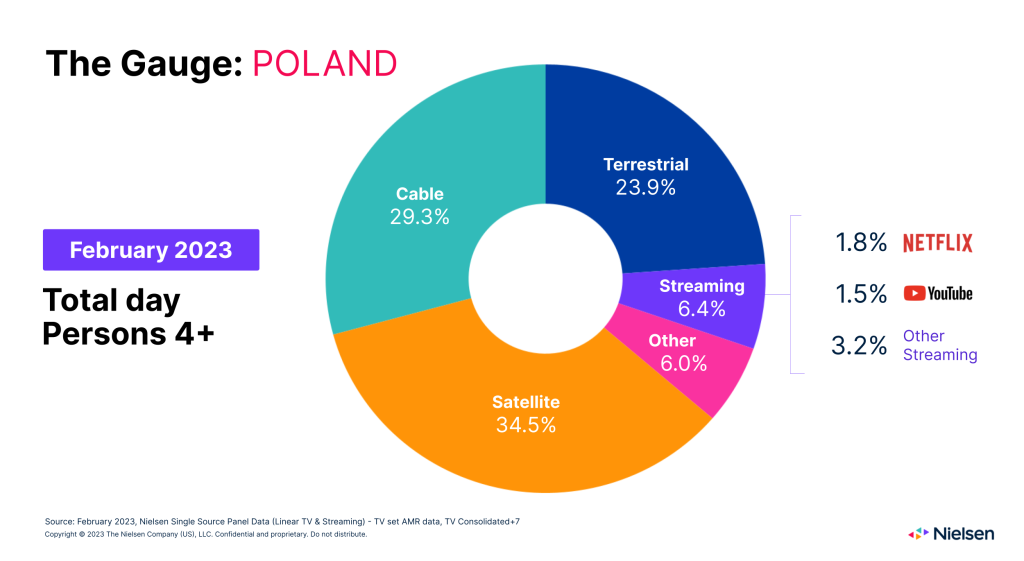
Streaming viewership on the TV glass is on the rise. In February, Poles spent an average of 16 minutes a day watching streaming content on TV (an increase of 1 minute from January). Streaming viewership reached a record 6.4% of total TV time, surpassing 6% of TV usage for the first time.
Netflix and YouTube were the most popular streaming platforms. Together, they accounted for more than 50% of all streaming viewership on the TV glass. Netflix remained the most popular streaming option, retaining a 1.8% share of total TV viewership. We have, however, observed an increase in the viewing figures within the “other streaming” category, which includes providers that have not yet obtained a 1% share of TV usage (these services include HBO Max, Disney+, Viaplay, and SkyShowtime, which premiered on the Polish market in February 2023). None of these services alone captured 0.5% of total TV viewership, but the rise in their aggregate usage from 2.7% to 3.2% in February resulted in an overall increase in the streaming share. YouTube’s share also increased (from 1.3% in January to 1.5% in February).
À propos de la The Gauge
The Gauge a été créée pour fournir à l'industrie des médias une analyse mensuelle de l'utilisation de la télévision à travers les principales plateformes de diffusion de la télévision. Nielsen a publié sa première édition de The Gauge aux États-Unis en mai 2021.
À propos de la méthodologie de The Gauge
The data comes from Nielsen’s single-source panel consisting of 3,500 households and almost 9,700 panelists. The Gauge: Poland is based on monthly AMR (Average Minute Rating) audience share data. The data is presented for people over 4 years old, broken down into cable, satellite, terrestrial television (both linear and shifted in time up to 7 days), and viewership from streaming (live streaming viewership of TV stations on OTT platforms is classified as streaming viewership). The “Other” category includes views of unrecognized content.
Nielsen Pologne a créé cette itération de la The Gauge en utilisant des méthodologies conceptuellement similaires à celles de la version américaine. Les différences méthodologiques doivent être prises en compte lors de toute comparaison.
