Télécharger une version pdf de ce rapport
The impact of the novel coronavirus (COVID-19) is widespread and will likely shape business and consumer behavior for months to come. And while the humanitarian and safety-related aspects of this outbreak are top of mind globally, it’s unquestionable that social distancing, quarantining and staying home will have a significant effect on media consumption, which could rise up to 60%, according to recent research from Nielsen’s U.S. media team.
The implications of today’s reality for the media industry are straightforward: Content creators, networks, studios, media agencies, advertisers and brands have significantly more opportunity to engage with consumers simply because of the clear correlation between time at home and media consumption. So for networks, for example, the increased TV time might warrant an adjustment to programming schedules—or programming itself. And from an advertising perspective, brands and agencies will likely need to both adjust which products are being marketed, as well as the tone in which they’re delivering they’re messages.
Social distancing, quarantining and staying home will have a significant effect on media consumption, which could rise up to 60%.
As the world adjusts to this new reality, Nielsen Media recently examined how COVID-19 has affected media consumption across North Asia, which includes many of the countries, regions, and territories that were first affected by the COVID-19 outbreak: Chinese Mainland, Hong Kong, Taiwan, Japan, and South Korea. This region isn’t the only one affected, but it was one of the first to feel the effects of social distancing and quarantining. We hope the insights from the early days of the global pandemic can help businesses anticipate and respond to market needs and consumer behavior amid times of significant disruption.
L'HEURE DES MÉDIAS AUGMENTE ET LES APPLICATIONS AIDENT LES CONSOMMATEURS À S'ADAPTER À LA VIE EN INTÉRIEUR
As we expected, retail consumption changed as worries about COVID-19 spread around the globe, and it’s far from unexpected that consumers also increased their media behavior as they spent more time inside. As with any significant shift in consumer behavior, however, it is possible that some changes could hold even after COVID-19. Across North Asia, we tracked four key media trends.
Extension de l'accès à la télévision
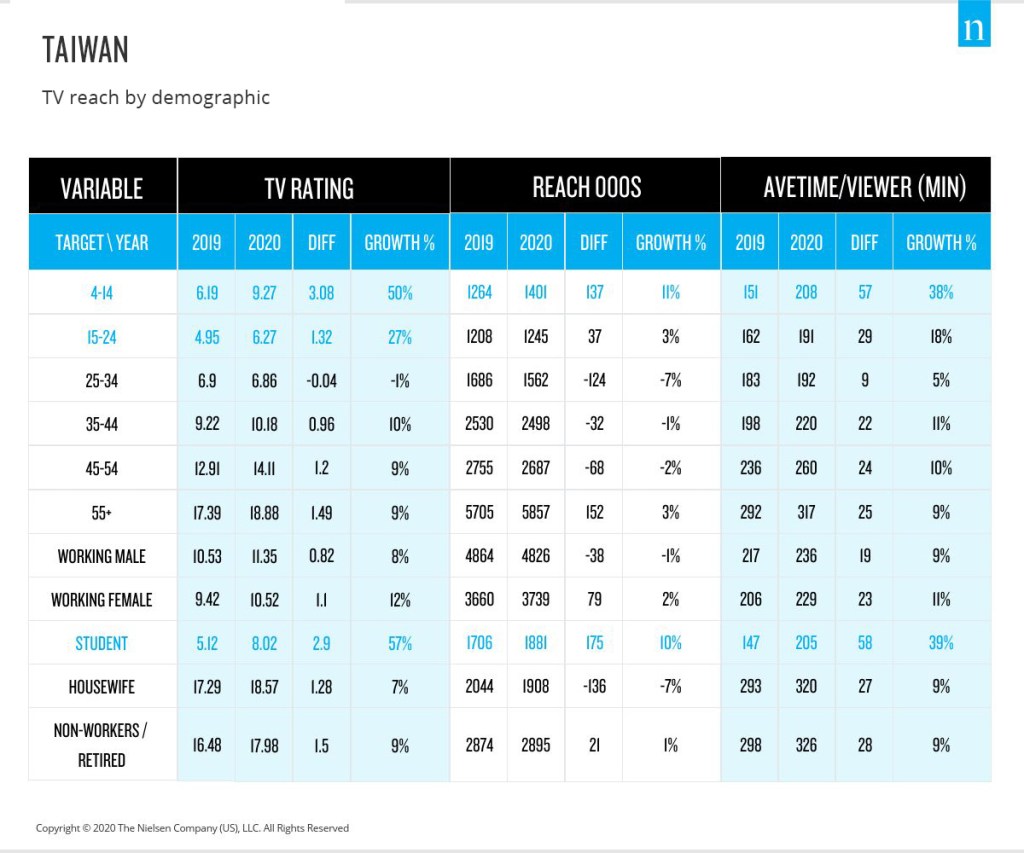
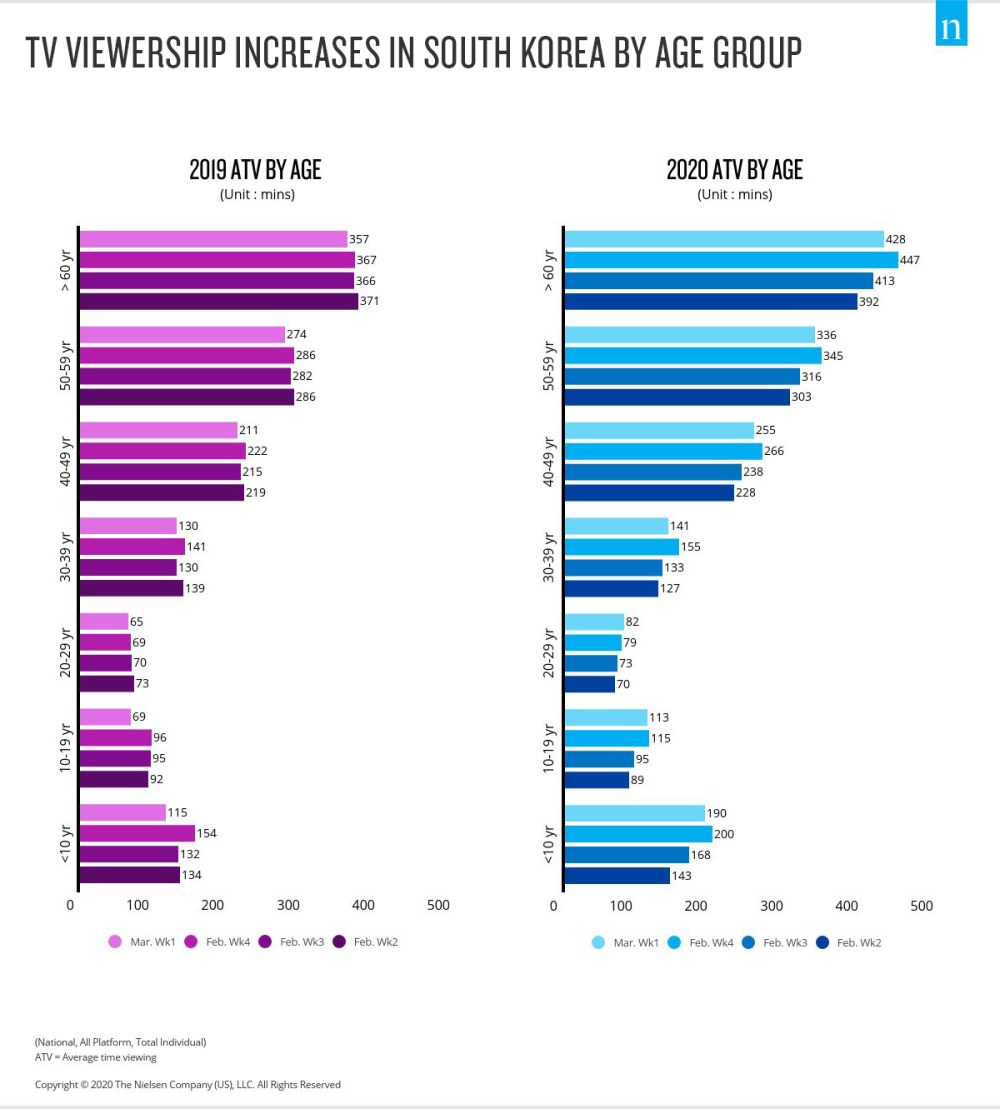
In Taiwan and Korea, the two markets where Nielsen measures television audiences, linear TV viewing grew in penetration and time spent. During the first three weeks of February, for example, Taiwan’s TV audience grew by 1 million viewers, for a total viewing population of approximately 21 million. News channels and programs were the primary beneficiaries of the increased penetration, followed by children’s programming. Kids in Taiwan and Korea, now home from school and forced to stay indoors, quickly gravitated to their TV screens and ramped up their linear program viewing. TV consumption also expanded considerably in Mainland China (source: CCData) and Hong Kong (source: Television Broadcasts Ltd.).
Les médias sociaux deviennent le canal de conversation du COVID-19
Social media, now a part of everyday life for most consumers engaged with the world digitally, became the primary source for buzz about all things COVID-19 as worries and news intensified. The level of social media buzz about COVID-19 far overshadowed most other topics (in the Mainland, for example, COVID-19 chatter outpaced volume for the Spring Gala Festival 3:1), and peaked in the first two weeks of heightening outbreak news in each market. To illustrate, social media engagement in Taiwan peaked in early February and in Korea in late February. The peaks reflected announcements about local infections and local states of emergency, respectively. After engagement peaked, netizens used social media less for discussion and more for news.
De nouveaux choix d'applications pour soutenir les modes de vie en intérieur
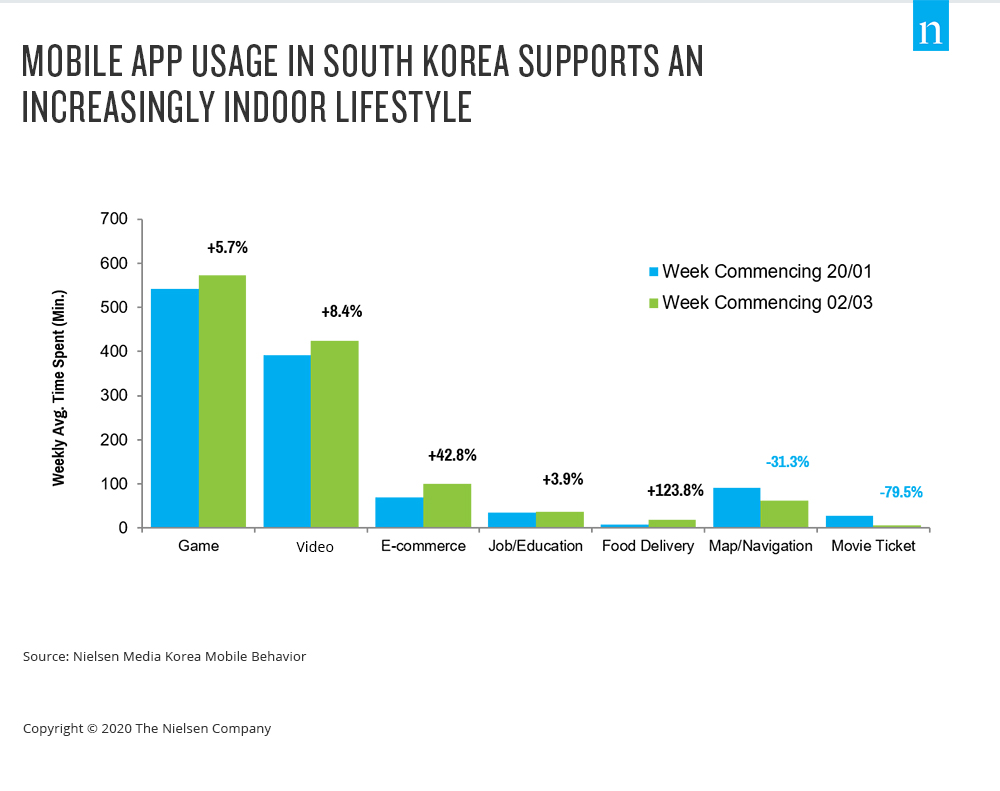
Across markets, media-hungry consumers weren’t just glued to the TV screen. Digitally savvy consumers have also gravitated to apps that meet the needs of their temporary indoor lifestyles, largely in the entertainment and e-commerce categories. While video and gaming apps have topped the entertainment options, consumers have embraced e-commerce for an array of needs: at-home delivery of goods and services, food delivery and online education. Even in markets like Hong Kong, which is generally a brick-and-mortar paradise with easy access to neighborhood stores of all kinds, consumers ramped up their adoption of e-commerce apps as COVID-19 pressures mounted. Conversely, we saw the usage of out-of-home apps such as movie ticketing and navigation maps decline.
Les annonceurs ont fait preuve d'une prudence excessive (et cela a peut-être été une occasion manquée)
Despite notably higher media consumption, a majority of advertisers pulled back on advertising campaigns and deferred others in an effort to bring investment in line with consumption and sentiment. This was likely a misstep, as the increased media time was likely the new “prime” time to brand build and interact with an engaged audience—albeit with the right tone and product/ service offerings. Certain sectors, such as health care brands, gaming companies and e-commerce operators, did lean in with disproportionate and opportunistic ad spending but the shift wasn’t widely adopted enough to encompass the depth and breadth of consumer interests or needs as the situation intensified.
“The knee-jerk reaction from advertisers at a time of crisis is typically to pull back or defer spends; however, COVID-19 is characterized by a situation where increased time at home means expanded media time and heightened consumer attention. For brands looking to authentically connect with the consumer during this difficult time and offer a solution, this is a time to lean in.”
-Ranjeet Laungani, North Asia Nielsen Media

Market-Level Media Engagement Snapshots
Taiwan’s TV Landscape Shifts Dramatically As COVID-19 Situation Evolves
As we expected, confinement in Taiwan resulted in a significant increase in TV viewing, particularly among young viewers who would normally be at school during the daytime hours. Overall TV ratings among the 4-14 and 5-24 age groups spiked 57% and 27%, respectively, over the same period last year (for the two-week period just following Chinese New Year).
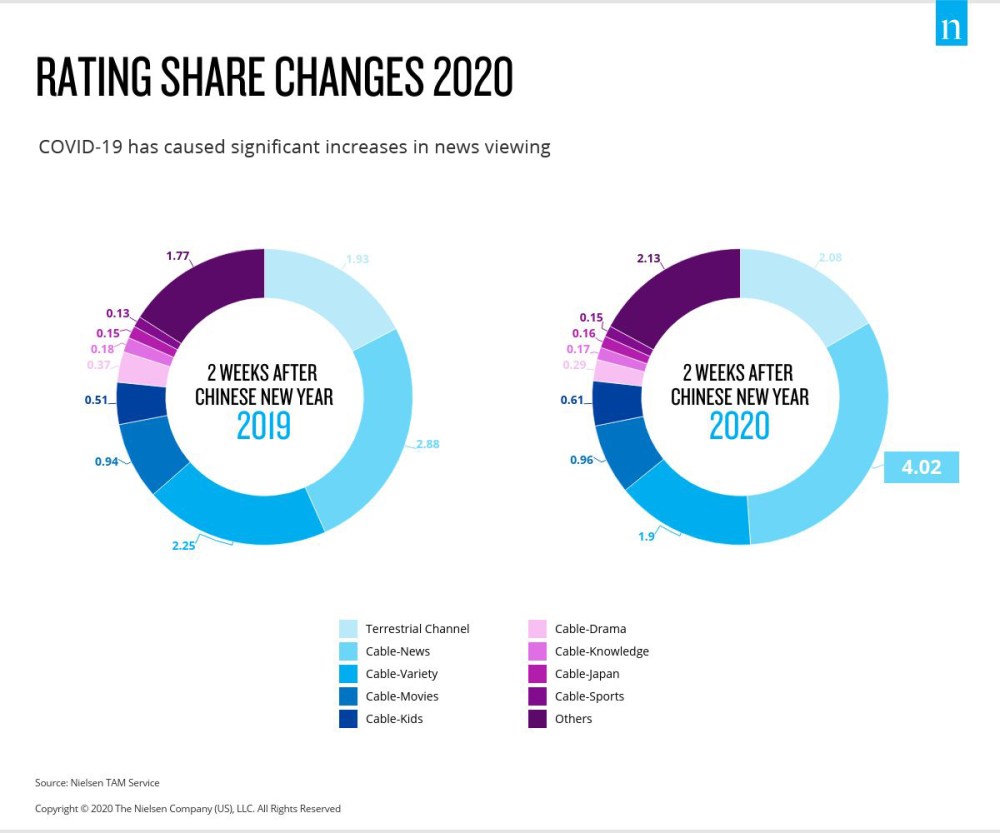
Unsurprisingly, the gravitation to TV has disproportionately benefited news channels. Children’s channels and programs have also seen notable spikes in viewership.
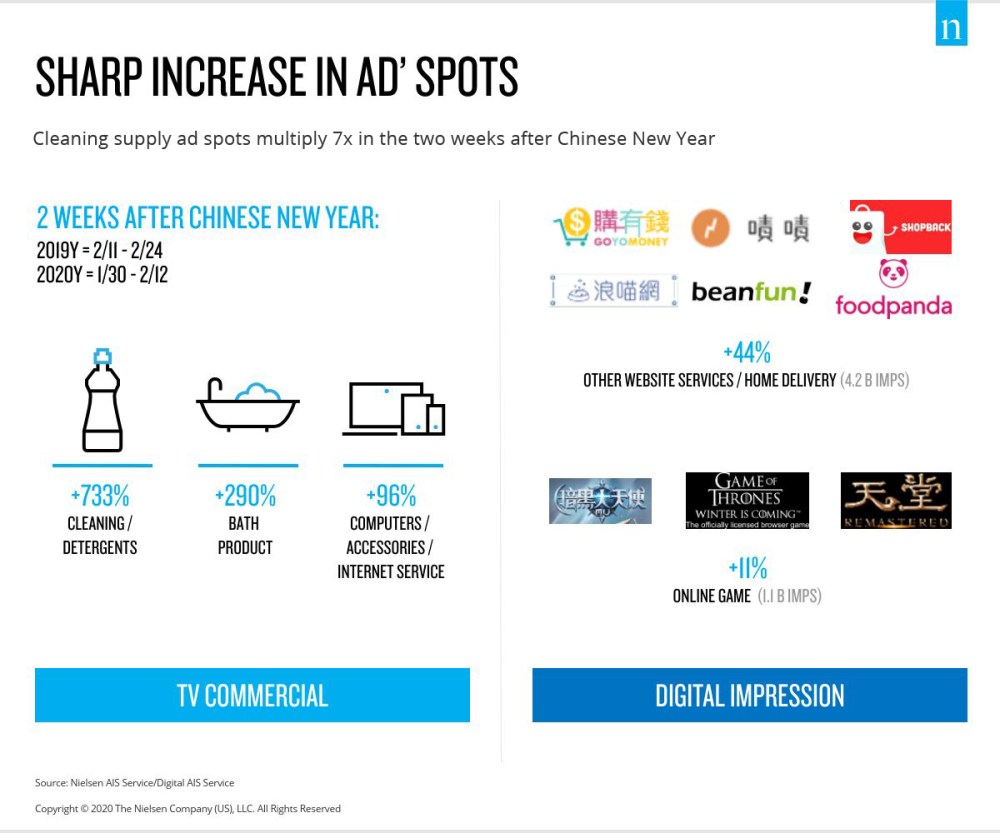
So how did advertisers respond to the increased engagement with TV? In short, brands in select categories responded by ramping up their advertising during a period that is typically a low season for ad spend. With consumers clamoring for cleaning and health-protection products, we saw a rise in opportunistic ad spending (and spots) from cleaning and bath supply companies.
We also saw an increase in digital ads for online gaming companies, which we equate with the increased numbers of kids at home during school closures. E-commerce and food delivery operators also ramped up their digital ad spending. And as expected, we saw reduced ad spend from online travel operators.
In the earlier days of the outbreak in Taiwan, social media usage skyrocketed among consumers who expressed everything from fear to worries about the future to prayer. While social media buzz about COVID-19 has remained steady since Chinese New Year, engagement peaked in early February. It then started to taper off as more people began to use social media to stay informed with news than to express their own personal experience.
“In Taiwan, we get a very well rounded view of how the consumer is engaging with media. During COVID-19, we saw expanded TV viewing in news and kids programming and advertisers, that were benefiting disproportionately from the situation leaning in to drive up TV and digital ad spends. We also saw very high engagement on social media, first as a platform for information sharing and then as a platform for news.”
-Irene Chen, Nielsen Media Taiwan

Despite Heightened Media Use in Hong Kong, Advertisers Retreat
In Hong Kong, behavior in the local community began to change as soon as the first case of COVID-19 was confirmed on Jan. 23, 2020. The changes involved behaviors, mindsets and media consumption. Many of those changes reflected the efforts that the government and private companies took to reduce the spread of the virus. Importantly, many consumers in Hong Kong lived through SARS, which means they fully understand the need to minimize social interactions.
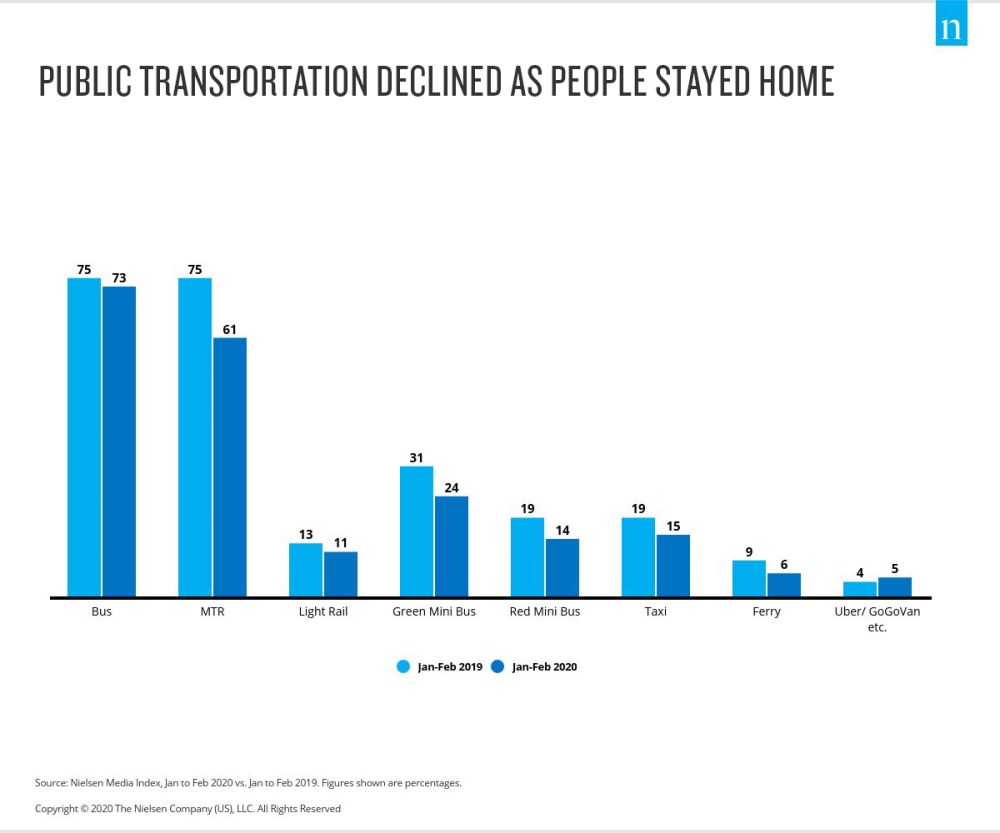
As consumers began restricting their time outside, reliance on the public subway dropped by 14 percentage points during the first two months of the year, the average amount of time consumers spent at home increased by 12% (Source: Nielsen Media Index). Should this trend continue, it could be a tough year for the outdoor advertising segment in Hong Kong.
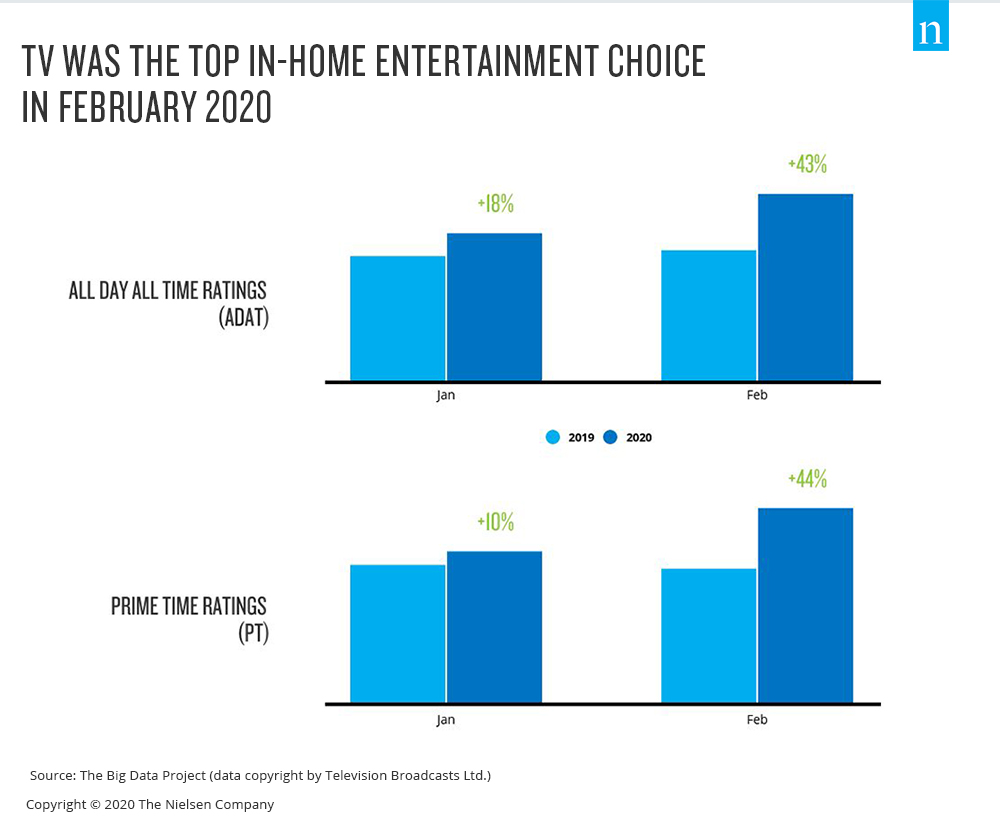
As more consumers stayed home, TV viewing increased. Ratings for all day and all time periods increased by 43% in February 2020 compared with February 2019, while primetime ratings during the same period increased by 44% (source: Television Broadcasts Ltd.).
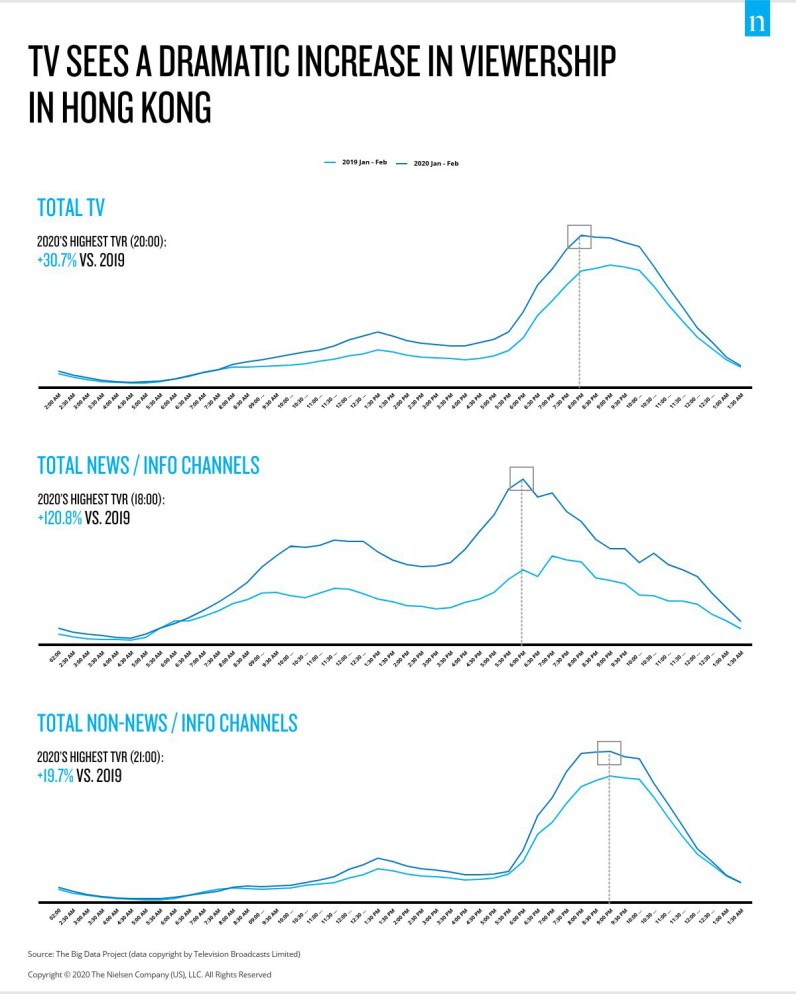
As was the case in Taiwan, news was the top TV genre, with ratings up 121% from January to February 2020 compared with the same period a year earlier. Non-news content was also popular, reporting a 20% uptick on ratings for the same time slot compared with a year ago.
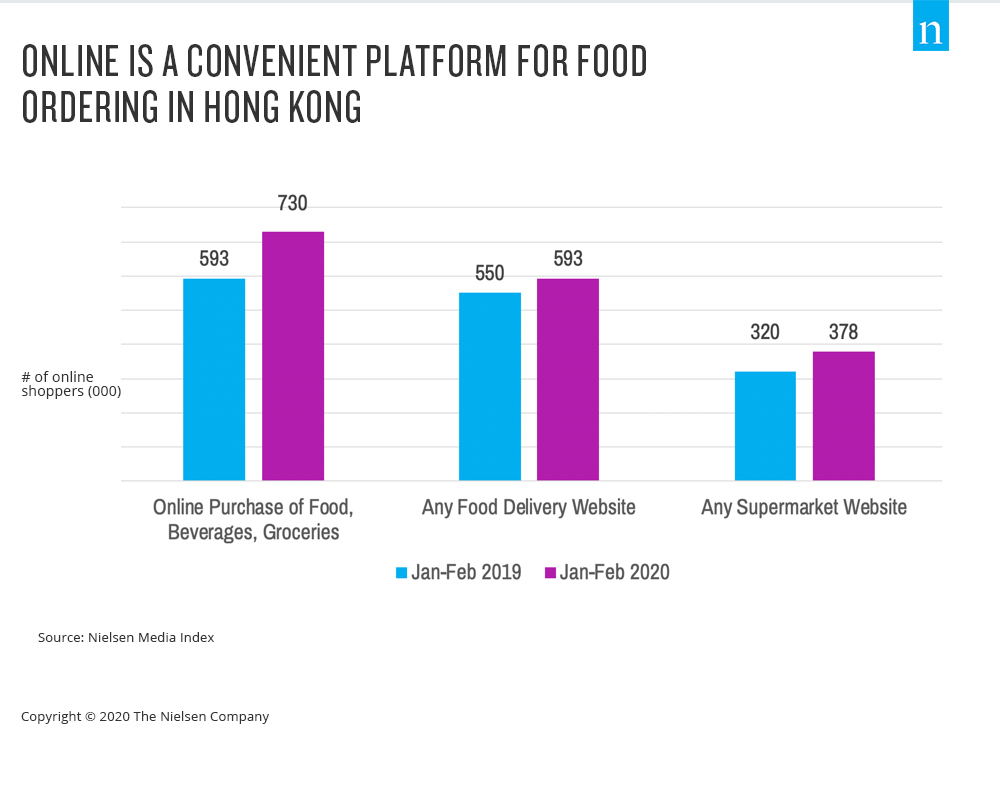
In addition to spending more time with TV, consumers in Hong Kong spent quite a bit more time online as the outbreak intensified. Entertainment activities increased, as did shopping for surgical masks, hand sanitizers and cleansing agents. Typically, Hong Kong consumers are very accustomed to traditional in-person shopping. So as more consumers opted to stay home, online—and online shopping—activities skyrocketed. Based on the latest round (Jan-Feb 2020) of the Nielsen Media Index study, when we asked consumers how behaviors changed in the past seven days, we learned that internet usage grew to a historical high of 99%, while the penetration of online shopping increased by 8%. Average spending on online shopping increased by USD$114 over a three-month period (Source: Nielsen Media Index).
L'apparition de nouveaux comportements liés au fait de passer plus de temps à faire des achats en ligne a été un fait marquant pour les consommateurs de Hong Kong contraints de rester à l'intérieur à cause de l'épidémie. L'augmentation de l'audience de la télévision est devenue la norme à ce moment-là, car le consommateur moyen cherchait à se tenir au courant de la situation, souvent tendue et évolutive. Les entreprises qui ont considérablement réduit leurs dépenses publicitaires dans le contexte de la crise actuelle devraient s'efforcer de renouer rapidement avec le consommateur lorsque la situation redeviendra normale. -Clare Lui, Nielsen Media Hong Kong, -Claire Lui, Nielsen Media Hong Kong Despite the increased media consumption among consumers in Hong Kong, the spread of COVID-19 created notable uncertainties in the advertising world. Most advertisers and marketers have remained cautious with their ad campaigns, and many have suspended the campaigns they have planned for the first few months of the year. We, along with many in the industry, expect this sense of caution to continue in the coming weeks., Malgré l'augmentation de la consommation de médias parmi les consommateurs de Hong Kong, la propagation du COVID-19 a créé des incertitudes notables dans le monde de la publicité. La plupart des annonceurs et des spécialistes du marketing sont restés prudents dans leurs campagnes publicitaires et beaucoup ont suspendu les campagnes qu'ils avaient prévues pour les premiers mois de l'année. Comme de nombreux acteurs du secteur, nous nous attendons à ce que ce sentiment de prudence se poursuive dans les semaines à venir. “The impact of COVID-19 is absolutely substantial,” said David Yeung, Vice President of Marketing Communications, Consumer Group, at HKT Limited. “Almost all industries have been badly hit, with lots of closure in the news for retail outlets, restaurants, etc. Under such circumstances, many marketers have no choice but to suspend marketing campaigns and activities for now. The key to survival is to adapt to the changing business environment very quickly and to ensure threats are turned into opportunities by tapping into technology and data.”, L'impact du COVID-19 est absolument considérable"
-Clare Lui, Nielsen Media Hong Kong
Despite the increased media consumption among consumers in Hong Kong, the spread of COVID-19 created notable uncertainties in the advertising world. Most advertisers and marketers have remained cautious with their ad campaigns, and many have suspended the campaigns they have planned for the first few months of the year. We, along with many in the industry, expect this sense of caution to continue in the coming weeks.
“The impact of COVID-19 is absolutely substantial,” said David Yeung, Vice President of Marketing Communications, Consumer Group, at HKT Limited. “Almost all industries have been badly hit, with lots of closure in the news for retail outlets, restaurants, etc. Under such circumstances, many marketers have no choice but to suspend marketing campaigns and activities for now. The key to survival is to adapt to the changing business environment very quickly and to ensure threats are turned into opportunities by tapping into technology and data.”
La consommation de médias en Chine continentale atteint de nouveaux sommets
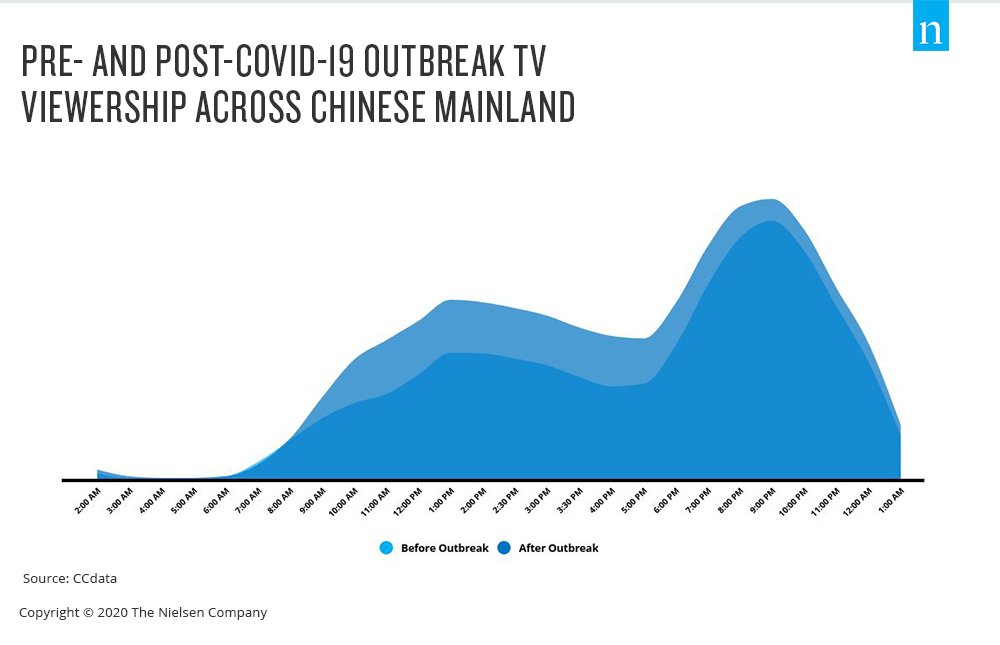
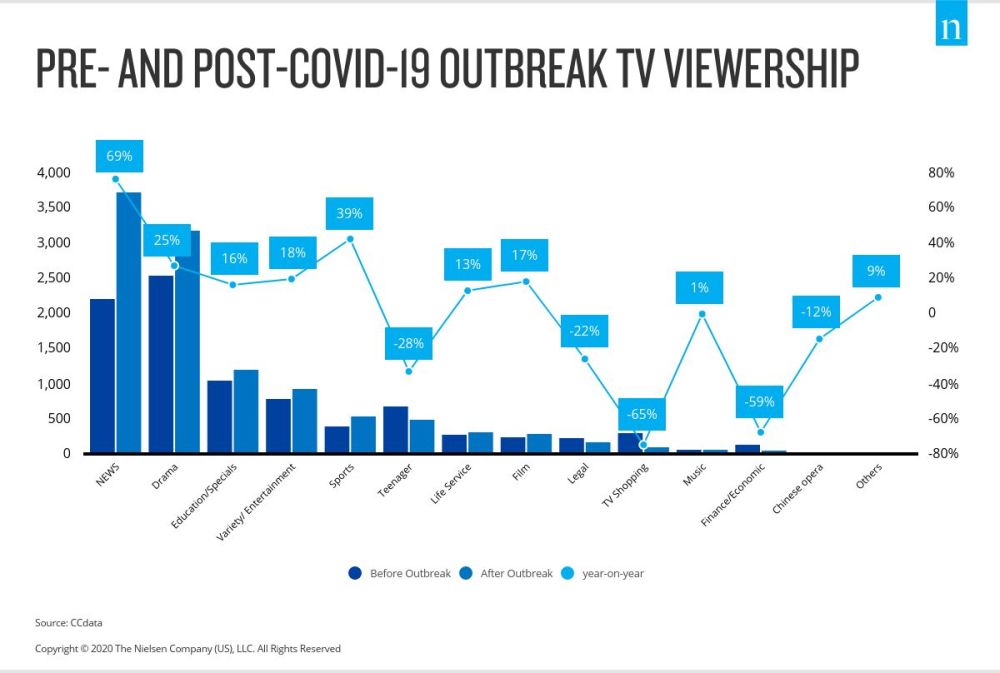
Chinese Mainland was the first to experience the strains of the COVID-19 outbreak, and media consumption among consumers has risen dramatically since the early part of the year. While increased TV viewing each day was expected, the degree of increase has been unprecedented, rising by 70 minutes to 7 hours and 40 minutes per day among current TV viewers (Source: CCData). The news and drama genres have experienced the most viewership growth.
Les annonceurs qui ont été contraints au fil du temps de raconter leurs histoires dans des formats publicitaires compressés - des créneaux de 30 secondes à près de 5 secondes ces dernières années - ont maintenant la possibilité de raconter des histoires plus longues et sous une forme mieux adaptée à l'actualité et aux drames. -James Gong, Nielsen Media Chinese Mainland, -James Gong, Nielsen Media Chinese Mainland As news of the outbreak intensified, so did conversations across social media, as chatter about COVID-19 between Jan. 20 and Feb. 20 far exceeded conversations about many other hot topics during the same period (Source: Sina Weibo)., Les conversations sur les médias sociaux se sont intensifiées au fur et à mesure que les informations sur l'épidémie s'intensifiaient. En effet, entre le 20 janvier et le 20 février, les conversations sur le COVID-19 ont largement dépassé les conversations sur de nombreux autres sujets d'actualité au cours de la même période (Source : Sina Weibo). Despite the circumstances, Nielsen social intelligence data suggests that Chinese consumers are making most of their indoor situations. As consumers adjusted to their new reality, conversations online shifted to “what to do at home,” “spending time with family” and “cooking delicacies.”, Malgré les circonstances, les données de Nielsen Social Intelligence suggèrent que les consommateurs chinois tirent le meilleur parti de leur situation à l'intérieur. Au fur et à mesure que les consommateurs s'adaptent à leur nouvelle réalité, les conversations en ligne s'orientent vers ce qu'il faut faire à la maison"
-James Gong, Nielsen Media Chinese Mainland
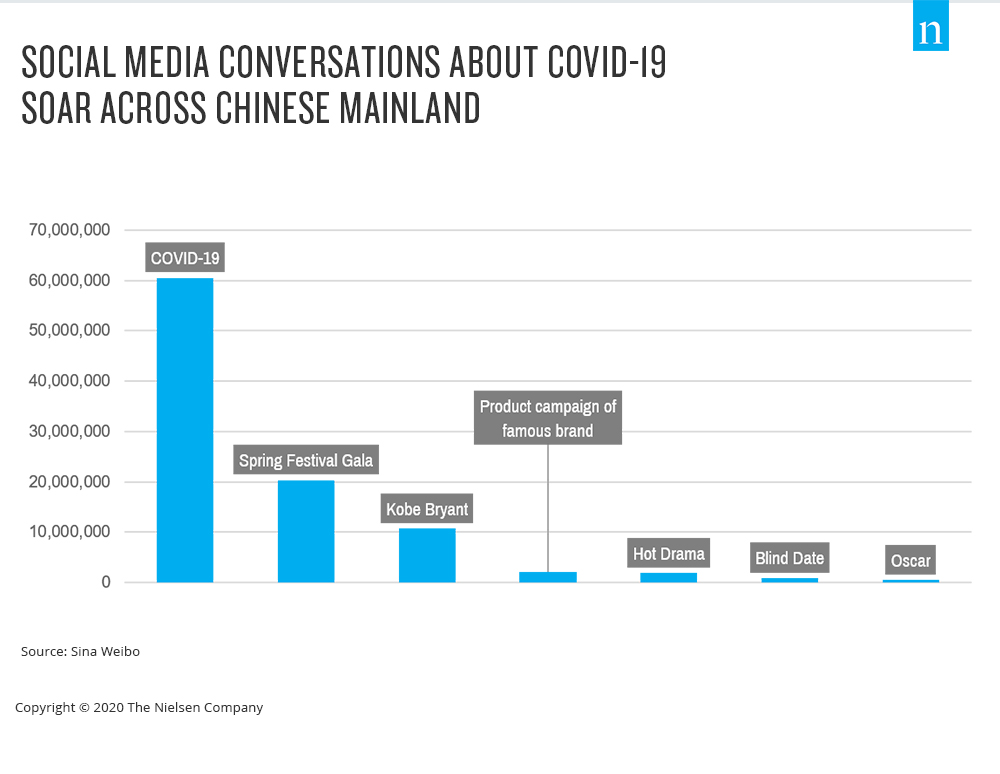
As news of the outbreak intensified, so did conversations across social media, as chatter about COVID-19 between Jan. 20 and Feb. 20 far exceeded conversations about many other hot topics during the same period (Source: Sina Weibo).
Despite the circumstances, Nielsen social intelligence data suggests that Chinese consumers are making most of their indoor situations. As consumers adjusted to their new reality, conversations online shifted to “what to do at home,” “spending time with family” and “cooking delicacies.”
Toward the middle of March, consumer sentiment in the mainland had improved considerably as the outbreak passed its peak. As a sense of normalcy began to return, advertisers started to evaluate investing in media research to gauge the improving consumer sentiment and release pending digital ad campaigns that they had placed on hold during much of February.
As Zod Fang, Head of GroupM Knowledge, GroupM China puts it, there is opportunity ahead: “Moving forward China will enter into the recovery stage soon. The Chinese government is releasing more and more policies to stimulate the economy and consumption. This will lead to greater demand. Therefore, brands need to get prepared. Work with agencies to have an overall plan including sourcing, logistics, marketing and sales etc to fully seize the opportunity.”
L'augmentation de l'utilisation des médias en Corée du Sud est plus tardive que dans les autres pays d'Asie du Nord
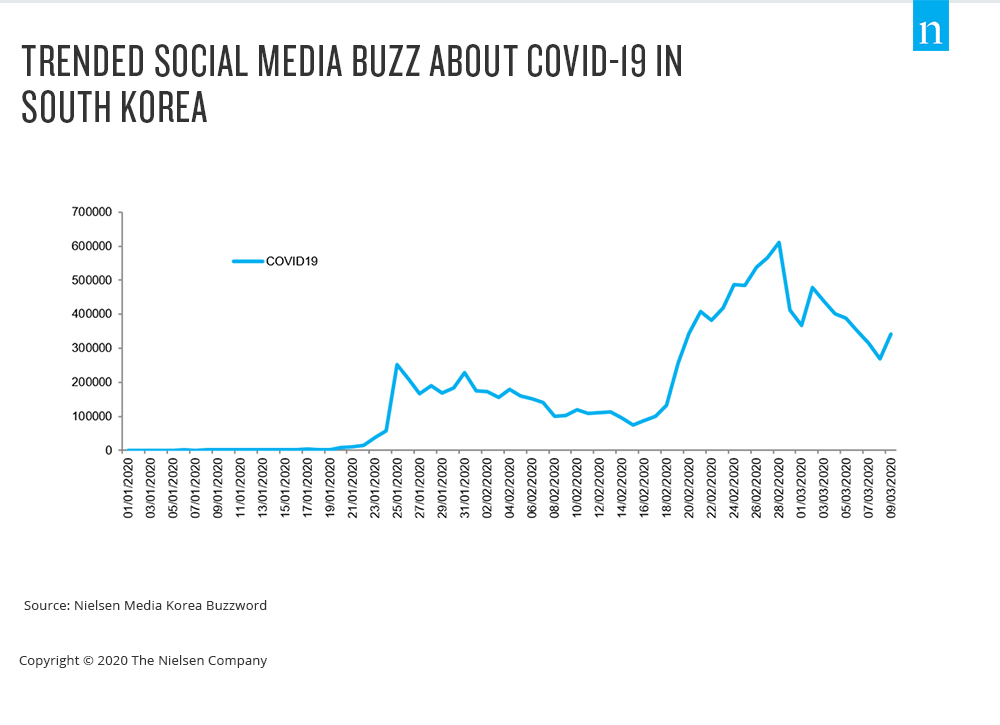
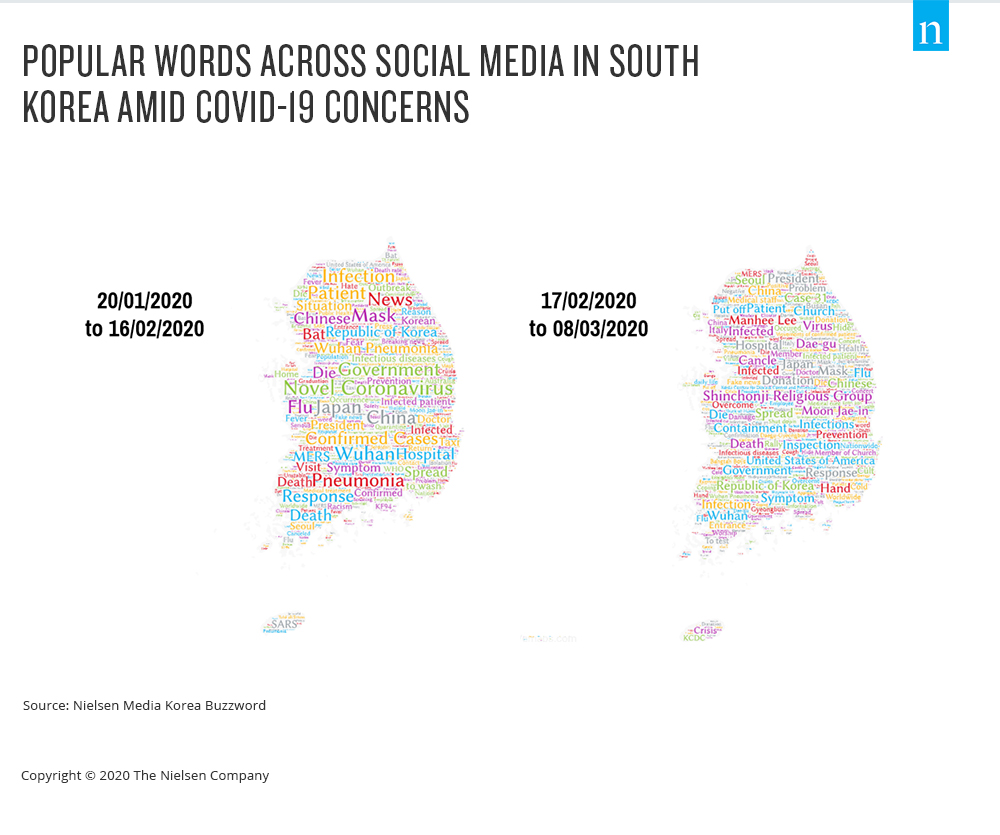
As we saw across other areas of North Asia, consumers in South Korea were quick to increase their digital media usage as news about COVID-19 spread, especially across social media following confirmed cases in Daegu on Feb. 19, 2020. Notably, news that person-to-person transmission was linked to a specific religious group sparked a spike in social chatter about the group, called “Shinchonji.”
Across mobile apps, consumers amplified their use across several key categories: games, video, food-ordering and e-commerce. It was somewhat less expected to see increased use of job and education apps, but the uptick makes sense given the replacement of many in-person classes with online lectures. Also expected was the significant decline in the usage of transportation and outdoor entertainment apps, such as maps/navigation and movie ticketing.
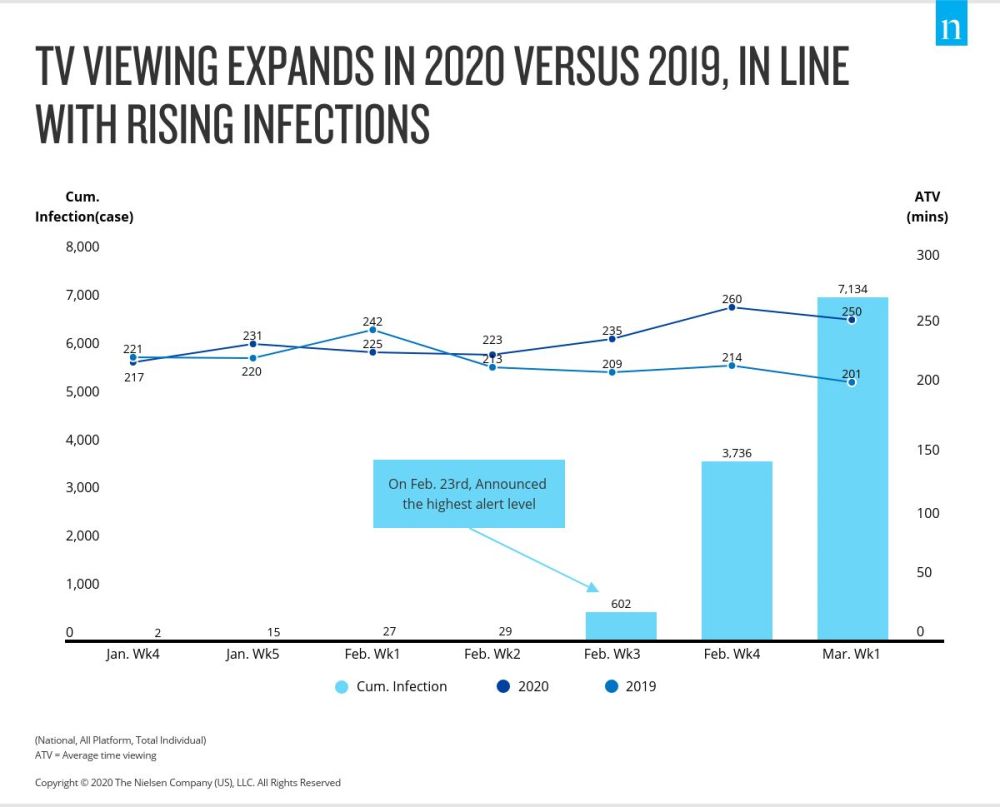
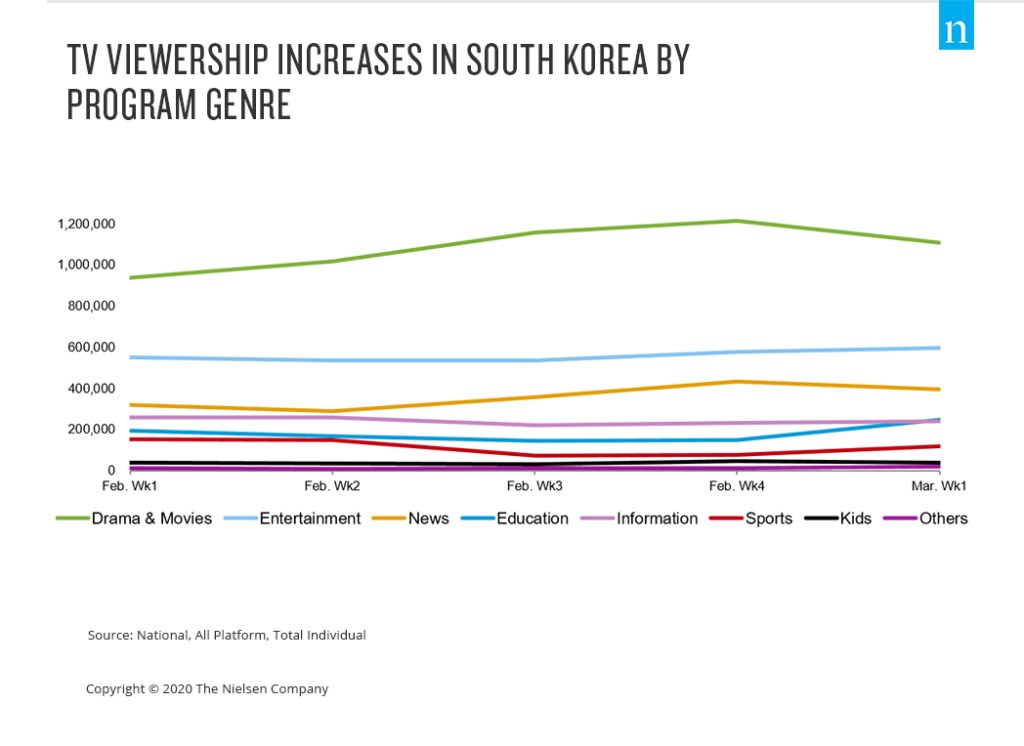
With respect to TV viewing, activity (viewing time) did not change much when the first case of COVID-19 was reported in South Korea on Jan. 23, 2020. That changed in the third week of February, and then skyrocketed in week four, coinciding with the country’s alert level being elevated to its highest warning threshold.
“South Korean consumers quickly adapted their mobile app preferences to cater to their indoor lifestyles and were glued on to their TV sets, across age groups, to monitor the evolving situation as the crises heightened. It was an opportunistic time for advertisers to make their brands available and engage in constructive conversation.”-Dohyun Yoo, Nielsen Media Korea
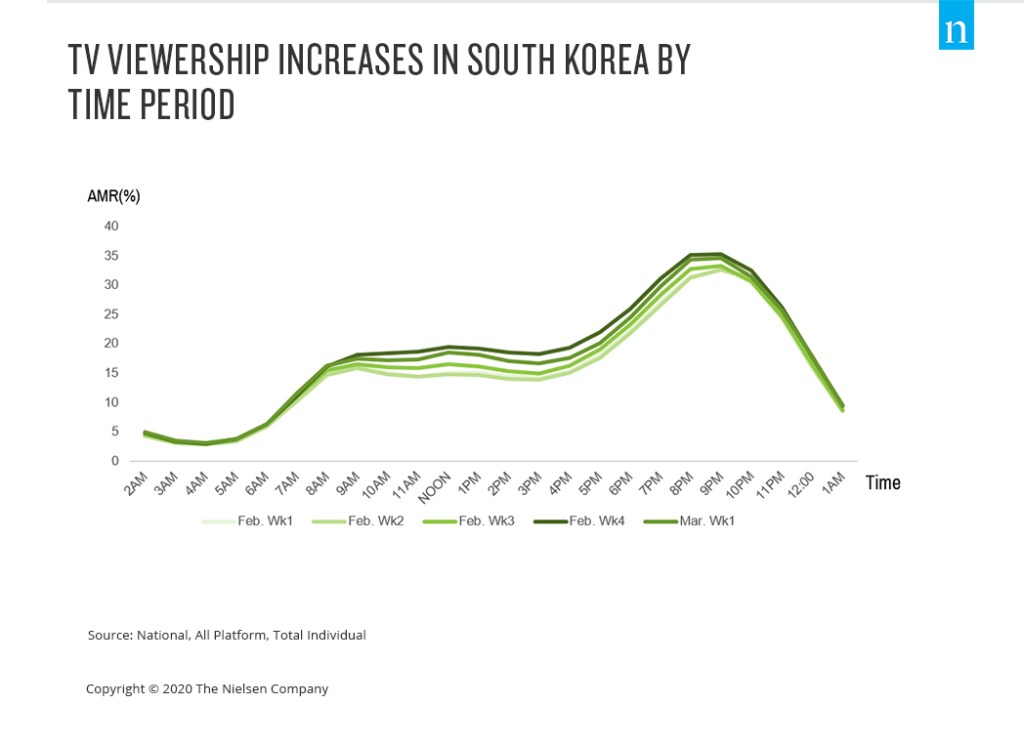
This year’s TV viewing behavior, while driven by COVID-19 worries, represented an opportunity for media companies and advertisers during a period that isn’t characterized by heavy TV viewing. The heightened average time spent viewing between noon and 18:00 was notably a reflection of students and parents being home at a time when they normally would be elsewhere.
Le cycle de l'information est à l'origine de l'augmentation de la consommation de médias au Japon
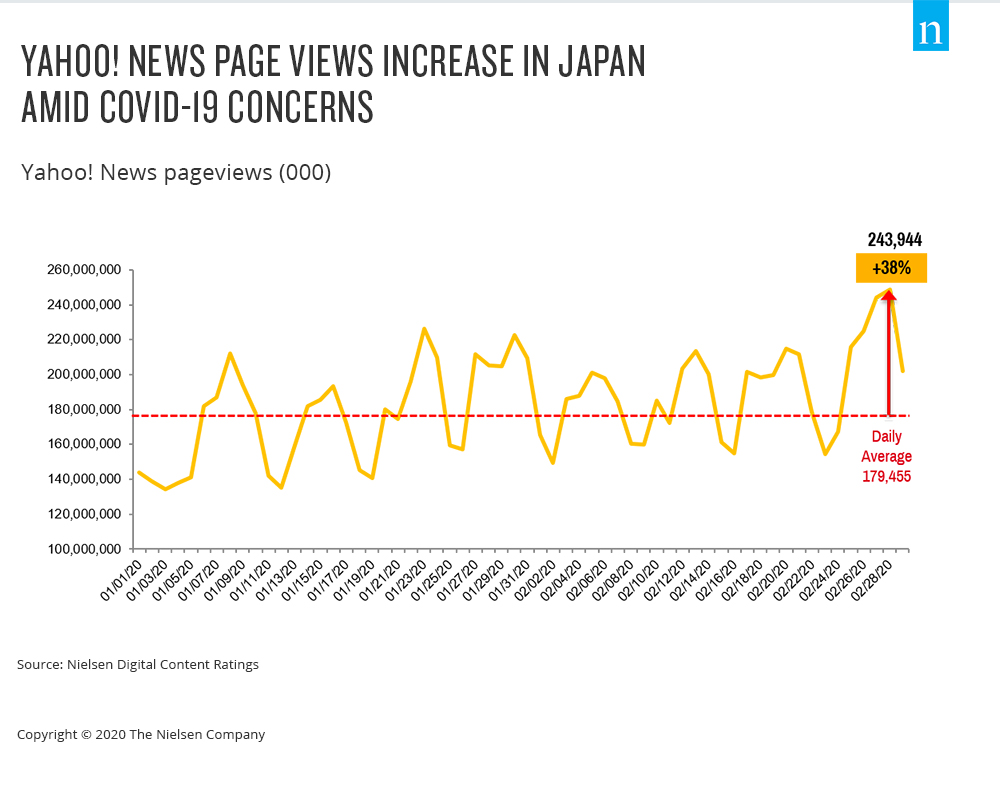
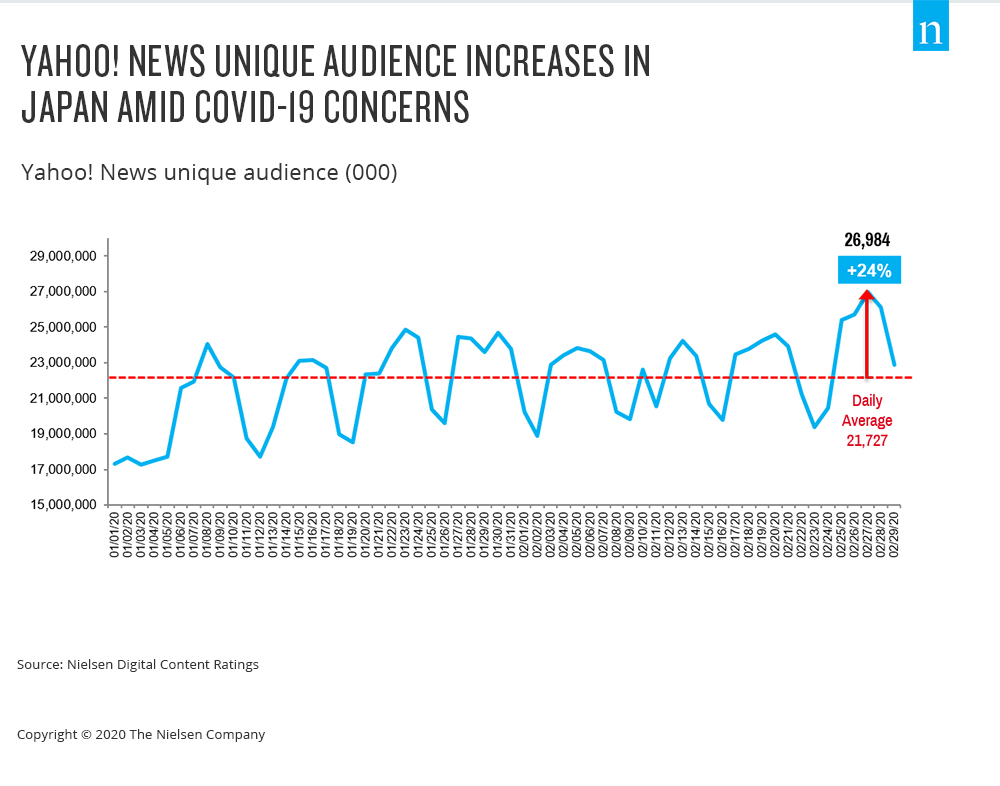
News consumption in a crisis is to be expected, but daily digital news consumption in Japan increased by the millions as worries about COVID-19 spread toward the end of February. Page views across Yahoo! News spiked to nearly 244 million on Feb. 27, 2020, 38% higher than the daily average. The increase was driven by an additional 27 million people users, 24% more than the daily average during the month of February, according to Nielsen Digital Content Ratings.
As consumers spend more time indoors, online media consumption peaked. According to NTT Communications, one of the major ISPs in Japan, internet traffic on weekdays (from 9:00 a.m. to 16:00 p.m.) in the first week of March increased by 35% and also went up 40% in the following week compared to average weekly usage. NHK news attributed this increase in traffic to online video, educational programs, and online classes due to the expansion of remote work and school closures.
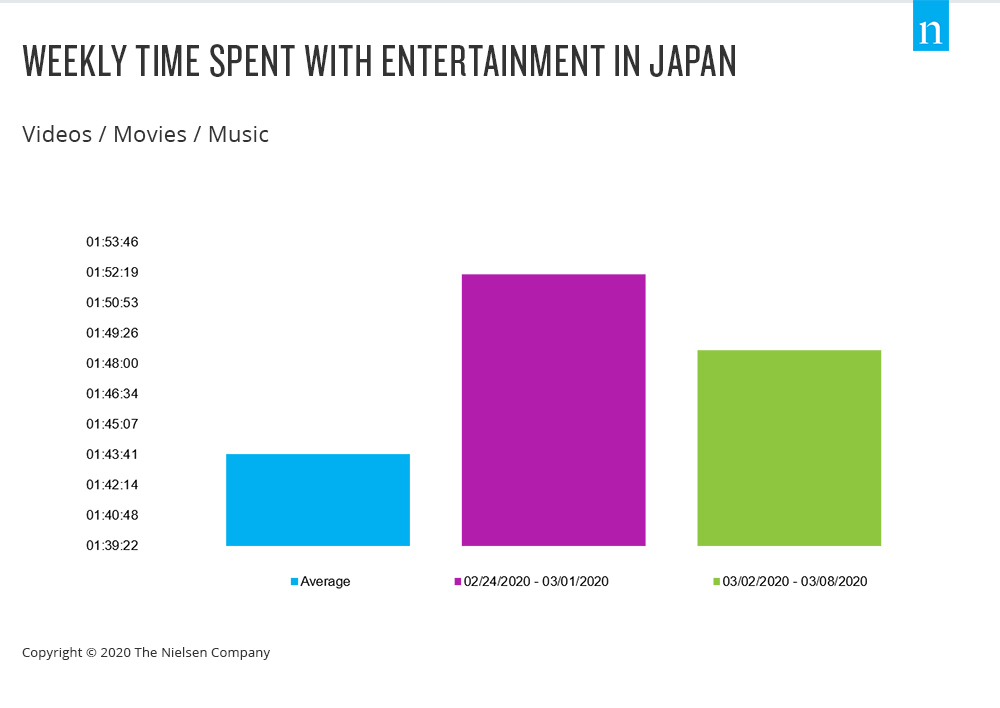
At home desktop consumption of content saw a meaningful upward shift. In the last week of February and the first week of March, Nielsen saw media consumption growth in the weekly time spent on websites in the “Entertainment –Videos/Movies” category, according to Nielsen NetView, with 8.7% and 4.9% growth respectively compared to the average of the first 3 weeks in February.
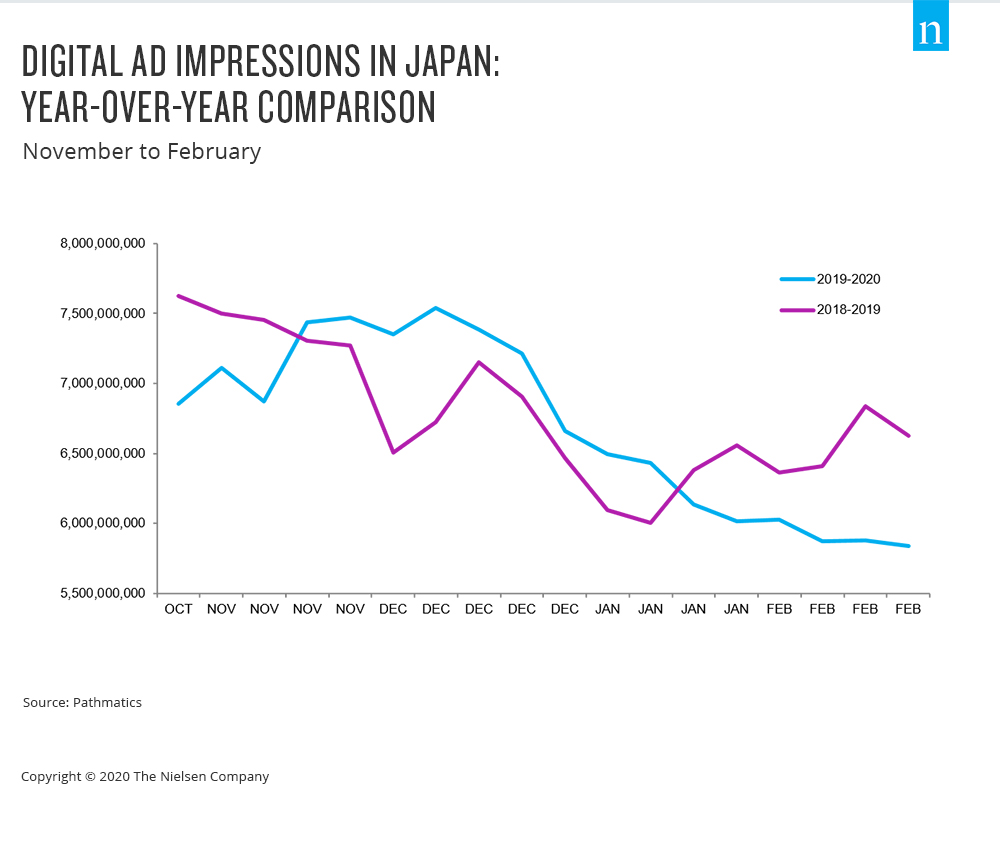
During this time, we see advertisers taking a cautious approach in Japan in the early days of the outbreak. While some reduction in digital campaigns is expected this time of the year (the two months are generally soft), we continue to see a downward trend in Japan in 2020, even more than what seasonality would otherwise suggest.
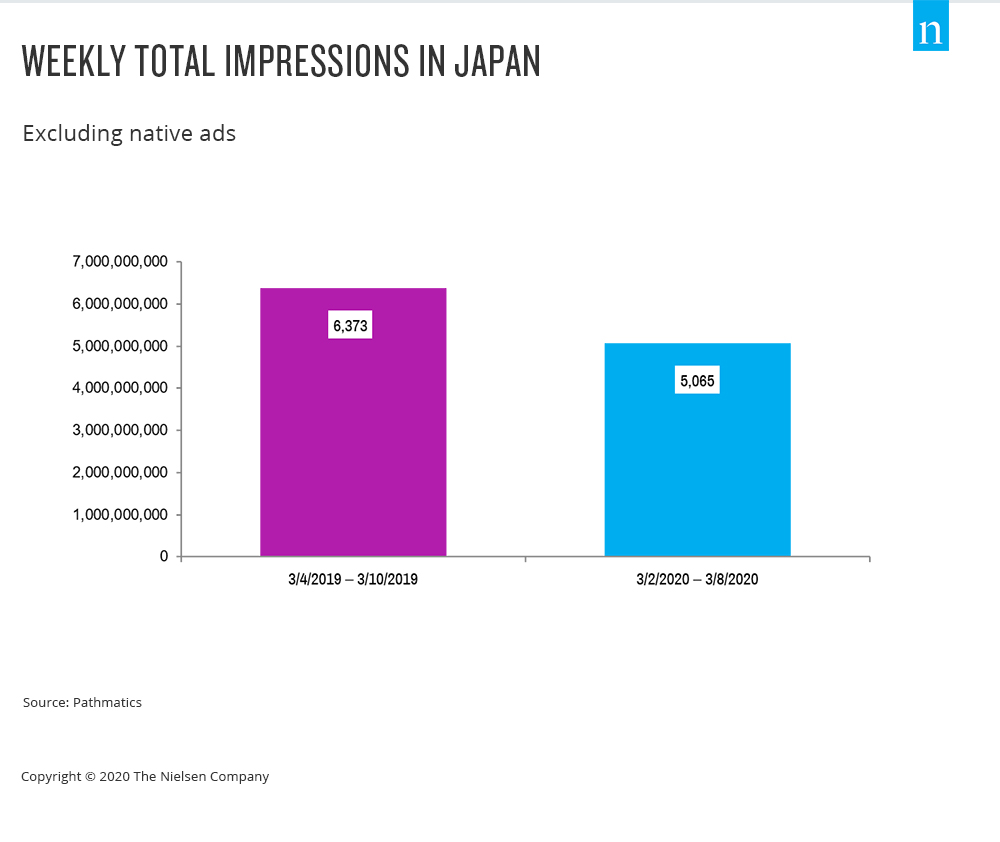
There is a considerable pull back in digital campaigns. We saw about 5,065 million impressions on digital advertising campaigns (excluding native ads) in the week of March 2, which was 20.5% smaller than during the week of March 4, 2019, according to Pathmatics. At this stage, advertisers are erring on the side of caution in this market.
“Even as content consumption around news spiked in Japan as the situation intensified and being in-home led to greater desktop content consumption, advertisers pulled back spendING significantly and quickly in line with consumption sentiment in Japan. This means that advertisers may have missed an opportunity to connect and build their brand propositionS with a more engaged audience.”
-Jun Miyamoto, Nielsen Media Japan
About the Authors
Ranjeet Laungani: North Asia; ranjeet.laungani@nielsen.com
Irene Chen: Taiwan; irene.chen@nielsen.com
Clare Lui: Hong Kong; clare.lui@nielsen.com
James Gong: Mainland China; james.gong@nielsen.com
Dohyun Yoo: South Korea; dohyun.yoo@nielsen.com
Jun Miyamoto: Japan; jun.miyamoto@nielsen.com