Da immer mehr Menschen in den USA geimpft werden können, sehen Verbraucher und Unternehmen das Licht am Ende des Tunnels. Der "Impf-Smalltalk" hält Einzug in die Videokonferenzen, und Unternehmen und Verbraucher beginnen, über eine Zukunft nach der Pandemie zu sprechen und zu planen. Und wenn wir uns ansehen, wer am eifrigsten ist, um voranzukommen, dann sind es Minderheitengruppen, die die Führung übernehmen.
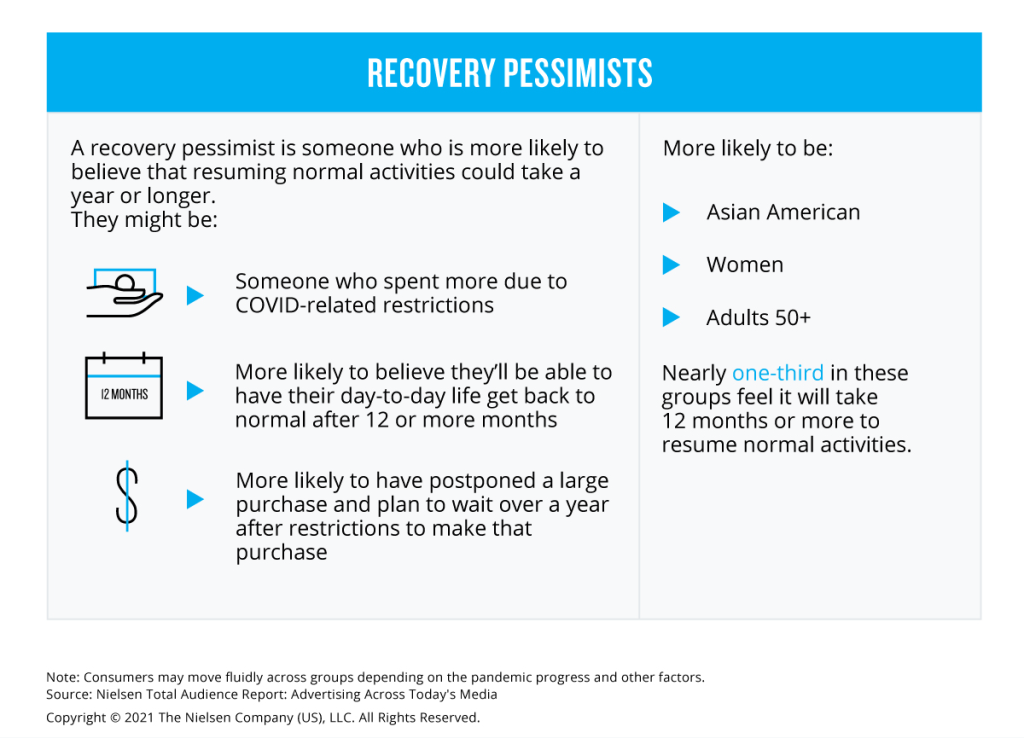
Early on in the pandemic, we saw how COVID-19 impacted different communities and industries unequally. As more states reopen and people resume “normal” activities, it’s clear that these communities and industries will bounce back at different tempos. Using data from the latest Nielsen Total Audience Report: Advertising Across Today’s Media, we’ve identified three primary consumer recovery groups: Recovery Optimists, Cautious Optimists und Recovery Pessimists. While consumers who identify with these categories may change as the vaccine rollout progresses, age, gender and ethnicity are a few of the factors advertisers can consider when looking at who’s most optimistic and eager to spend.
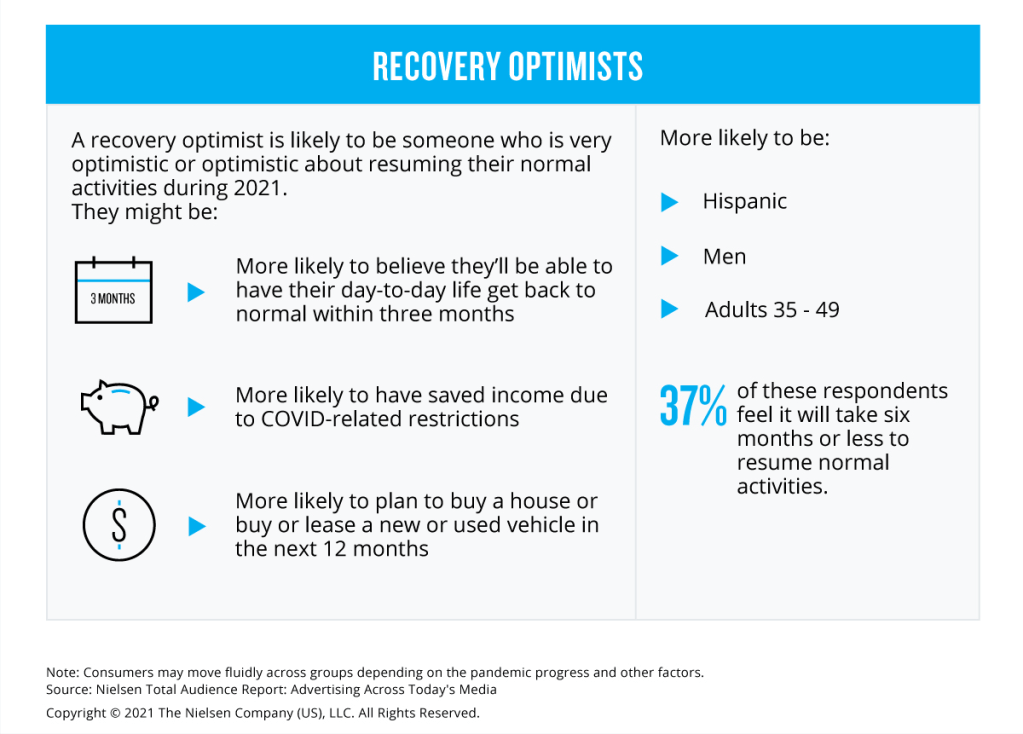
Despite research from the CDC showing that Black, African Americans and Hispanic or Latino persons are two to three times more at risk of COVID-related hospitalizations and death than their White, non-Hispanic counterparts, these consumers are among the most optimistic and eager to spend.
Based on the results from a recent Nielsen survey, Hispanic consumers are more likely to be Genesungsoptimisten. During COVID-19, these respondents reported that they were moderately impacted by COVID-related restrictions, with 44% saying they were able to save more compared with 39% of all adults 18+. Over half (53%) said they were able to make “major” purchases ($500+) during the pandemic compared with 43% of adults 18+.
In den nächsten 12 Monaten wollen hispanische Befragte mit doppelt so hoher Wahrscheinlichkeit ein neues Haus kaufen wie der Durchschnittserwachsene und mit höherer Wahrscheinlichkeit ein neues oder gebrauchtes Fahrzeug kaufen oder leasen. Diese Verbraucher wollen am ehesten einen Urlaub planen oder buchen (71 %), in Restaurants essen gehen (70 %) und Cafés besuchen (69 %). Werbetreibende können diese Verbrauchergruppe über ihr Smartphone erreichen, auf dem sie im zweiten Quartal 2020 mehr als 18 Stunden pro Woche mit dem Anschauen von Videos, dem Streamen von Audiodateien und sozialen Netzwerken verbrachten.
Black consumers are more likely to be Cautious Optimists, because a larger percentage reported believing it’ll take longer to recover and have been more hesitant to make larger purchases during the past year. Black respondents indicated they were moderately impacted by COVID-related restrictions, with 52% saying they were able to save more income. Yet nearly six-in-10 indicated that they did not make a “major” ($500+) purchase in 2020, which is more than any other multicultural consumer group.
Sobald die Beschränkungen aufgehoben werden, sind die afroamerikanischen Verbraucher bereit, Geld auszugeben. Sie gaben mit 1,3-facher bzw. 1,7-facher Wahrscheinlichkeit an, im nächsten Jahr ein Auto kaufen oder leasen bzw. ein Haus kaufen zu wollen. Auf einer kleineren Ausgabenskala sind afroamerikanische Verbraucher bereit, einen Friseur- oder Nagelsalon aufzusuchen (72 %), in Restaurants zu essen (66 %) und Cafés und Cafés zu besuchen (65 %). Eine gute Nachricht für die Reisebranche: Zwei Drittel (64 %) der Afroamerikaner sind an Flugreisen interessiert und damit die bereitwilligsten unter den multikulturellen Verbrauchern.
Advertisers looking to engage with Black consumers should keep in mind the social activism and diversity pledges made over the last year, as well as how that translates into the omnichannel experience, which is especially relevant to this consumer group that over-indexes on time spent across TV, the computer and smartphones. For Vorsichtige Optimisten, the messaging can be positive, but should not abandon health-safety considerations.
Many factors play into who falls into the Erholungspessimisten category, including confidence in vaccine information, protocol and ease of access. These individuals are more likely to have been significantly or severely impacted by the pandemic financially and could belong to more at-risk communities, are caretakers, or are managing additional burdens due to the pandemic. This includes women, who are more likely to be caretakers and take on household responsibilities as well as people who are 50+.
Werbetreibende sollten diese Gruppe nicht abtun. Stattdessen sollten sie verstehen, dass diese Verbraucher möglicherweise mehr Beruhigung und kontinuierliche Förderung von Gesundheits- und Sicherheitsprotokollen benötigen. Die gute Nachricht ist, dass diese Personen zwar nicht sofort bereit sind, Geld auszugeben, aber sie verbringen wahrscheinlich mehr Zeit mit sozial distanzierten Aktivitäten wie Fernsehen und Streaming.
It’s important to note that these consumer groups are not static. The enhanced rollout of the vaccine program, successful re-opening of schools and sustained falling COVID-19 cases could improve the overall optimism of Erholungspessimisten and allow them to step into the Vorsichtige Optimisten category. While set-backs and re-closures may downgrade consumer optimism.
For additional insights download the latest Nielsen Total Audience Report: Advertising Across Today’s Media or see past reports and trends on our Nielsen Total Audience Report Hub.