Se você pesquisar um cobertor de tecido waffle na Amazon, estilos de verão na Target ou uma máquina de lavar louça na Best Buy, há uma boa chance de que os primeiros resultados de pesquisa que você verá sejam anúncios patrocinados. Também é possível que você veja um banner promocional na parte superior da página e um vídeo com uma boa marca após uma ou duas rolagens. Essa é a mídia de varejo em ação: publicidade adaptada ao seu humor de compras.
Retail media networks are all about seizing the moment, so let’s jump right in.
O que são redes de mídia de varejo?
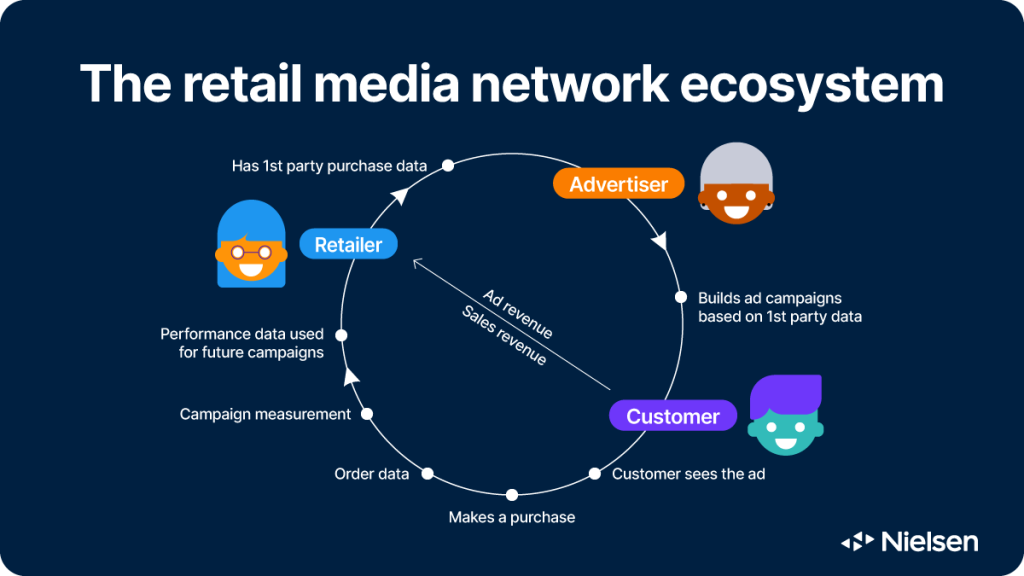
According to eMarketer, a retail media network is “an asset owned and operated by a retailer that publishes advertisements, or a third-party publisher with ads that leverage a retailer’s first-party shopper data.”
Os varejistas coletam dados sobre seu comportamento de compras e os utilizam para personalizar sua experiência, inclusive os anúncios que você vê. Eles podem usar seu perfil de compras - e tudo o mais que souberem sobre você a partir de suas interações com eles - para influenciar os anúncios que você vê (ou ouve) nas mídias sociais, na TV a cabo e no rádio digital. E, além disso, as redes de mídia de varejo podem vincular perfeitamente as impressões às vendas em uma plataforma, algo que não estava amplamente disponível antes.
Como a mídia de varejo começou?
Para a maioria dos observadores do setor, o nascimento da mídia de varejo foi o lançamento da solução de publicidade programática da Amazon, a Amazon Ads Platform (AAP), em 2012.
Learning from people’s shopping behavior, presenting them with relevant offers and reaching them at the point of purchase wasn’t exactly a new idea. Direct to consumer (DTC) brands, and brands with loyalty programs before them, had long used first-party shopper data to target consumers. And grocery chains and big box retailers have always featured in-store displays and promotions. But the scale and automation offered by Amazon were unprecedented.
From about $600 million that first year to $45 billion in 2023, the rise of Amazon’s ad business has been meteoric—and that was before the launch of its ad-supported Prime Video tier in early 2024. Over time, its success has drawn hundreds of other retailers into the media business. Walmart, Target, Kroger, Instacart, The Home Depot and others are fueling a sector that’s growing at twice the pace of social media (16.3% vs. 8.7% in 2023, according to the IAB) and is expected to overtake linear TV over the next couple of years.
Por que há tanto entusiasmo?
As redes de mídia de varejo são vantajosas para varejistas, marcas e consumidores.
For large retailers, scale and specialized audiences can represent a whole new revenue stream—with much stronger margins than their core retail business to boot. BCG estimates retail media margins in the 70% to 90% range for onsite ads and 20% to 40% for offsite ads, at a time when inflation, supply-chain issues and other macroeconomic conditions are putting intense pressure on retailers’ standard lines of business.
For brands, retail media networks offer a chance to create audiences based on recent shopping behavior and reach those audiences with finely tuned messages at a time when they’re likely to be more receptive to those messages. Relevant ads to the right people and in the right context is a great combination, especially now that third-party cookies and other legacy identifiers are (slowly) being deprecated. And retail media networks aren’t limited to lower-funnel campaigns either. No wonder 70% of global marketers say retail media networks are more important to their 2024 media plan than the previous year.
Os consumidores também saem ganhando, pois não veem anúncios de casacos para neve ou cruzeiros para o Alasca quando estão comprando shorts e aulas de mergulho com snorkel no Havaí.
Considerações importantes sobre o mix de mídia
Embora a mídia de varejo seja, sem dúvida, um novo canal interessante para os anunciantes, você só deve investir nela pelos motivos certos. O público-alvo vale o custo mais alto? Você pode alcançar não apenas os clientes existentes, mas também novos clientes em potencial atraentes? Como ele se encaixa no restante do seu mix de mídia? Você tem relatórios consistentes para comparar o desempenho em outras redes de varejo?
Embora a mídia de varejo seja, sem dúvida, um novo canal interessante para os anunciantes, você só deve investir nela pelos motivos certos.
Too many marketers add retail media to their mix out of fear of missing out or out of concern that retailers might retaliate with inferior ‘shelf’ placement if they don’t buy advertising on the platform—something Forrester described as a form of hidden tax. Some advertisers are also under the impression that retail media networks solve the attribution puzzle with their closed-loop measurement because they’re so close to the moment of purchase. But last touch attribution isn’t any more reliable just because it’s on retail media.
Tratar a mídia de varejo como apenas mais um canal
With hundreds of options on the market, over two-thirds of ad buyers (69%) are overwhelmed by the complexity of the current retail media buying process. While there are calls for standardization, it’s still largely siloed from other media transactions—to say nothing of the process of reconciling retail media buying with the rest of the media ecosystem. Four in ten ad buyers have only enough bandwidth to work with at most three retail media networks at a time.
In a sign that retail media is maturing, the IAB just proposed new standards in Europe to tear down silos between players and harmonize their offerings. At Nielsen, we think that’s a good first step. Brands need consistent, transparent and outcomes-minded measurement across all of their media partners to get a full picture and build confidence in their overall media spend.
As marcas precisam de métricas consistentes, transparentes e voltadas para os resultados em todos os seus parceiros de mídia para ter uma visão completa e criar confiança em seus gastos gerais com mídia.
Esse fator de confiança é essencial para liberar gastos reais. Embora os anunciantes não se importem em transferir algum orçamento devido ao aumento mensurável das vendas, ainda há incerteza quanto ao valor incremental que a mídia de varejo pode oferecer. A melhor coisa que pode acontecer com a mídia de varejo é ser tratada como qualquer outro canal. E a movimentação de orçamentos reais em escala exigirá comparabilidade em todas as métricas de medição.
Oportunidades emergentes da mídia de varejo
This is the right time for standards. Online and offline retail media are merging thanks to the rise of digital “smart” shelves, in-store mobile experiences and loyalty programs that connect in-store and online data to build holistic consumer profiles. And retail media is already growing beyond lower-funnel activities and even retail, for that matter, with market leaders like Lyft, Marriott e Chase showing the way. It’s also crossing over into the CTV space, with trailblazing partnerships between Instacart and Roku, Walmart and Peacock, and of course Amazon and Prime Video.
Nielsen’s Need to Know reviews the fundamentals of audience measurement and demystifies the media industry’s hottest topics. Read every article here.