A sazonalidade desempenha um papel importante em um declínio geral de 3% no uso da televisão durante o mês
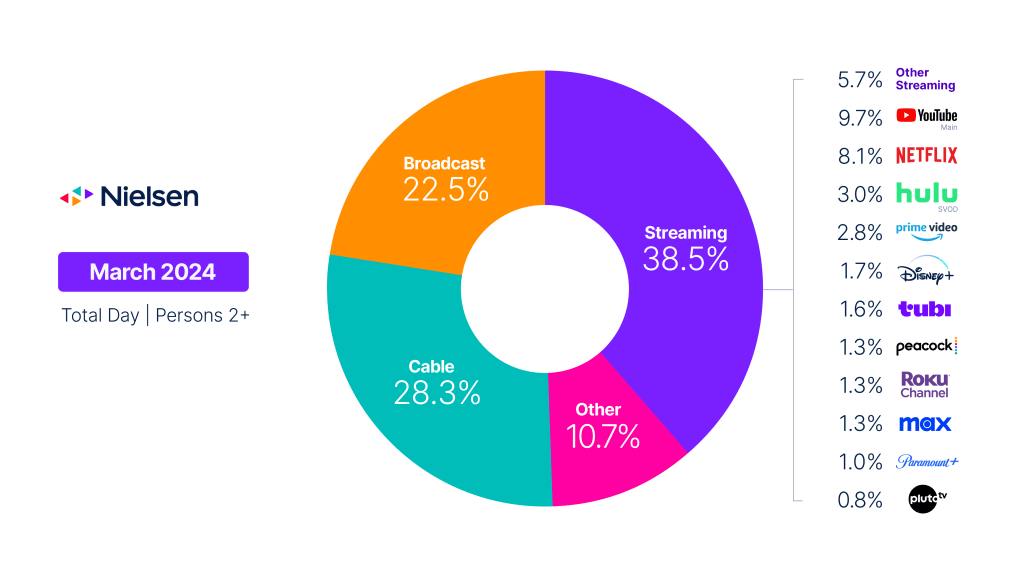
Following seasonal viewing trends that typically begin in February, overall television usage in the U.S. dipped again in March. Despite declines across categories, cable and streaming saw their share of TV viewing increase in this month’s report of The GaugeTM as a result of smaller declines in viewing in these categories compared with the overall decline of 3% on a monthly basis. While these changes follow similar month-over-month trends from last year, they also point at larger shifts happening to Americans’ media habits.
A crescente influência dos esportes femininos
Similar to March 2023, the NCAA “March Madness” tournament helped cable viewing hold steady and gain 0.7 share point, as the category saw a 43% bump in sports viewing, to finish the month with 28.3% of TV. However, unlike last year, which was driven almost exclusively by the men’s division, the NCAA women’s games charged onto TV screens this March.
De fato, o jogo de basquete feminino da NCAA entre o Iowa Hawkeyes e o West Virginia Mountaineers, em 25 de março, na ESPN, ficou entre as 10 melhores transmissões a cabo do mês (sétima no geral). O jogo comparável do ano passado mal chegou ao top 100 entre as transmissões a cabo. E isso não incluiu os jogos Elite Eight, Final Four e Championship, que ocorreram em abril.
The appeal of the tournament among sports fans highlights the impact that high-demand content has on viewership, regardless of platform or channel, and also highlights a larger trend we’re seeing in the rise of women’s sports.
Sazonalidade ou mudança de hábitos de mídia?
Além do March Madness, as mudanças de fevereiro para março na TV em 2024 são quase idênticas à transição que vimos no ano passado, refletindo a sazonalidade na exibição como resultado das mudanças anuais no clima, férias, feriados etc. No entanto, podemos ver evidências de transformações maiores que afetam o setor quando analisamos os dados mais a fundo.
Following seasonal trends similar to the past few years, broadcast viewing fell 6% in March to finish with a 22.5% share of television. To add some perspective, when Nielsen released the first edition of the GaugeTM in May 2021, the broadcast category accounted for 25% of television viewing, and despite the continued declines, the category has been fairly resilient, with a less sharp drop than some might have expected.
Comparativamente, a visualização de streaming caiu apenas 1% em relação ao mês anterior, mas ganhou 0,8 ponto de participação, terminando com 38,5% da visualização de televisão em março. Nenhuma categoria teve uma mudança mais drástica do que a de streaming em uma base anual, pois ganhou 12% em relação ao ano anterior e acrescentou 4,4 pontos de participação. Parte dessa mudança veio dos provedores de canais FAST (PlutoTV, The Roku Channel e TubiTV), sendo que uma parte considerável dos títulos foi impulsionada pelo conteúdo de redes a cabo.
So while the cable category may be shrinking in terms of its share of television, cable content remains powerful with consumers. In addition to March Madness, the State of The Union address on March 7, which drew 32.2 million viewers in total (14.1 million on cable alone), reminds us that cable remains a news-driven category as six of the top 10 cable telecasts this month were related to the event. As we look toward November, cable will play a significant role in how audiences connect with news media ahead of the 2024 U.S. elections.
Tendências de dados de março com Brian Fuhrer
Metodologia e perguntas frequentes
Como o "The Gauge" é criado?
The data for The Gauge is derived from two separately weighted panels and combined to create the graphic. Nielsen’s streaming data is derived from a subset of Streaming Meter-enabled TV households within the National TV panel. The linear TV sources (broadcast and cable), as well as total usage are based on viewing from Nielsen’s overall TV panel.
Todos os dados são baseados no período de tempo para cada fonte de visualização. Os dados, que representam um mês de transmissão, baseiam-se na visualização Live+7 para o intervalo do relatório (Observação: Live+7 inclui visualização de televisão ao vivo e visualização até sete dias depois para conteúdo linear).
What is included in “other”?
Within The Gauge, “other” includes all other TV usage that does not fall into the broadcast, cable or streaming categories. This primarily includes all other tuning (unmeasured sources), unmeasured video on demand (VOD), audio streaming, gaming and other device (DVD playback) use.
Beginning with the May 2023 interval, Nielsen began utilizing Classificações de conteúdo de streaming to identify original content distributed by platforms reported in that service to reclassify content viewed via cable set top boxes. This viewing will credit to streaming and to the streaming platform which distributed it. It will also be removed from the other category, where it was previously reflected. Content not identified as original within Streaming Content Ratings and viewed through a cable set top box will still be included in other.
O que está incluído em "outro streaming"?
As plataformas de streaming listadas como "outros tipos de streaming" incluem qualquer streaming de vídeo de alta largura de banda na televisão que não esteja separado individualmente. Os aplicativos projetados para fornecer transmissão ao vivo e programação a cabo (linear) (aplicativos vMVPD ou MVPD, como Sling TV ou Charter/Spectrum) estão excluídos de "outro streaming".
Qual é a contribuição do streaming linear?
Linear streaming (as defined by the aggregation of viewing to vMVPD/MVPD apps) is excluded from the streaming category as the broadcast and cable content viewed through these apps credits to its respective category. This methodological change was implemented with the February 2023 interval.
E quanto à transmissão ao vivo no Hulu e no YouTube?
O streaming linear por meio de aplicativos vMVPD (por exemplo, Hulu Live, YouTube TV) é excluído da categoria de streaming. "Hulu SVOD" e "YouTube Main" na categoria de streaming referem-se ao uso das plataformas sem a inclusão de streaming linear.