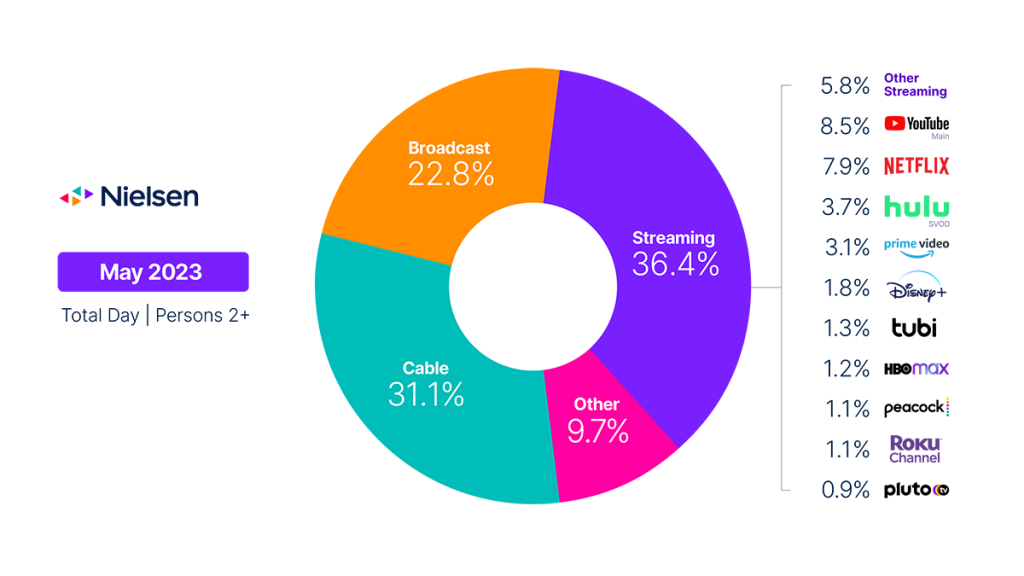
O streaming atinge 36,4% do total de visualizações de TV; o Roku Channel entra com 1,1% do uso de TV
Nota do editor: implementamos uma alteração na metodologia que credita a visualização de originais de streaming (conforme identificado pela Nielsen Streaming Content Ratings) por meio de decodificadores a cabo à categoria de streaming. Essa visualização foi incluída anteriormente na categoria "outros".
Após uma queda de 2,1% na visualização em abril, o uso de streaming se recuperou em maio, capturando 36,4% da TV, e o público continua a aproveitar a crescente variedade de serviços. Embora uma mudança na metodologia para capturar mais completamente o uso de streaming tenha sido um fator no aumento mensal, aproximadamente metade do aumento de 2,5% no uso mensal refletiu o comportamento de visualização. Separadamente, o Roku Channel é o mais recente serviço a obter cobertura autônoma no The Gauge, capturando 1,1% do uso total da TV em maio. No entanto, apesar dos ganhos com streaming, o uso total da TV caiu 4,4% em relação a abril.
The breakout performance of the Roku Channel in May highlights the increasing footprint of free ad-supported television (FAST) services. Combined, the three FAST services that are independently reported in The GaugeTM (Pluto TV, Tubi TV, Roku Channel) are each comparable in usage to Peacock and HBO Max. And in aggregate, they account for more viewership than Amazon Prime Video.
Netflix and Amazon Prime Video each gained momentum in May, posting usage gains of 9.2% and 5.1%, respectively. Roughly half of the Netflix increase was driven by the methodology change, coupled with the fact that the platform had the top three streaming titles this month: Queen Charlotte: A Bridgerton Story (5.4 billion viewing minutes), A Man Called Otto (3.1 billion) and The Mother (3.0 billion). Capturing 3.1% of TV, Amazon Prime Video benefitted from the strength of The Marvelous Mrs. Maisel e Citadel, which combined for 2.7 billion minutes. And for the fourth straight month, YouTube maintained its stance as the top platform, gaining 0.4 share points to account for 8.5% of TV.
The 4.4% drop in total TV viewing in May was driven by reduced broadcast and cable viewing, which posted drops of 5.5% and 5.4%, respectively. The declines caused broadcast and cable to each surrender 0.3 share points. A 25% drop in sports viewing was largely responsible for the declines on broadcast, but viewership of the Kentucky Derby outpaced NCIS, Young Sheldon, Blue Bloods, Ghosts e FBI. Cable ended its streak of share gains in the previous two months, but the extensive coverage of the NBA Finals on ESPN and TNT fueled a 12% increase in sports viewership, and accounted for the top four cable programs in May. And despite the traction that the CNN Town Hall generated, news viewing fell more than 11% from April. On a year-over-year basis, broadcast viewing was down 5.6% and cable viewing was down 13.7%.
Tendências de dados de maio com Brian Fuhrer
Explicação da mudança de metodologia
Metodologia e perguntas frequentes
The Gauge fornece uma macroanálise mensal dos comportamentos de visualização do público nas principais plataformas de transmissão de televisão, incluindo transmissão, streaming, cabo e outras fontes. Ele também inclui um detalhamento dos principais distribuidores individuais de streaming. O gráfico em si representa o uso total mensal da televisão, dividido em parcela de visualização por categoria e por distribuidores individuais de streaming.
Como o "The Gauge" é criado?
Os dados do The Gauge são derivados de dois painéis ponderados separadamente e combinados para criar o gráfico. Os dados de streaming da Nielsen são derivados de um subconjunto de residências com TV em nosso Painel Nacional que estão habilitadas para o Streaming Meter. As fontes de TV linear (transmissão e cabo), bem como o uso total, são baseados na visualização do painel geral de TV da Nielsen.
Todos os dados são baseados no período de tempo para cada fonte de visualização. Os dados, que representam um mês de transmissão, baseiam-se na visualização Live+7 para o intervalo do relatório (Observação: Live+7 inclui visualização de televisão ao vivo e visualização até sete dias depois para conteúdo linear).
O que está incluído em "Outros"?
No The Gauge, "Outros" inclui todos os outros usos de TV que não se enquadram nas categorias de transmissão, cabo ou streaming. Isso inclui principalmente todos os outros tipos de sintonia (fontes não medidas), vídeo sob demanda (VOD) não medido, streaming de áudio, jogos e uso de outros dispositivos (reprodução de DVD).
Beginning with the May 2023 interval, Nielsen began utilizing Streaming Content Ratings to identify original content distributed by platforms reported in that service to reclassify content viewed via cable set top boxes. This viewing will credit to streaming and to the streaming platform which distributed it. It will also be removed from the other category, where it was previously reflected. Content not identified as original within Streaming Content Ratings and viewed through a cable set top box will still be included in other.
O que está incluído em "outro streaming"?
As plataformas de streaming listadas como "outros tipos de streaming" incluem qualquer streaming de vídeo de alta largura de banda na televisão que não esteja separado individualmente. Os aplicativos projetados para fornecer transmissão ao vivo e programação a cabo (linear) (aplicativos VMVPD ou MVPD, como Sling TV ou Charter/Spectrum) estão excluídos de "outros streaming".
Qual é a contribuição do streaming linear?
Linear streaming (as defined by the aggregation of viewing to vMVPD/MVPD apps) is excluded from the streaming category as the broadcast and cable content viewed through these apps credits to its respective category. This methodological change was implemented with the February 2023 interval.
E quanto à transmissão linear no Hulu e no YouTube?
O streaming linear por meio de aplicativos vMVPD (por exemplo, Hulu Live, YouTube TV) é excluído da categoria de streaming. "Hulu SVOD" e "YouTube Main" na categoria de streaming referem-se ao uso das plataformas sem a inclusão de streaming linear.