Como a medição digital se compara à medição da TV?
In a lot of ways, it’s similar: It involves panels, big data and technology to capture what people are doing online and who they are. As with TV, publishers use measurement to gauge the popularity of their content and value their ad inventory, and advertisers use it to verify that their campaigns are running and reaching their intended audience at the right frequency1.
Embora os princípios básicos e os objetivos finais da medição digital e da TV sejam semelhantes, as ferramentas, os processos e o ecossistema envolvidos são muito diferentes.
Vamos nos aprofundar para entender as nuances de como medir os públicos e as campanhas digitais.
Afinal, o que queremos dizer com "medição digital"?
At the most basic level, digital measurement means monitoring a user’s exposure to ads and content delivered over the internet. When we talk about digital measurement in the media industry, we generally focus on two dominant digital experiences: walled gardens and the open web.2
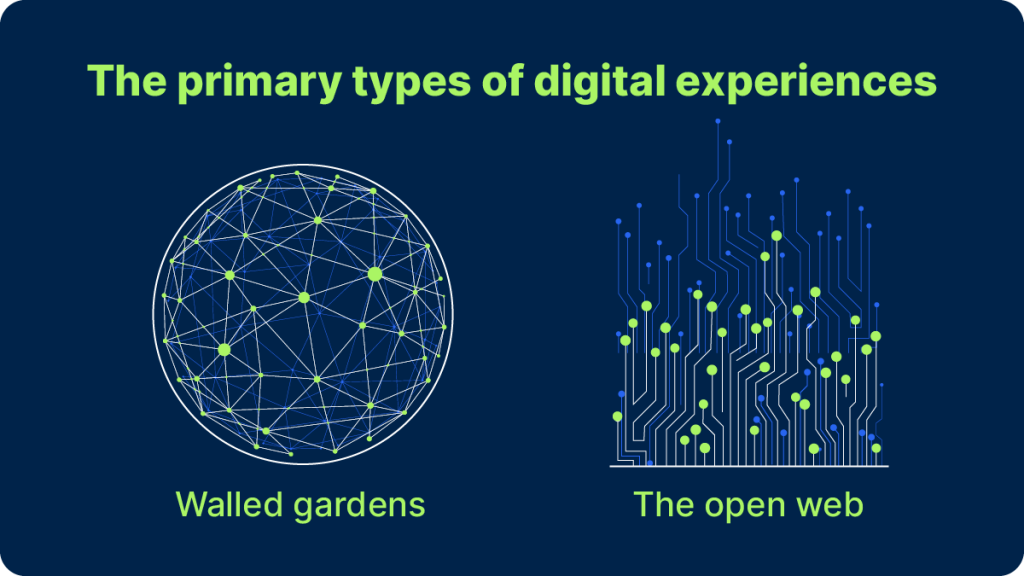
A principal diferença entre os dois é que os jardins murados restringem o acesso aos seus dados primários - você sabe, como um jardim trancado atrás de um muro - e a Web aberta não. Os sites de mídia social são um exemplo de jardins murados, enquanto sites e aplicativos como Weather.com, Words With Friends e CNN fazem parte da Web aberta.
Essa é uma distinção importante para fins de medição: Tecnicamente, um jardim murado deve ter uma ideia bastante clara de quem está acessando o conteúdo e vendo anúncios em sua plataforma. Mas se outras empresas quiserem medir o consumo de anúncios ou de conteúdo dentro desses jardins murados, em geral, elas precisam criar integrações personalizadas que estejam em conformidade com as normas de privacidade.
Embora os sites na Web aberta possam ter dados primários robustos e autenticados, isso nem sempre é garantido. Nesses casos, os sites gerais geralmente dependem de IDs de proxy e outras soluções de adtech para identificar, direcionar e medir os usuários.
Desafios atuais do setor
On the open web, the ongoing deprecation of third-party cookies and device IDs is making it more difficult to identify users and is forcing stakeholders to rethink their measurement approach. Apple’s decision in 2021 to change default app tracking permissions (from opt-out to opt-in) wiped out three-fourths of IDFAs (Apple’s mobile ad IDs) from consideration. And Google is scheduled to phase out third-party cookies in the second half of 2024, the final blow to an ID system that held up for the most part, but was always an imperfect solution. Cookies aren’t people, after all.
For walled gardens, the practice of sharing granular subscriber data with outside parties is largely a thing of the past, even for anonymized measurement purposes. To comply with major data global privacy regulations, walled gardens are now sharing activity data with advertisers and measurement companies in aggregate form, if they’re sharing it at all.
Esses são desafios sérios para a medição que forçaram o setor a procurar identificadores, sinais e atributos do consumidor em outros lugares. E tudo começa com uma impressão.
O que é exatamente uma "impressão" digital?
Antes de entrarmos nos detalhes de como é um processo moderno de medição digital, vamos explicar o que é uma impressão.
As impressões medem o número de vezes que um anúncio ou conteúdo foi exibido em um dispositivo digital. Embora as impressões forneçam o volume total de exposição ao seu anúncio ou conteúdo, elas não medem quantas pessoas realmente o viram. (Assim, por exemplo, se cinco pessoas viram seu anúncio no LinkedIn duas vezes, isso significa que as impressões de sua campanha seriam 10.
As diretrizes atuais de visibilidade de mídia digital para qualificar uma impressão estipulam que um anúncio deve estar pelo menos 50% em foco na tela do usuário - não escondido atrás de outra janela, por exemplo, ou sendo reproduzido em segundo plano - por pelo menos 1 segundo para anúncios gráficos e 2 segundos consecutivos para anúncios em vídeo. O tempo de impressão e os limites de visibilidade agora oferecem uma base sólida para que anunciantes e editores definam os termos de suas transações de mídia.
Agora que entendemos qual atividade digital estamos medindo, vamos ver como medi-la.
5 etapas principais no processo de medição digital
Na Nielsen, consideramos a medição digital como um processo de cinco etapas:
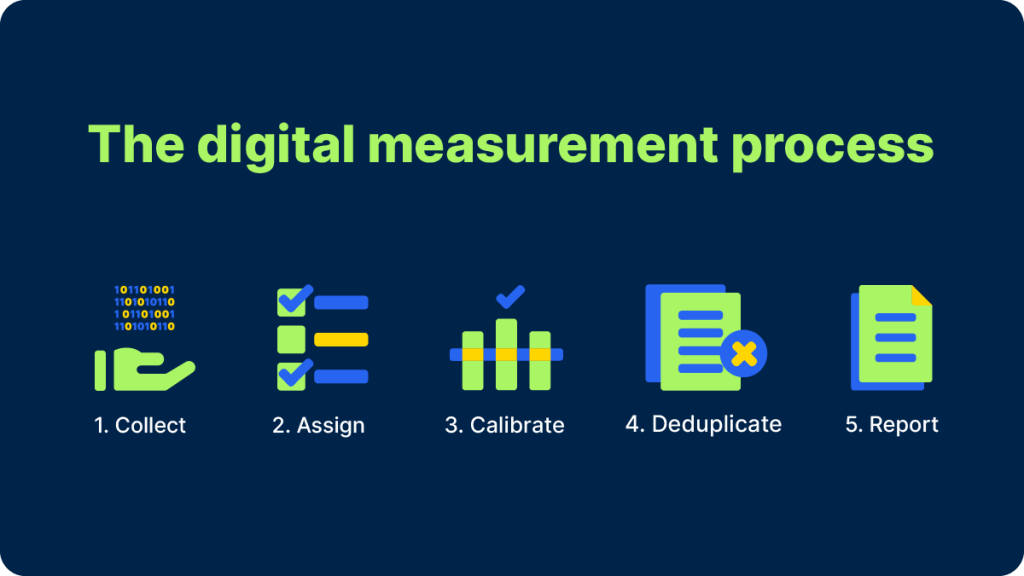
Etapa 1: COLETA
The first step in the process is to make sure that the content and ads data is all properly captured and identified. For web content, a page URL is an acceptable identifier, but there might be multiple ads on a single url that will need to be uniquely identified. For content measurement, clients’ integrate Nielsen’s SDK3 within their websites or apps. For ads measurement, we either use direct integrations with publishers, or ask advertisers or their agencies to integrate Nielsen tags in their ads when they traffic campaigns. When ads are delivered to the user’s browser or app, those Nielsen tags ping our servers with information about the ad that was delivered along with important meta-data information that enables us to filter out any invalid robotic traffic. Javascript tags, on top of all the campaign data, capture additional signals for measuring second-by-second viewability data (for display and video ads) and audio volume levels (for video ads). This allows us to accurately collect all the impression data.
Etapa 2: ATRIBUIR
The next step is to assign those impressions to a person. With the ecosystem changes discussed above, we’re now transitioning to a system where cookies are replaced with alternate identifiers and first-party data provided by clients—such as hashed email addresses, Unified ID 2.0 or self-reported demographic labels—and verified against our own growing ID graph. The goal is to get as close as possible to the demographic profile of the person who was exposed to the content or ad, and if that’s not possible, at least attach some useful information about their behavior and interests.
Etapa 3: CALIBRAR
Then, you need to calibrate your data for demographic accuracy. It’s important to acknowledge that even the best demo assignment process in the world will still return many cases where the user couldn’t be identified, and those misses can’t be assumed to be randomly distributed across all demographic groups. This may lead an advertiser to draw erroneous conclusions about the impact of their campaign. A panel can be used as a source of truth to calibrate census-level impressions. At Nielsen, we maintain digital and participant panels of 725,000 for exactly that purpose. Some are equipped with a computer meter, others with a mobile meter to measure their app and web usage on smartphones and tablets. And we make sure we have accurate demographic and profiling data for everyone in the panel
Etapa 4: DEDUPLICAR
Next, you must ensure your campaign reach isn’t inflated across devices . Over the course of a campaign, people are typically exposed to it many times, especially when that campaign is running on multiple walled gardens and on the open web. Multiple exposures are generally a good thing—it takes a few impressions to make an impression—but advertisers are rightfully very mindful of ad waste4 and putting off consumers with repetitive ads. Deduplicating reach—that is, ensuring the same viewer isn’t counted multiple times—and calculating a campaign’s true frequency are critical steps in the measurement process.
Etapa 5: RELATÓRIO
Finally, you need to monitor performance. Everything above needs to happen on a continuous basis, and actionable reports need to be available as quickly as possible to give marketers the insights they need to reallocate funds to their most effective channels and most receptive audiences while their campaign is still in flight and there’s still time to change course.
Avanço em direção à medição de mídia cruzada
O setor de medição está sob forte pressão para se adaptar às enormes mudanças já em andamento no ecossistema digital. Os anunciantes precisam de uma visão clara do desempenho da campanha nos dispositivos digitais, confiança nos resultados e ferramentas confiáveis para otimizar suas campanhas em andamento.
But there’s even more pressure to get digital and TV impressions on a level playing field. This is an ongoing effort—what constitutes an impression on linear TV and on digital platforms aren’t the same yet—but thanks to the development of a common ID system and launch of Nielsen ONE, we’re already helping marketers deduplicate reach and frequency across select digital and linear platforms in key markets around the world.
At Nielsen, we’ve also recently launched ‘Always On’ digital measurement with proactive partners like YouTube to emulate the way that linear measurement is done and help marketers turn on digital measurement capabilities on a continuous basis, rather than campaign-by-campaign.
Ainda há muito trabalho a ser feito para que a medição completa de mídia cruzada se torne realidade em nosso setor, mas com as prioridades, as ferramentas e o processo certos, estamos mais perto do que nunca.
Nielsen’s Need to Know reviews the fundamentals of audience measurement and demystifies the media industry’s hottest topics. Read every article here.
Sources
1For an overview of TV measurement, read Need to Know: How Are TV Audiences Measured?
2Connected-TV platforms and retail media networks share many characteristics with both walled gardens and the open web. Stay tuned for a future Need to Know article on those fast-growing media channels.
3The Nielsen software development kit (SDK) is one of multiple framework SDKs that Nielsen provides to measure both static and video content across platforms.
4Nielsen’s Digital Ad Ratings estimate that 37% of digital ad spend is currently wasted on impressions that are off-target, out-of-view or SIVT.