
Two of my three daughters, ages 4 and 6, are the biggest women’s soccer fans you’ll find. My youngest, age 1, has started to dribble, but she’s still too young to know what a fan is. They frequently host front-yard matches that feature our beloved home team, the Washington Spirit, facing another team from the National Women’s Soccer League (NWSL). We’ve also had the pleasure of attending a few games in person, but our family ritual of watching the Spirit on TV is what really cemented their fandom—until recently.
Nesta temporada, a grande maioria dos 24 jogos da temporada regular do Spirit passou da nossa rede esportiva regional local (RSN) na TV para plataformas de streaming. Portanto, pouco antes da abertura da temporada, eu me vi lutando para me inscrever na Paramount+, que transmite 16 jogos do Spirit este ano, apenas para descobrir que o aplicativo não está disponível na minha smart TV. "É melhor para mim ver na TV", resmungou minha filha do meio enquanto disputava com a irmã uma visão melhor do iPad. Assistimos a 30 minutos de ação antes das meninas irem para a cama às 20h, mas foi só isso, pois a Paramount+ não oferece replays completos como os DVRs.
Pouco antes do jogo 2, descobri que estava no Twitch, um aplicativo separado que transmite cinco jogos do Spirit nesta temporada. Mas, assim como antes, tivemos que assistir no tablet. "Papai, preciso ir ao banheiro. Você pode pausar isso, por favor?", perguntou meu filho mais velho, ao que tive de responder: "Desculpe, mas não dá para pausar como a TV".
Não tem sido a experiência de visualização mais tranquila para nós, mas continuaremos fazendo isso. Minhas filhas não me dão escolha e, felizmente, nossa família tem os dispositivos, a conectividade com a Internet e o orçamento para fazer isso. Mas será que o fã de esportes comum também tem o desejo, o tempo e os recursos para fazer isso? A resposta, com toda a probabilidade, determinará o futuro dos esportes femininos (se não dos esportes em geral).
Women’s sports have always been hard to find on TV. Aside from the Olympics, World Cup soccer, golf and tennis, women’s sports have taken a distant back seat to men’s for decades. Nielsen data show that in 2019, the last full pre-COVID season, 96% of televised professional basketball games were of the NBA, while only 4% were of the WNBA. Pro golf was slightly more equitable, with 77% of events with men, 18% women (and 5% both men and women), but still nowhere close to gender parity. One shouldn’t expect a multi-billion dollar industry with a status quo rooted in men’s sports to change overnight, but there’s a growing consensus that it must make progress and soon.
Why is gender equity in sports media so important? It’s not only the right thing to do, but it also has a profound effect on industry economics. There is a direct correlation between the audience size of a sports league’s televised events and the financial health of that league. By way of example, the 256 regular season NFL games last year delivered an average audience of over 15 million viewers, and seven games were among the top 10 highest rated primetime TV shows in 2020. So it’s not surprising that the NFL commanded a whopping $10 billion per year in its most recent media rights deal and provides a very comfortable minimum player salary of $610,000 per year.
Comparatively, only nine NWSL games were televised in 2020, with an average audience of 434,000 viewers, 35 times smaller than that of the NFL (1). So it’s understandable that the NWSL’s latest rights deal was also smaller, reportedly $1.5 million per year, leading to a much lower minimum player salary, $20,000 per year. Therefore, more viewers equals more money and, even in the year 2021, TV audience sizes still matter and quite a lot.
So if you’re a sports league or media partner of one, what should you do? You should maximize total viewership however possible, regardless of platform, using a strategic set of media channels, both streaming and linear TV. After all, if you’re trying to grow your fan base, shouldn’t you make your product available to as many people as possible? A best practice is what I’d call the “barbell strategy.” On one end of the barbell is streaming, also known as connected TV (CTV), which accounted for 27% of total TV usage in June 2021 in the U.S. An ideal approach would prioritize high-reaching, ad-supported streaming apps that are free to the consumer, which minimizes a viewer’s “barrier to entry.”
On the other end of the barbell is traditional, or linear, TV. Despite Americans increasingly “cutting the cord,” linear TV is still the overwhelming way that people watch TV, sports in particular. For example, in June 2021, 49 million households watched ESPN or a RSN. This compares with the 30 million who watched a network streaming app. The vast majority (73%) of ESPN/RSN watching households did not watch a network streaming app (2). Therefore, sports leagues, women’s included, just can’t afford not to have a strong linear TV presence (and putting just a few playoff games on broadcast networks is not enough). In a perfect world, TV distribution would leverage both RSNs (to foster and capitalize on home-team loyalty) and national TV networks (to drive reach and awareness among the general population).
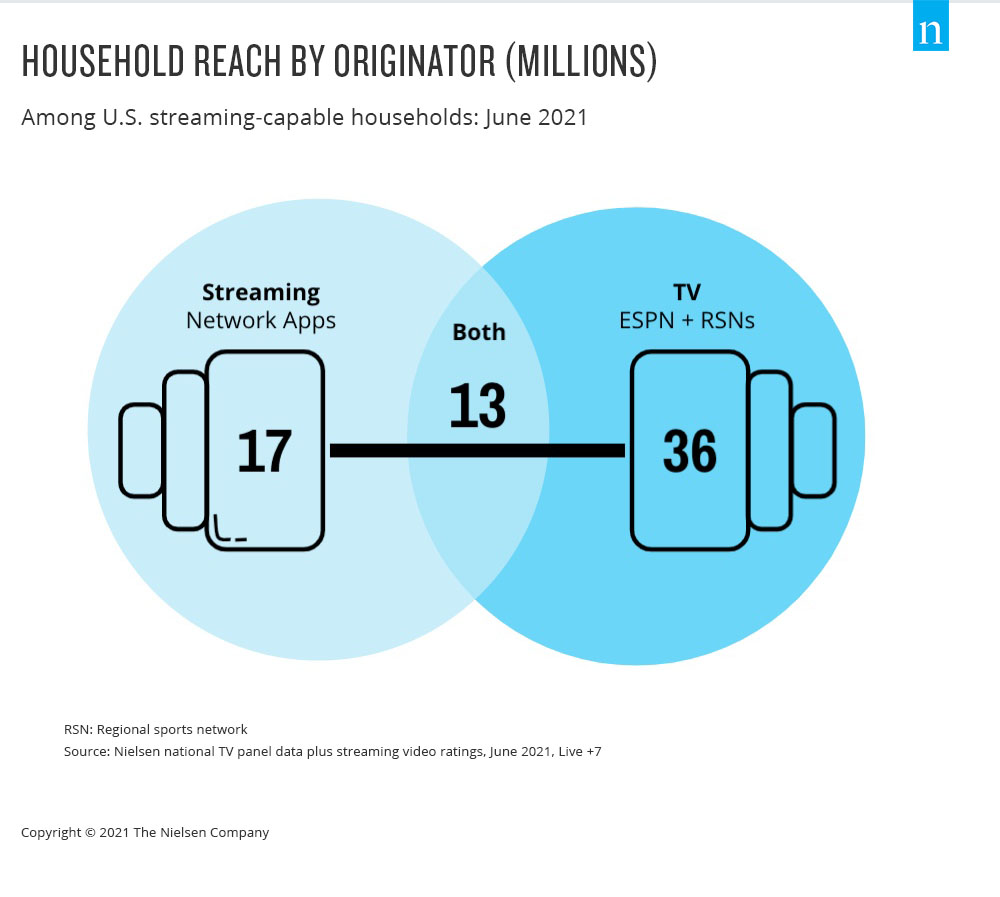
De modo geral, uma estratégia de barbell bem executada maximiza o alcance por meio da escolha do consumidor; os espectadores que preferem fazer streaming farão streaming e os que preferem assistir à TV, seja ao vivo ou com mudança de horário, farão isso. O segredo é que esses dois grupos são altamente complementares e se somam para produzir o maior público possível.
And for those who believe that such a strategy isn’t realistic because one can’t reasonably expect profit-driven TV networks to carry lower-viewership women’s sports, I’d offer two counterpoints. First, to paraphrase Cathy Engelbert, Commissioner of the WNBA, you first need to televise women’s sports sufficiently in order to give them a fair shot at achieving greater viewership. Rome wasn’t built in a day and the NFL has been on TV for 82 years. Second, small audiences for men’s boxing, drag racing, esports and soccer (3) (with Major League Soccer having lower 2021 average viewership than the NWSL) hasn’t prevented these sports from airing prominently on national TV.
Maximizing content reach has the added benefit of driving brand impact. The brand here is the league. You’d be surprised how few people are even aware that certain sports leagues exist. Harder still is producing the high level of awareness that’s required to drive viewership intent across large numbers of people. Key to the mix is not just the content itself, but also promotions, including paid, owned and earned, which further drive awareness and intent to view. Content and promotions reaching sufficient numbers of the right people creates a virtuous cycle.
A conscientização leva à intenção de assistir, impulsionando a visualização real e, por fim, grandes públicos repetidos que atraem grandes anunciantes, acordos lucrativos de direitos de mídia e sucesso financeiro para redes de TV, aplicativos de streaming, ligas e jogadores. Por outro lado, a alternativa de relegar os esportes femininos a aplicativos de streaming por assinatura de nicho, por mais modernos que sejam atualmente, além de algumas exibições simbólicas na TV, com toda a probabilidade propagará as tendências atuais de relativa obscuridade e baixo desempenho financeiro.
Para encerrar com uma nota pessoal, os últimos dois anos influenciaram muitos de nós a buscar um propósito mais profundo em nossas vidas profissionais e, como pai de três meninas, este é o meu. Quando se trata de igualdade na mídia, inclusive de gênero, acho que nós do setor estamos em uma posição única - e temos uma obrigação especial - de realmente fazer isso acontecer. Minha esperança é que, quando minhas filhas tiverem a minha idade, os esportes femininos sejam tão acessíveis e bem-sucedidos quanto os masculinos, e que elas vejam este editorial como uma lembrança pitoresca de anos passados, que já se foram há muito tempo.
Notas
(1) 434,000 viewers is the weighted average of the seven televised Fall Series games and the two televised Challenge Cup games
(2) Dados do Painel Nacional de TV da Nielsen mais as classificações de streaming de vídeo; entre domicílios com capacidade de streaming, junho de 2021, ao vivo +7
(3) Dados do painel de TV nacional da Nielsen, P2+, janeiro-junho de 2021, ao vivo +7