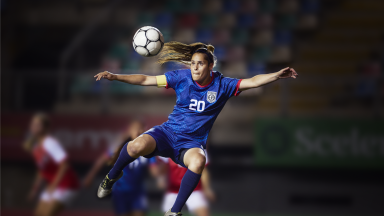
As mulheres representam mais da metade da população dos EUA, mas ainda lutam pela igualdade no mundo dos esportes, onde a discriminação baseada em gênero é muito comum. Recentemente, vimos um exemplo muito público e doloroso, nada menos que durante o Mês da História da Mulher, da desigualdade gritante no tratamento de atletas do sexo feminino e masculino no Torneio de Basquete da NCAA. É difícil entender como a negligência em fornecer às alunas-atletas os equipamentos e as instalações adequadas - especialmente durante o maior torneio do esporte - ainda pode acontecer hoje em dia. Infelizmente, parece que o sexismo nos esportes está enraizado desde o momento em que nossos filhos praticam esportes juvenis. Essa desigualdade também é institucionalizada - desde a forma como definimos o que se qualifica como esporte até as imagens usadas para representar as atletas, as disparidades nas instalações e o apoio às atletas.
As superstar athlete and World Cup champion Megan Rapinoe testified to Congress, “One cannot simply outperform inequality or be excellent enough to escape discrimination of any kind.” As a mother of a son and a daughter, this inequality hit very close to home just last week. Up until two weeks ago, in my state of California, all youth sports, which were prohibited for nearly a year, were permitted to return. All sports, that is, except for one female-dominated sport: cheer. While my son was able to get back on the field and enjoy his sport, I, alongside many other concerned parents, had to continue to advocate at the state level for equity for cheer athletes. We were successful, but why did we even have to fight for recognition and equal treatment for these athletes? Women and girls in sports should not be an afterthought.
It is disheartening to see that the fight for equality for women’s sports continues beyond grade school, as collegiate athletes in the NCAA Women’s Basketball Tournament recently experienced firsthand. Like many of you, I recently saw the viral video from University of Oregon sophomore forward Sedona Prince showing the weight room facilities provided for the female players at the basketball tournament compared with the facilities provided for the men. The women’s weight room consisted of a single set of dumbbells and some yoga mats, while the men’s weight room was stocked with state-of-the-art training equipment, rows of weights, and workout machines. Her TikTok video was further socialized on Instagram and Twitter and now has more than 20 million views.
A indignação foi rápida, pois muitas pessoas foram rápidas em criticar as desigualdades gritantes para essas atletas, mas as marcas entraram em cena ainda mais rápido. O clamor para corrigir a situação não veio apenas de celebridades, jornalistas esportivos e fãs, mas também das empresas. Marcas de fitness e varejo como Orange Theory, Dick's Sporting Goods e Tonal responderam para apoiar essas atletas (que têm grande influência na mídia social) com equipamentos no dia seguinte e se ofereceram para disponibilizar instalações de treinamento adequadas. Pouco tempo depois, a NCAA reconheceu esse terrível erro de julgamento e instalou uma sala de musculação feminina totalmente funcional, juntamente com um pedido de desculpas.
These brands understand the power of the moment and of female athletes. Research from Nielsen Sports illustrates the power female athletes hold as social media endorsers. Fans like to buy products and services that their favorite athletes endorse on social media. When brands partner with athletes to embrace their power and advocate for equity, they can enact change as well as accountability in sports institutions. That’s a winning play for brands—fully embracing the power of female athletes, while proactively building equity in women’s sports and not just in response to a crisis.
There are several fundamental truths here that brands need to embrace: social media is powerful; female athletes are powerful influencers; and consumers are asking more from brands when it comes to social responsibility. For example, a global Nielsen Fan Insights study reveals that 47.5% of respondents have a greater interest in brands that have been socially responsible and “do good.” The good news is that some brands are taking notice and recalibrating business and marketing models to meet consumers’ changing needs in a new era of sports sponsorship. The brands stepping in to act on the values they espouse as an organization are a perfect example. Brands, including leagues, teams, owners, and even school districts, must address changing consumer and social demands and their female athletes’ needs by operating with equity in women’s sports.
Mais oportunidades levam a mais público
The weight room in San Antonio isn’t the only place where we need to see change. While we’re seeing progress in how women are represented on television in scripted content, we have not seen the same visibility in women’s sports. This isn’t for lack of women’s sporting events or even viewer interest, but rather the relative lack of access to women’s team sporting events being broadcast and promoted on TV compared with men’s events. We know this needs to change, but it is a catch 22. Far fewer women’s sports are being broadcast, and when they are, games are often carried on difficult to find, smaller outlets, and are under-promoted, naturally resulting in smaller audiences. This overall lack of investment and promotion on television negatively affects audience draw, and therefore ROI for advertisers and sponsors. This lower brand investment is being used to justify disparities in resources for women’s sports. And the cycle continues.
A boa notícia é que parece estar havendo uma mudança na maré. A cobertura do Torneio de Basquete Feminino da NCAA deste ano é uma das mais amplas de sua história, graças à expansão da cobertura da ESPN - uma medida que até agora dobrou o alcance da audiência da primeira rodada do torneio feminino em comparação com a de 2019.
Along with the gripping game play, the increase in reach is most likely attributed to the number of games actually being aired. Round 1 of the tournament in 2019 was exclusively broadcast on ESPN2, which aired just nine game windows. This year’s NCAA women’s games have been on ABC, ESPN, ESPN2 and ESPNU, and every single one of the 32 games has been aired in round 1. When audiences have access to women’s sports, they tune in. Female athletes deserve the facilities, equipment and support they need to thrive. While the men’s tournament has seen multi-network coverage since 2011, the women’s tournament is finally seeing increased coverage, with 2021 marking the first time the women’s tournament has been on network TV—and not just on cable—in decades. Because that viewing opportunity exists, more people are watching. It is time women’s sports get the investment, coverage and support they deserve. Advertisers should take note: A growing fan base means a bigger audience.
Já se passaram quase 50 anos desde que a legislação do Título IX concedeu às mulheres oportunidades iguais de praticar esportes. Mas a legislação também exige o tratamento igualitário de estudantes-atletas do sexo feminino e masculino, desde equipamentos até instalações competitivas, publicidade, promoções e muito mais. À medida que mais e mais marcas defendem a igualdade para os esportes femininos e as atletas se tornam mais influentes como endossantes de marcas, espero que vejamos menos disparidades no tempo de jogo, nas instalações, nas parcerias com marcas e na cobertura dos esportes femininos na tela. E que, para as futuras atletas, a equidade nos esportes femininos seja um sucesso.